


Nearly 60 percent of people disapprove of the latest labor law amendments, while 62 percent believe the amendments only benefit employers, a Pollster Online Survey poll has found.
More than 40 percent of poll respondents said that the rules stipulated in the Labor Standards Act (勞動基準法) should be relaxed to increase flexibility for workers, with 30 percent disagreeing, the poll said.
However, when asked for their view on each of the amendments that the government said would increase flexibility, a majority of respondents said they do not support them.
The amendment that reduces rest time between shifts from 11 to eight hours is the least popular, with 61 percent of respondents saying they do not support the change, while only 15 percent saying they do, the poll said.
The amendment that increased the maximum number of consecutive work days from seven to 12 is the second-least popular, the poll said, with 58 percent not approving of the change and only 14 percent approving of it.
Forty-seven percent of respondents disapproved of the amendment that increased the monthly overtime cap from 46 hours to 54 hours, with 21 percent saying they approve of it.
Respondents appeared divided over the amendment that requires companies to pay workers overtime by actual hours worked instead of in blocks of four hours, with 33 percent supporting the change and 39 opposing it.
Fifty-nine percent of respondents are not happy with the amendments overall, while only 13 percent are happy, the poll said.
Sixty-two percent of respondents said the amendments benefit only employers, while only 12 percent said they benefit both employers and employees.
The survey said that 61 percent of respondents believe that the amendments provide less protection for workers’ rights, while 10 percent believe the opposite.
An analysis of the survey showed that respondents who are younger and who have lower job positions are more likely to oppose the amendments.
“The amendments were definitely a mistake,” National Chengchi University Institute of Labor Research professor Liu Mei-chun (劉梅君) said.
Keeping salaries low and prolonging work hours will not make the nation more competitive in the global market, she said, adding that the government should develop a more sustainable economic model.
“I hope the government can amend the labor law again soon, because the faster you correct a mistake the better,” she added.
The poll — commissioned by the Grassroots Influence Culture and Education Foundation, and conducted between Jan. 12 and Wednesday last week — collected 1,120 online questionnaires from people aged 20 and above. It has a confidence level of 95 percent and a margin of error of 2.93 percentage points.
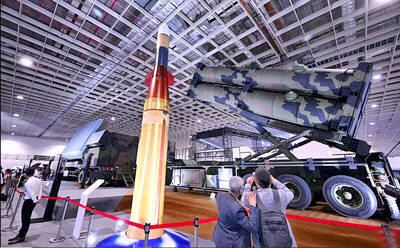
Taiwan is to commence mass production of the Tien Kung (天弓, “Sky Bow”) III, IV and V missiles by the second quarter of this year if the legislature approves the government’s NT$1.25 trillion (US$39.78 billion) special defense budget, an official said yesterday. Commenting on condition of anonymity, a defense official with knowledge of the matter said that the advanced systems are expected to provide crucial capabilities against ballistic and cruise missiles for the proposed “T-Dome,” an advanced, multi-layered air defense network. The Tien Kung III is an air defense missile with a maximum interception altitude of 35km. The Tien Kung IV and V
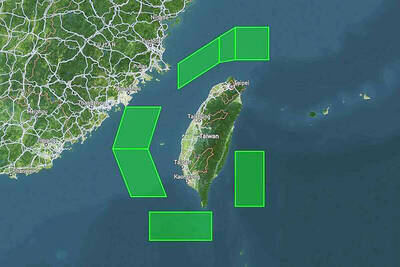
The disruption of 941 flights in and out of Taiwan due to China’s large-scale military exercises was no accident, but rather the result of a “quasi-blockade” used to simulate creating the air and sea routes needed for an amphibious landing, a military expert said. The disruptions occurred on Tuesday and lasted about 10 hours as China conducted live-fire drills in the Taiwan Strait. The Civil Aviation Administration (CAA) said the exercises affected 857 international flights and 84 domestic flights, affecting more than 100,000 travelers. Su Tzu-yun (蘇紫雲), a research fellow at the government-sponsored Institute for National Defense and Security Research, said the air
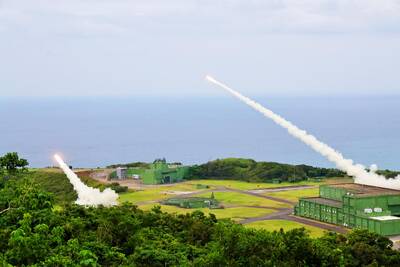
Taiwan lacks effective and cost-efficient armaments to intercept rockets, making the planned “T-Dome” interception system necessary, two experts said on Tuesday. The concerns were raised after China’s military fired two waves of rockets during live-fire drills around Taiwan on Tuesday, part of two-day exercises code-named “Justice Mission 2025.” The first wave involved 17 rockets launched at 9am from Pingtan in China’s Fujian Province, according to Lieutenant General Hsieh Jih-sheng (謝日升) of the Office of the Deputy Chief of the General Staff for Intelligence at the Ministry of National Defense. Those rockets landed 70 nautical miles (129.6km) northeast of Keelung without flying over Taiwan,
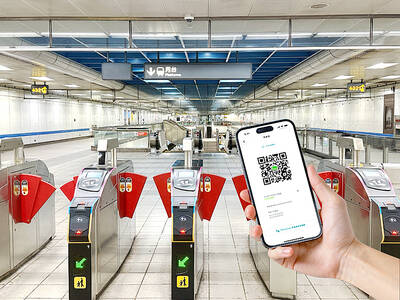
City buses in Taipei and New Taipei City, as well as the Taipei MRT, would on Saturday begin accepting QR code payments from five electronic payment providers, the Taipei Department of Transportation said yesterday. The new option would allow passengers to use the “transportation QR code” feature from EasyWallet, iPass Money, iCash Pay, Jkopay or PXPay Plus. Passengers should open their preferred electronic payment app, select the “transportation code” — not the regular payment code — unlock it, and scan the code at ticket readers or gates, General Planning Division Director-General Liu Kuo-chu (劉國著) said. People should move through the


 RSS
RSS