


The Ill-gotten Party Assets Settlement Committee’s ongoing investigation into the Republic of China Public Service Association has found that several Chinese Nationalist Party (KMT) members, including some party heavyweights, combined their years worked at the association with years worked in the public sector when calculating their pensions, sources said.
The investigation is part of the committee’s preparatory work for a public hearing expected to be held on Friday next week to discuss whether the association is affiliated with the KMT.
The association’s task to recruit KMT members is clearly stated in the party’s “guidelines for the promotion of public service,” said a committee member, who spoke on condition of anonymity.
The document stipulates that the association, which was founded in 1952 with more than 300 local branches, is in charge of dividing service work among party members; conducting trainings, promotional works and public surveys; and recruiting talent to the party.
The probe has found that a number of party members, including former vice president Lien Chan (連戰) and former KMT chairman Wu Po-hsiung (吳伯雄), have combined their years at the association with their public-service years, exploiting the past party-state system and receiving higher pensions from taxpayers’ money, the commitee member said.
Lien was the association’s director and deputy secretary-general from November 1976 to October 1978, while Wu was its director from June 1982 to June 1984, the member said.
Other former members include former KMT vice chairman Lin Fong-cheng (林豐正), who worked as interim director of the association’s Tainan branch between June 1980 and August 1981; KMT Vice Chairman Jason Hu (胡志強), who served as the association’s party affairs liaison when studying in the UK from 1975 to 1984; and former Judicial Yuan president Shih Chi-yang (施啟揚), who was the association’s deputy director between April 1973 and December 1976.
The association’s link with the KMT can be further evidenced by the minutes of its board of director meetings submitted to the Ministry of the Interior, the member said.
The documents show that Lin, after being elected association chairman in 2003, expressed his hope to channel the power of the public, and organize more innovative and larger campaign events for the 2004 presidential election, the member added.
“It shows that the association’s various branches are clearly local KMT workshops, responsible for recruitment and campaign work,” the committee member said, adding that because of such practices, government resources have been inappropriately used to pay for KMT staff.
All wrongfully paid pensions should be recovered in accordance with the Act on the Settlement of the Combination of Years of Service in Public Sector and Political Organizations (公職人員年資併社團專職人員年資計發退離給與處理條例) passed by the legislature in April last year, the member said.

The military has spotted two Chinese warships operating in waters near Penghu County in the Taiwan Strait and sent its own naval and air forces to monitor the vessels, the Ministry of National Defense (MND) said. Beijing sends warships and warplanes into the waters and skies around Taiwan on an almost daily basis, drawing condemnation from Taipei. While the ministry offers daily updates on the locations of Chinese military aircraft, it only rarely gives details of where Chinese warships are operating, generally only when it detects aircraft carriers, as happened last week. A Chinese destroyer and a frigate entered waters to the southwest
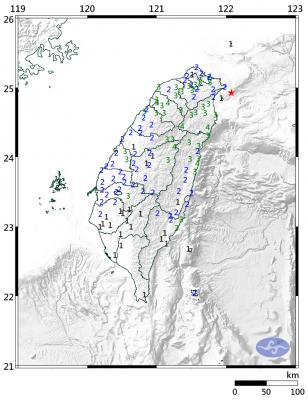
A magnitude 6.1 earthquake struck off the coast of Yilan County at 8:39pm tonight, the Central Weather Administration (CWA) said, with no immediate reports of damage or injuries. The epicenter was 38.7km east-northeast of Yilan County Hall at a focal depth of 98.3km, the CWA’s Seismological Center said. The quake’s maximum intensity, which gauges the actual physical effect of a seismic event, was a level 4 on Taiwan’s 7-tier intensity scale, the center said. That intensity level was recorded in Yilan County’s Nanao Township (南澳), Hsinchu County’s Guansi Township (關西), Nantou County’s Hehuanshan (合歡山) and Hualien County’s Yanliao (鹽寮). An intensity of 3 was

Japanese Prime Minister Sanae Takaichi’s comment last year on Tokyo’s potential reaction to a Taiwan-China conflict has forced Beijing to rewrite its invasion plans, a retired Japanese general said. Takaichi told the Diet on Nov. 7 last year that a Chinese naval blockade or military attack on Taiwan could constitute a “survival-threatening situation” for Japan, potentially allowing Tokyo to exercise its right to collective self-defense. Former Japan Ground Self-Defense Force general Kiyofumi Ogawa said in a recent speech that the remark has been interpreted as meaning Japan could intervene in the early stages of a Taiwan Strait conflict, undermining China’s previous assumptions

Taiwan Railways Corp (TRC) today announced that Shin Kong Mitsukoshi has been selected as the preferred bidder to operate the Taipei Railway Station shopping mall, replacing the current operator, Breeze Development Co Ltd. Among eight qualified firms that delivered presentations and were evaluated by a review committee, Shin Kong Mitsukoshi was ranked first, while Breeze was named the runner-up, the rail company said in a statement. Contract negotiations are to proceed in accordance with regulations, it said, adding that if negotiations with the top bidder fail, it could invite the second-ranked applicant to enter talks. Breeze in a statement today expressed doubts over


 RSS
RSS