


It was 1999 when Allison Lee (李麗華), then 35 years old and working at the Taipei Department of Labor, first came into contact with migrant workers.
After a brief stint at the department, Lee discovered that bureaucracy was hindering her efforts to help them and decided that working for a civilian organization would be more practical.
Now 53, Lee continues to work to uphold the rights of migrant workers, despite having experienced verbal threats from ship owners and their intermediaries.
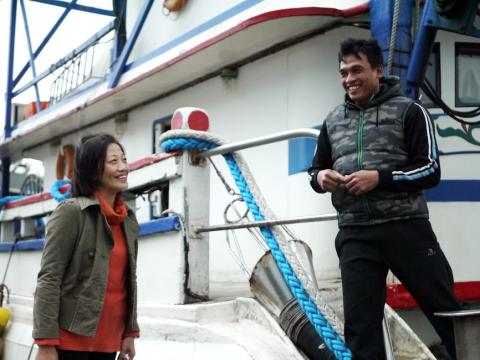
Photo: Chien Hui-ju, Taipei Times
“My only hope is that one day migrant workers will no longer be exploited,” she said.
When asked why she dedicated her life to helping migrant workers, Lee said it might have stemmed from her experiences working in a factory in then-Taoyuan County after she graduated from vocational high school.
At 27, she joined the Chingjen Labor Security and Sanitation Service Center of the Congregation of the Immaculate Heart of Mary, a Catholic religious order, and spoke out against the illnesses that miners contract.
Lee eventually made a name for herself in the migrant worker community.
She was once contacted about a migrant worker who lost his arm while working on a boat registered to Nanfangao Fishing Port (南方澳漁港) in Yilan County’s Suao Township (蘇澳). She later discovered, after poring over the Labor Union Act (工會法), that migrant workers were permitted to form unions.
Lee was instrumental in efforts to launch the Yilan Migrant Fishermen Union in 2013.
“At first it was difficult to rally the workers to my cause,” Lee said, adding that despite her reputation, many migrant workers at the docks were initially suspicious of her.
The intermediary agencies that dispatched workers for different jobs openly told the workers that she was lying, Lee said, adding that she was left with only one option: to prove her sincerity with action.
“I was not afraid for myself. I was only concerned that the workers would suffer more,” Lee said.
The agencies often came up with reasons to dock the workers’ pay. The migrants, who were earning between NT$10,000 and NT$20,000 per month, would have difficulty being self-sufficient when their pay was halved or worse, she said.
Lee poured her entire savings into the union and even sold her car.
“One time I wished to attend a rally in Taipei and found myself penniless, but I did not hesitate for even a second to spend the money in my husband’s account,” Lee said, adding that her husband only had NT$5,000 at the time.
Gradually the workers came to believe in the union as more boat owners were punished for assaulting migrant workers or docking their salaries, Lee said.
“I was moved to tears when those workers told me that their hearts and minds would never abandon the union,” she said.
If she did not try to do as much as she could, she would regret it in her old age, she said.
“It has always been my ultimate goal to be out of a job and see migrant workers stand up for themselves,” Lee said.
When the union first started, she had to translate or explain laws to the growing number of members, which reached 300 at its peak, but she is proud to say that she is almost no longer needed.
There was one case she regretted in September 2015, when an Indonesian man in his 40s, known only as Supriyanto, died from abuse by a fishing boat owner.
While visiting Supriyanto’s family in Indonesia, Lee said she was saddened when Supriyanto’s eldest son said he would never become a fisher out of fear he would be beaten to death like his father.
“Migrant workers come to Taiwan and work hard for our fishery businesses and we repay them with broken families,” Lee said.
Many of the migrant workers affectionately call her their “big sister,” and Lee said she was once asked by a migrant worker why she helped them so much.
“Do you help us out of compassion or are you simply a good person?” the worker asked, to which Lee said: “A little of both, I guess.”

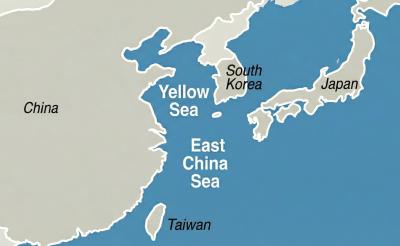
China has reserved offshore airspace in the Yellow Sea and East China Sea from March 27 to May 6, issuing alerts usually used to warn of military exercises, although no such exercises have been announced, the Wall Street Journal (WSJ) reported yesterday. Reserving such a large area for 40 days without explanation is an “unusual step,” as military exercises normally only last a few days, the paper said. These alerts, known as Notice to Air Missions (Notams), “are intended to inform pilots and aviation authorities of temporary airspace hazards or restrictions,” the article said. The airspace reserved in the alert is

NAMING SPAT: The foreign ministry called on Denmark to propose an acceptable solution to the erroneous nationality used for Taiwanese on residence permits Taiwan has revoked some privileges for Danish diplomatic staff over a Danish permit that lists “Taiwan” as “China,” Eric Huang (黃鈞耀), head of the Ministry of Foreign Affairs’ Department of European Affairs, told a news conference in Taipei yesterday. Reporters asked Huang whether the Danish government had responded to the ministry’s request that it correct the nationality on Danish residence permits of Taiwanese, which has been listed as “China” since 2024. Taiwan’s representative office in Denmark continues to communicate with the Danish government, and the ministry has revoked some privileges previously granted to Danish representatives in Taiwan and would continue to review

More than 6,000 Taiwanese students have participated in exchange programs in China over the past two years, despite the Mainland Affairs Council’s (MAC) “orange light” travel advisory, government records showed. The MAC’s publicly available registry showed that Taiwanese college and university students who went on exchange programs across the Strait numbered 3,592 and 2,966 people respectively. The National Immigration Agency data revealed that 2,296 and 2,551 Chinese students visited Taiwan for study in the same two years. A review of the Web sites of publicly-run universities and colleges showed that Taiwanese higher education institutions continued to recruit students for Chinese educational programs without

A bipartisan group of US senators has introduced a bill to enhance cooperation with Taiwan on drone development and to reduce reliance on supply chains linked to China. The proposed Blue Skies for Taiwan Act of 2026 was introduced by Republican US senators Ted Cruz and John Curtis, and Democratic US senators Jeff Merkley and Andy Kim. The legislation seeks to ease constraints on Taiwan-US cooperation in uncrewed aerial systems (UAS), including dependence on China-sourced components, limited access to capital and regulatory barriers under US export controls, a news release issued by Cruz on Wednesday said. The bill would establish a "Blue UAS


 RSS
RSS