


Since the passage of the Act on Promoting Transitional Justice (促進轉型正義條例) on Dec. 5, people have been speculating if, when and how former president Chiang Kai-shek’s (蔣介石) symbols will be removed.
The Democratic Progressive Party (DPP) administration has lamented that the question unfairly reduces the grand project of transitional justice to a single issue, but the answer to this question is long overdue.
For decades, Chiang’s statues have stood in public places, his portrait has adorned the nation’s NT$1, NT$5 and NT$10 coins, and schools and roads have been named after him, serving as a heart-wrenching reminder that despite Taiwan’s democratization in the 1990s, a dictator blamed for the deaths of 10 million people continues to be honored and remembered here.
That is why the symbols have been repeatedly vandalized and singled out by proponents of transitional justice as an issue that demands change.
Passing the act has been hailed as an important milestone on Taiwan’s path of democratic consolidation, but change might not come as quickly and extensively as some had hoped, despite the establishment on Dec. 7 of an independent ad hoc commission of the Executive Yuan for the promotion of transitional justice, just two days after the law was passed.
The speed and extent to which the commission will deal with Chiang’s symbols hinges on the DPP’s “pragmatic” evaluation of public opinion, said National Chengchi University (NCCU) Graduate Institute of Taiwan History chair Li Fu-chung (李福鐘), who sits on the Cabinet’s Ill-gotten Party Assets Settlement Committee.
“Judging from my experiences at the party asset settlement committee, you can choose to either cut to the bone when dealing with the Chinese Nationalist Party’s (KMT) ill-gotten assets or show some level of leniency,” Li said. “The DPP administration has apparently opted for the latter.”
Li said the same applies to the ad hoc commission: The nine-member body might either address only a few symbolic items that have a more limited effect on society as a whole — such as Taipei’s Chiang Kai-shek Memorial Hall or Chiang’s statues in public places — or go all the way to erase his name and portrait from all aspects of people’s lives.
Public opinion will have a decisive say in whether the DPP administration will adopt the more extensive approach, Li said.
“After all, Taiwanese politics have always been about pragmatism, which is local politicians’ guiding principle and the key to whether they can win votes,” he said.
Li said another thing to pay close attention to is the appointment of the commission’s chairman, who is to be nominated by Premier William Lai (賴清德) and approved by the legislature — they will effectively decide the commission’s character and priorities.
The act was designed as “framework legislation,” which means that the task of removing symbols related to Chiang might take longer than expected, Taiwan Association for Truth and Reconciliation executive secretary Su Ching-hsuan (蘇慶軒) said.
“The act only describes the main tasks of the commission,” Su said. “Each individual task will have to be fleshed out in another piece of legislation. This takes time and increases uncertainty.”
Su said that the legislature has passed or proposed bills to provide a legal basis for most of the commission’s primary tasks, including a draft political archives act for the declassification and collection of political archives and the National Human Rights Museum Organization Act (國家人權博物館組織法) for the preservation of historical sites of injustice.
However, the task of “erasing symbols nostalgic or in memory of authoritarian rulers in public buildings and spaces” might have to wait until the ad hoc commission draws up legislation and submits it to the legislature, Su said.
It goes without saying that the image of an initiator of human rights violations that have deeply affected people’s lives should be erased, Su said when asked about Chiang’s statues.
“As long as there is one victim of Chiang’s state violence urging the removal of his symbols, we should do it,” Su said. “Otherwise, are we not telling the victims to just suck it up? Then what is the point of passing a transitional justice promotion act in the first place?”
As an example, Su said removing statues from their original locations would send a message that their erection was illegitimate and that human rights values should be respected.
However, removing Chiang’s statues will be a difficult process that stirs up controversy, said Lin Nan-tung (林南彤), president of NCCU’s Wild Fire student group, whose continued pressure on university authorities to remove two on-campus Chiang statues yielded a “semi-victory” this year.
NCCU used to be known as the Central Party Affairs School, of which Chiang served as president from its establishment in Nanjing, China, in 1927 until 1947 and which awarded him the honorary title of “perpetual president emeritus.”
Amid growing pressure from the student group, NCCU authorities in January established a “statue committee.” In September, the university passed a motion to dispose of one of the two statues, but it has yet to decide which one.
“Even a small community like NCCU had to hold three dispute-laden public hearings before the matter was taken up by the school affairs meeting,” Lin said, adding that progress was slow, but the group managed to change some minds in the process.
Some people harbored the misconception that the passage of the act would immediately be followed by the eradication of symbols, but such reforms are not possible before the historical truth and political archives are restored, Lin said.
Education is another important element of transitional justice, Lin said.
“Instead of simply removing Chiang’s statues, we should go the extra mile and put up signs in their original locations, explaining to younger people what used to stand there and why it had to be taken away,” she said. “That is what transitional justice is all about.”


UPGRADE: The Kang Ding-class frigate is replacing its Chaparall missiles with Tien Chien II and Hua Yang VLS, which would provide it with long-range, 360° air defense Taiwan plans to produce 1,200 to 1,376 Hai Chien II missiles (海劍二, Sea Sword II) — also known as TC-2N — to serve as the standard air defense system of the navy’s surface combatant fleet, a source said yesterday. Last week, the Hai Chien II, the naval version of the Tien Kung II missile (天劍二, Sky Sword II), completed a live-fire test in waters off the National Chungshan Institute of Science and Technology’s Jiupeng facility (九鵬) in Pingtung County’s Manjhou Township (滿州). The MIM72 Chaparral and other dated air defense missiles that currently arm Taiwanese ships have inadequate range to combat Chinese

REASONS FOR TRAVEL: An assistant professor said that proposed amendments to penalize drivers if they used drugs overseas would not deter people from traveling People who operate a motor vehicle under the influence of marijuana would have their driver’s license revoked, even if they used the substance while overseas, the Ministry of Transportation and Communications said yesterday, citing proposed amendments to the Road Traffic Management and Penalty Act (道路交通管理處罰條例). The amendments would also authorize the government to revoke the licenses of people determined to have used Category 1 or Category 2 narcotics, even if they were not operating a vehicle while under the influence of drugs, as well as ban them from taking the license test for three years, the ministry said. People aged 18 or
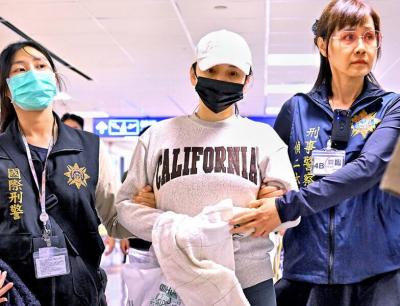
Johanne Liou (劉喬安), a Taiwanese woman who shot to unwanted fame during the Sunflower movement protests in 2014, returned to Taiwan last night after being deported from the US. She is to stand trial in Taiwan for charges involving embezzlement, fraud and drug crimes. The Criminal Investigation Bureau (CIB) said it took her into custody at Taiwan Taoyuan International Airport and would first question her before transferring her to the New Taipei District Prosecutors’ Office. She was arrested upon disembarking a flight from San Francisco that landed shortly before 7pm. Liou absconded to the US in 2019 after jumping bail
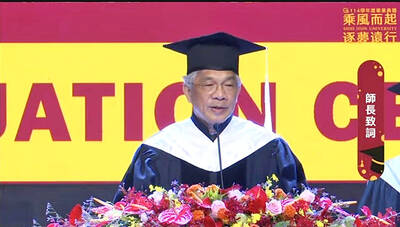
Shih Hsin University President Chen Ching-he (陳清河) yesterday issued a public apology for comments made in his commencement speech last week, stating that he has asked the school to suspend his duties and halt his wages for two months as a show of contrition. At the commencement ceremony on May 30, Chen said, “If you don’t manage your time well, or your own emotions, or your health, then I am telling every one of you — put a quick end to ‘you,’ because the world has no need for ‘you.’” The comments have sparked significant controversy online, and Chen through an open


 RSS
RSS