


Labor rights campaigners yesterday morning clashed with police while attempting to storm the Legislative Yuan in protest of amendments to the Labor Standards Act (勞動基準法 ) proposed by the government.
The Democratic Progressive Party (DPP) has been leading efforts to amend the law a second time, after last year passing amendments that proved controversial with employers and workers alike.
The legislature’s Economic Committee and Social Welfare and Environmental Hygiene Committee yesterday were to review sections of the amendments that would affect employees’ weekly work schedules.
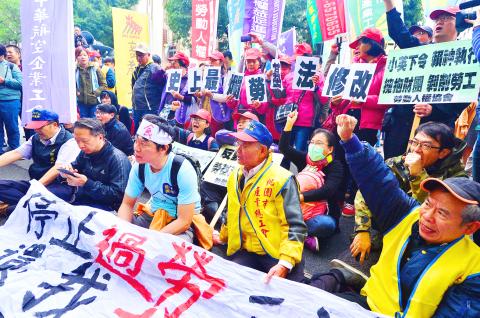
Photo: Wang Yi-sung, Taipei Times
However, New Power Party Legislator Hsu Yung-ming (徐永明) filibustered the proceedings with a long speech and Chinese Nationalist Party (KMT) lawmakers put additional speeches on the agenda.
Close to 100 protestors showed up at the Legislative Yuan to march around its premises, chanting: “Say no to the bad Labor Standards Act amendments; give back our seven holidays.”
The protest was organized by the National Federation of Education Unions, as well as other groups.
When the demonstration reached the Legislative Yuan’s main gate on Qingdao E Road, several protesters tried to jump over the wall and enter the building, leading to scuffles with the police. Eggs were thrown at the officers, who used nets for overhead protection and called in reinforcements.
Although the clash died down, protesters tried to return to the Legislative Yuan at about 12:30pm, just as the lawmakers were reconvening for the afternoon session. As the protesters were now marching against traffic, the police blocked their progress, triggering another shoving match on Zhongshan S Road.
Unable to push past the police line, the protesters made a detour through Linsen N Road back to their original staging point by the Legislative Yuan, where they demanded that DPP lawmakers vote against the party line by chanting their names.
Early yesterday morning, labor activists splashed or sprayed paint on the Executive Yuan, President Tsai Ing-wen’s (蔡英文) official residence, the Ministry of Labor and the Ministry of Economic Affairs, police said.
Five protestors were arrested and the authorities are seeking to press charges under the Social Order Maintenance Act (社會秩序維護法) and for littering, the Taipei Police Department’s Zhongzheng Second Precinct said in a statement.
About a dozen members of Labor Struggle, a coalition of labor unions and student groups, including a man surnamed Lin (林) and a man surnamed Hsieh (謝), used various vehicles to splash paint on government offices at about 1:57am, the police said.
Police at watch stations immediately called for backup and quick reaction teams arrested five people, who remained in custody at press time last night.
The protesters left red paint on the building and wrote “blood and sweat” on the asphalt.
In a statement, Labor Struggle said the organization is opposed to the DPP’s “bullying tactics” of rolling back workers’ right to rest and it takes responsibility for the act.
Presidential Office spokesman Sidney Lin (林鶴明) said that in a democratic nation, the public has the right to express dissent, but the office hopes that discussions can contribute to rational public discourse for the common good.
“Radicalizing and confrontational speech cause discussions on public policy to lose focus and are counterproductive,” he said.

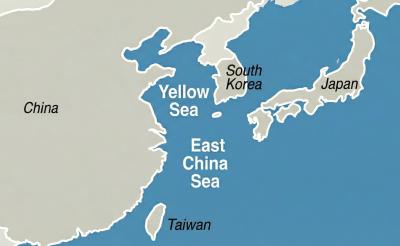
China has reserved offshore airspace in the Yellow Sea and East China Sea from March 27 to May 6, issuing alerts usually used to warn of military exercises, although no such exercises have been announced, the Wall Street Journal (WSJ) reported yesterday. Reserving such a large area for 40 days without explanation is an “unusual step,” as military exercises normally only last a few days, the paper said. These alerts, known as Notice to Air Missions (Notams), “are intended to inform pilots and aviation authorities of temporary airspace hazards or restrictions,” the article said. The airspace reserved in the alert is

NAMING SPAT: The foreign ministry called on Denmark to propose an acceptable solution to the erroneous nationality used for Taiwanese on residence permits Taiwan has revoked some privileges for Danish diplomatic staff over a Danish permit that lists “Taiwan” as “China,” Eric Huang (黃鈞耀), head of the Ministry of Foreign Affairs’ Department of European Affairs, told a news conference in Taipei yesterday. Reporters asked Huang whether the Danish government had responded to the ministry’s request that it correct the nationality on Danish residence permits of Taiwanese, which has been listed as “China” since 2024. Taiwan’s representative office in Denmark continues to communicate with the Danish government, and the ministry has revoked some privileges previously granted to Danish representatives in Taiwan and would continue to review

More than 6,000 Taiwanese students have participated in exchange programs in China over the past two years, despite the Mainland Affairs Council’s (MAC) “orange light” travel advisory, government records showed. The MAC’s publicly available registry showed that Taiwanese college and university students who went on exchange programs across the Strait numbered 3,592 and 2,966 people respectively. The National Immigration Agency data revealed that 2,296 and 2,551 Chinese students visited Taiwan for study in the same two years. A review of the Web sites of publicly-run universities and colleges showed that Taiwanese higher education institutions continued to recruit students for Chinese educational programs without
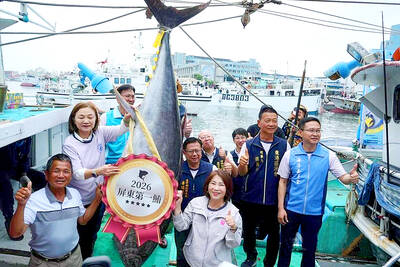
The first bluefin tuna of the season, brought to shore in Pingtung County and weighing 190kg, was yesterday auctioned for NT$10,600 (US$333.5) per kilogram, setting a record high for the local market. The auction was held at the fish market in Donggang Fishing Harbor, where the Siaoliouciou Island-registered fishing vessel Fu Yu Ching No. 2 delivered the “Pingtung First Tuna” it had caught for bidding. Bidding was intense, and the tuna was ultimately jointly purchased by a local restaurant and a local company for NT$10,600 per kilogram — NT$300 ,more than last year — for a total of NT$2.014 million. The 67-year-old skipper


 RSS
RSS