


Chinese Nationalist Party (KMT) Chairman Wu Den-yih (吳敦義) yesterday rejected allegations that he was involved in negotiations with then-Executive Yuan secretary-general Chien Tai-lang (簡太郎) over a navy minesweeper project during his tenure as vice president and accused President Tsai Ing-wen (蔡英文) of having a close connection with a scandal-hit shipbuilder.
Local media reported that Chien, who led Cabinet negotiations for a syndicated loan to Ching Fu Shipbuilding Co (慶富造船) in 2015, met with Wu twice at the Presidential Office Building.
Wu said that while there were ample opportunities to meet with Chien, who was unlikely to speak with him about the minesweeper project, because the vice president has no clearly defined state function.
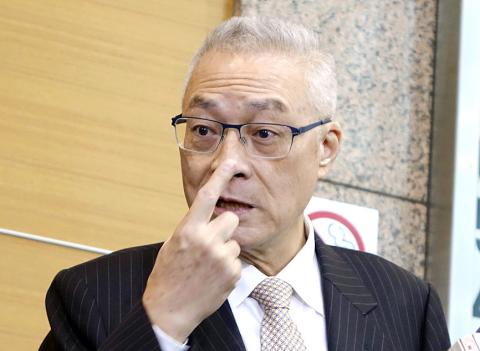
Photo: Wang Yi-sung, Taipei Times
Wu displayed a picture of Tsai talking with Ching Fu president and founder Chen Ching-nan (陳慶男) at Coast Guard Administration drills in Keelung earlier this year, saying: “This picture says everything.”
There are only two possible explanations for any person being allowed past the security perimeter of the head of state overseeing a security exercise: either Tsai agreed to meet with Chen, or “security forces let him through because he was familiar to them,” Wu said.
It is impossible for anyone to pass the security guarding the head of state if the president does not wish to meet them, or if the security personnel are not familiar with them, Wu said.
Asked about the Democratic Progressive Party’s (DPP) remarks that Wu seems eager to distance himself from the case, Wu said: “I have no need to detach myself from allegations that never stuck.”
He also denied that he was connected to the Ching Fu case through former Bank of Taiwan president Shiau Chang-ruey (蕭長瑞), who served as the director of Wu’s office after the Tsai administration took power.
Retired presidents and vice presidents are granted courtesy funds after they have concluded their terms and most of them establish offices with that money.
Wu said Shiau did not talk to him about the loans and soon left his office to work at the Bank of Taiwan.
“It is without doubt that I did not exceeded my bounds during my tenure as vice president,” Wu said.
DPP spokesperson Ho Meng-hua (何孟樺) said that Wu’s denial and deflection betrays his concern about the incident and that he cannot give a straight answer about his involvement with Ching Fu.
Chen was the only person from the private sector to attend four state banquets that the administration of former president Ma Ying-jeou (馬英九) held for foreign dignitaries, Ho said, adding that Chen and his wife shared a table with Wu at one of the banquets.
Chen visited the Presidential Office Building twice when Chien was Cabinet secretary-general, Ho said, adding that the visits coincided with Chien’s meetings with banks on the syndicated loan and its amount.
Based on Wu’s logic, it could be questioned whether Wu had deep ties with Chen and his family, Ho said.

FUKUOKA SITUATION: Japanese media reported that the pathogen is expected to be identified by the summer, while the CDC downplayed the idea that it was hMPV A “mysterious cold-like illness” reported in Japan’s Fukuoka Prefecture does not seem to be a new disease, but Japanese authorities have been asked about the situation, the Centers for Disease Control (CDC) said yesterday. The Fukuoka Prefectural Medical Association on Wednesday told a news conference that a “mystery cold” that has become a hot topic on social media is “highly likely to be caused by some kind of viral infection,” Japan’s KBC News reported. “Many people are experiencing symptoms starting with a sore throat, followed by a runny nose, phlegm and a severe cough,” KBC News reported, citing association officials. Health authorities are

Nvidia Corp CEO Jensen Huang (黃仁勳) arrived in Taiwan yesterday ahead of upcoming AI and technology events, saying he plans to meet with clients and Taiwan Semiconductor Manufacturing Co Chairman C.C. Wei (魏哲家) during his visit. After landing at Taipei Songshan Airport, Huang posed for photos with fans and handed out Yakult drinks to reporters and supporters waiting at the scene, saying he has “a lot to do” during the trip. Asked about reports that Nvidia’s planned headquarters site in Taipei’s Beitou Shilin Technology Park could break ground on May 27, Huang said that if the company holds an event, he would

Carrefour Taiwan is to begin using a new name from the start of July, but it cannot divulge the name until then, the chairman of the supermarket chain's parent company said today. President Chain Store Co chairman Lo Chih-hsien (羅智先) was asked by reporters after a shareholders' meeting to confirm whether the company has settled on a new name for the supermarket brand. In March, the government-registered name of two Carrefour Taiwan branches was quietly changed to "Le Chia Kang" (樂家康) in Chinese, raising speculation that has been selected as the name. Lo said that because of local regulations and contractual obligations, the
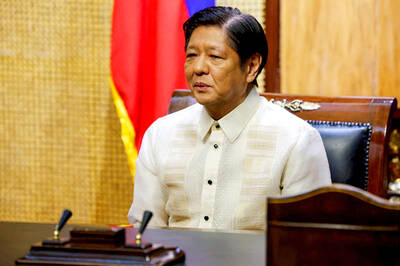
The Philippines would likely be involved in any conflict over Taiwan due to its proximity to the democracy claimed by China, President Ferdinand Marcos Jr said, reiterating a stance that risks angering Beijing. “In the Philippines, we do not have a choice because Taiwan is so close to the Philippines and we have almost 200,000 Filipino nationals living and working in Taiwan,” Marcos said in an interview with Japanese media in Manila on Monday. The Philippine leader’s comments come ahead of a state visit to Japan next week, where he is to meet with Japanese Prime Minister Sanae Takaichi to discuss security


 RSS
RSS