


Academia Sinica has not tried to intervene in the selection process for the president of National Taiwan University (NTU), even though its vice president is one of the candidates, Academia Sinica President James Liao (廖俊智) said during a legislative session yesterday.
The university has set up a 21-member ad hoc committee for the selection that includes nine NTU faculty members and student representatives, nine NTU alumni and others from the general public, and three representatives selected by the Ministry of Education.
Academia Sinica Vice President Chou Mei-yin (周美吟) and former Academia Sinica vice president Wang Fan-sen (王汎森) are among the eight candidates for the position, while Liao and other academics from the institution are part of the committee.
Media reports suggested the selection would take place in the shadow of the institution’s influence.
Several lawmakers from the legislature’s Education and Culture Committee raised concerns about the issue when Liao delivered the institution’s policy report.
He and other academics had not sought to become committee members, but were “passively” recommended to sit on the committee, Liao said.
There is no question of influence from Academia Sinica, he said, responding to questions from Democratic Progressive Party (DPP) Legislator Chen Ting-fei (陳亭妃).
Chou does not have to resign from her position, given the selection is not a political election and her work will not be affected, he said.
However, Liao’s participation in the selection is “inappropriate,” considering that Chou is his subordinate at Academia Sinica, Chinese Nationalist Party (KMT) Legislator Ko Chih-en (柯志恩) said.
“Academia Sinica has become intertwined with the nation’s political and economic fabric since [the indictment of] former Academia Sinica president Wong Chi-huey (翁啟惠),” she said.
Ko urged Liao to leave the committee to avoid a conflict of interest.
Liao said he would not take the advice, adding that legitimate procedure is essential to the selection process.
DPP Legislator Rosalia Wu (吳思瑤) defended Liao’s stance, saying he is fulfilling his social responsibility and that the issue has been unduly “politicized.”
Other than Chou and Wang, candidates for the presidency include former NTU acting president Chang Ching-jui (張慶瑞), former NTU College of Liberal Arts dean Chen Juo-shui (陳弱水), NTU College of Electrical Engineering and Computer Science dean Chen Ming-hsien (陳銘憲), NTU Institute for Advanced Studies in Humanities and Social Sciences dean Kuan Chung-ming (管中閔), former Institute for Information Industry president Wu Jui-pei (吳瑞北) and National Tsing Hua University vice president Wu Cheng-wen (吳誠文).
Candidates are to present their plans for the school in four meetings from Monday to Friday next week that are to be livestreamed.

NATIONAL SECURITY: Authorities are working to confirm the identities of the military personnel involved and investigating possible illegal conduct and regulatory violations Authorities are probing possible national security implications after Kinmen police and immigration officers on Sunday found a Chinese woman allegedly posing as a tourist while engaging in prostitution involving more than 10 military personnel. The woman, surnamed Chen (陳), has since been deported, authorities said, adding that investigators are still working to confirm the identities of those implicated, as the records only listed code names and aliases. The case stemmed from a report received by the Kinmen District Prosecutors’ Office on Friday last week from the Jinhu Precinct of the Kinmen County Police Bureau. On Sunday, police, along with the National Immigration

GLOBALGIVING: ‘ Caving to external pressure is not acceptable for an organization that has cultivated justice reform and human rights for 30 years,’ one NGO said A slew of non-government organizations (NGOs) have withdrawn from the GlobalGiving fundraising platform after it announced it would use “Chinese Taipei” instead of “Taiwan” from next month. The Taiwan Good Rice Association wrote on Facebook on Friday that it was informed on April 28 via a teleconference call of the change, which was made because the platform wanted to operate in China. Taiwan Good Rice is to terminate all cooperative relationships with GlobalGiving in response to the platform’s “unilateral and non-negotiable” decision to remove references to Taiwan, the NGO said. “Taiwan is in the official name of Taiwan Good Rice Association and the
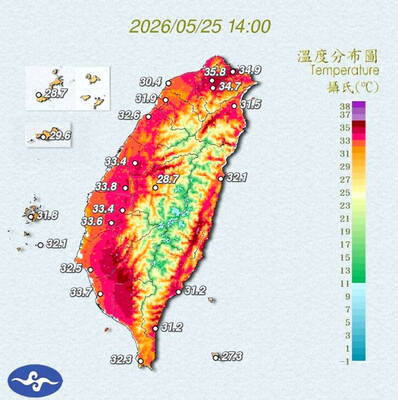
STAY COOL: The HPA recommended that people stay hydrated, use air-conditioning or fans while indoors, wear loose-fitting clothes and walk in the shade while outdoors Employers must implement measures such as installing cooling equipment, and providing drinking water and rest breaks for outdoor workers starting from Monday next week, the Taipei Department of Labor said on Sunday. Employers who fail to comply could face fines of NT$30,000 to NT$300,000 under the Occupational Safety and Health Act (職業安全衛生法), the department said. Businesses in Taipei employing fewer than 100 workers, as well as registered self-employed workers with labor insurance coverage, could receive on-site assessments and guidance from occupational safety consultants to help them apply for central government subsidies to implement or improve heat-protection measures, it said. Under the Ministry of

HEAVY WEATHER: Typhoon Jangmi is due to crash straight into the Ryukyus as airlines look to shift flights to larger aircraft or cancel flights to Okinawa entirely Taiwan’s international air carriers announced flight adjustments over the weekend as Typhoon Jangmi is forecast to hit the Ryukyu Islands today and tomorrow. The Central Weather Administration (CWA) upgraded Jangmi from a tropical storm to a typhoon at 8am yesterday, with the eye located 580km south of Naha city. It was moving north at 19kph. Today, China Airlines’ CI-120, CI-121, CI-122 and CI-123 flights between Taoyuan and Naha, Okinawa, have been canceled as well as CI-132 and CI-133 between Kaohsiung and Naha. EVA Air’s BR-112, BR-113, BR-186 and BR-185 flights between Taoyuan and Naha are also canceled. Low-cost carrier Tigerair Taiwan canceled IT-230,


 RSS
RSS