


Six versions of the draft information security management act, all based on the US’ Federal Information Security Modernization Act, are scheduled to be reviewed by the Legislative Yuan tomorrow.
The Executive Yuan, New Power Party (NPP) and People First Party (PFP) have versions set for review, in addition to two drafts by Democratic Progressive Party (DPP) legislators Chen Ting-fei (陳亭妃) and Yu Wan-ju (余宛如) respectively and a draft by Chinese Nationalist Party (KMT) Legislator Jason Hsu (許毓仁).
Under the Executive Yuan version, information security would be managed under three broad categories: governmental agencies, providers of key services to eight industries and government-funded foundations.
The eight industries include energy, water, information and communication, transportation, banking and finance, emergency rescue and hospitals, central and local governments, and science parks.
Under the Executive Yuan version, the Executive Yuan would be responsible for planning and implementing policies regarding national information security, developing related technologies, international exchanges and general planning.
Heads of all government agencies and units would be required to appoint an information security chief and would be obligated to report any security incidents.
Providers of key services and government-funded foundations would also be asked to set down information security plans and reactive measures, and would face fines between NT$100,000 and NT$1 million (US$3,314 and US$33,143) for failing to do so.
Chen’s version is similar to the Executive Yuan’s, but stipulates greater fines — between NT$500,000 and NT$3 million — if government authorities do not set and implement plans to uphold information security.
Providers and foundations would face fines between NT$300,000 and NT$2 million for failing to report incidents.
The NPP version stipulates that the Executive Yuan must establish an information security division tasked with handling all information security affairs, although it does not offer any punitive measures to complement its set of awards and prizes.
The PFP and KMT versions only extend regulations to government agencies, public enterprises and government-funded foundations, but do not limit private or civilian companies.
Yu in her version taps the Executive Yuan’s National Information and Communication Infrastructure Security task force to handle information security management, including the drafting of bills, handling of policy and establishing principles of action.
Ministerial-level agencies, municipalities, county governments and public enterprises would be tasked with the implementation of policies, while the standards for information security would follow the Ministry of Economic Affairs’ example.
If providers of key services were to violate the regulations, they could be fined between NT$100,000 and NT$1 million.
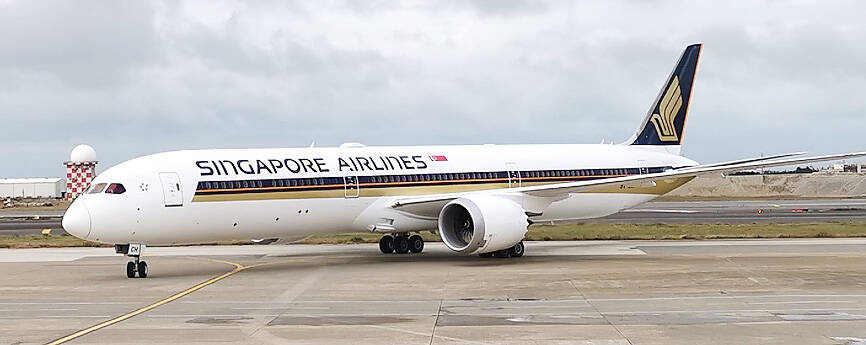
INCREASED CAPACITY: The flights on Mondays, Wednesdays, Fridays and Sundays would leave Singapore in the morning and Taipei in the afternoon Singapore Airlines is adding four supplementary flights to Taipei per week until May to meet increased tourist and business travel demand, the carrier said on Friday. The addition would raise the number of weekly flights it operates to Taipei to 18, Singapore Airlines Taiwan general manager Timothy Ouyang (歐陽漢源) said. The airline has recorded a steady rise in tourist and business travel to and from Taipei, and aims to provide more flexible travel arrangements for passengers, said Ouyang, who assumed the post in July last year. From now until Saturday next week, four additional flights would depart from Singapore on Monday, Wednesday, Friday
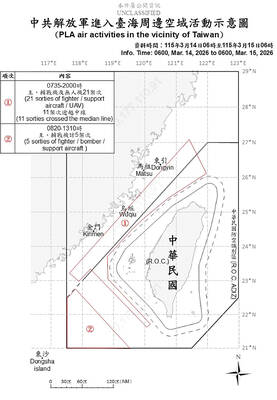
The Ministry of National Defense yesterday reported the return of large-scale Chinese air force activities after their unexplained absence for more than two weeks, which had prompted speculation regarding Beijing’s motives. China usually sends fighter jets, drones and other military aircraft around the nation on a daily basis. Interruptions to such routine are generally caused by bad weather. The Ministry of National Defense said it had detected 26 Chinese military aircraft in the Taiwan Strait over the previous 24 hours. It last reported that many aircraft on Feb. 25, when it spotted 30 aircraft, saying Beijing was carrying out another “joint combat
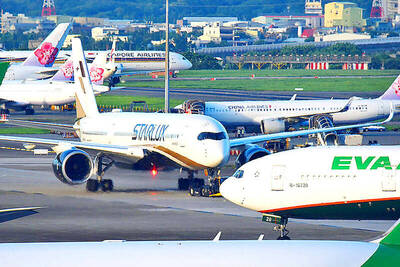
Taiwan’s three major international carriers are increasing booking fees, with EVA Airways having already increased the charge to US$28 per flight segment from US$25, while China Airlines (CAL) and Starlux Airlines are set to follow suit. Booking fees are charged by airlines through a global distribution system (GDS) and passed on to passengers. Carriers that apply the fees include CAL, EVA, Starlux and Tigerair Taiwan. A GDS is a computerized network operated by a company that connects airlines with travel agents and ticketing platforms, allowing reservations to be made and processed in real time. Major players include Amadeus, Sabre and Travelport. EVA Air began

Taiwan successfully defended its women’s 540 kilogram title and won its first-ever men’s 640 kg title at the 2026 World Indoor Tug of War Championships in Taipei yesterday. In the women’s event, Taiwan’s eight-person squad reached the final following a round-robin preliminary round and semifinals featuring teams from Ukraine, Japan, Thailand, Vietnam, the Basque Country and South Korea. In the finals, they swept the Basque team 2-0, giving the team composed mainly of National Taiwan Normal University students and graduates its second championship in a row, and its fourth in five years. Team captain


 RSS
RSS