

Premier William Lai (賴清德) yesterday told the Cabinet to provide more accurate forecasts and proposals before its scheduled announcement next week of a set of policies to tackle the electricity shortage in the industrial sector.
Lai convened a Cabinet meeting yesterday to discuss renewable energy options and the policy announced on Wednesday to promote rooftop solar systems, Executive Yuan spokesman Hsu Kuo-yung (徐國勇) said.
Ministries and Cabinet agencies were told to propose renewable generation plans to achieve the goal of boosting the share of renewable energy to 20 percent by 2025, Hsu said.
The policies to be announced on Wednesday next week are part of a package aimed at resolving five shortages facing the industrial sector: power, water, land, workforce and skilled workers.
During yesterday’s meeting, the Bureau of Energy presented its stimulus plan aimed at encouraging the public and businesses to construct rooftop solar systems to increase the solar power generation capacity by offering subsidies to households that would cover 40 percent of construction costs and 100 percent of design costs.
The two-year subsidy would begin next year, the bureau said.
The bureau also presented a review of the nation’s wind, solar, geothermal and hydropower generation capacity and operating reserve, Hsu said.
Lai told the Ministry of Economic Affairs and Taiwan Power Co to determine how much renewable power generation capacity can actually be obtained and how much capacity is needed for the nation to achieve the goal of raising the renewable energy portion of its electricity supply to 20 percent by 2025 when the nation has planned to phase out nuclear power, Hsu said.
Solar, wind and hydro power generation can often be restricted by seasonal and climate factors, while major technological breakthroughs are needed to effectively tap the geothermal heat.
Lai also asked the ministry and the bureau to provide an accurate estimate of the rooftop solar system subsidy program, its efficiency and budgeting, with the ministry ordered to announce a complete subsidy procedure this week.
The economics ministry was also asked to cooperate with the Ministry of Science and Technology in developing a plan to encourage businesses in industrial parks and science parks nationwide to install solar-panel systems on their roofs.
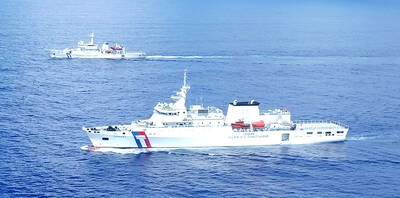
‘FRIENDSHIP FLEET’: A CGA official is scheduled to meet with the president of the Pacific nation, while one of the ships is to host a banquet and National Day event Two Coast Guard Administration (CGA) patrol vessels have docked at Malakal Harbor in Palau as part of an expedition exercise and diplomatic visit, during which a senior official is expected to meet with Palauan President Surangel Whipps Jr, the agency said yesterday. The two vessels, the 4,000-tonne-class Chiayi and the 1,000-tonne-class Penghu, set sail for Palau from Taiwan last week and arrived on Tuesday at Malakal Harbor, the CGA’s Fleet Branch said in a statement. The journey marks the second time the CGA has dispatched a “friendship fleet” to another country, after it sent its first-ever goodwill fleet, comprising the Hualien and
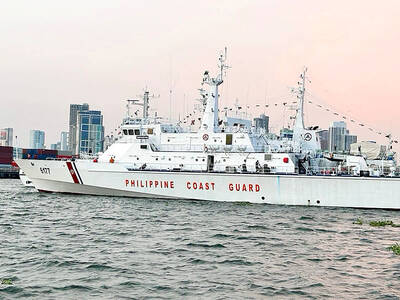
A patrol vessel donated by the Coast Guard Administration (CGA) to the Philippines was commissioned into the Philippine Coast Guard (PCG) on Friday, a Philippine non-governmental organization said. The CGA on Sept. 16 confirmed media reports that Taiwan had donated a retired 500-tonne patrol vessel to the Philippines. The Manila-based We Protect Our Seas (WPS) foundation, which served as an intermediary in the transfer, said that the vessel was formerly the CGA’s 500-tonne petrol vessel Kinmen (CG123). The WPS, in a statement issued on Friday, said the vessel, renamed as the BRP Sarangani, had been commissioned into the PCG the
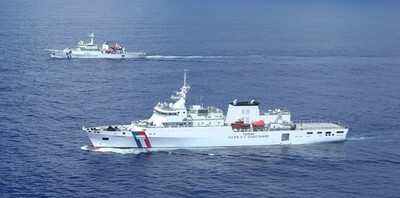
The Coast Guard Administration (CGA) today said that two of its patrol vessels have docked at Palau's Malakal Harbor as part of an expedition exercise and diplomatic visit, during which a senior official is expected to meet with the Palauan president. The two vessels, the 4,000-tonne-class Chiayi (嘉義) and the 1,000-tonne-class Penghu (澎湖), set sail for Palau from Taiwan last week and arrived at Malakal Harbor yesterday, the CGA's Fleet Branch said in a statement. The journey marked the second time the CGA has dispatched a "Friendship Fleet" to another country, after it sent its first-ever goodwill fleet, comprising the Hualien (花蓮)
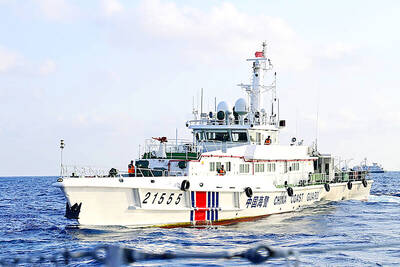
‘GRAY ZONE’ TACTICS: Beijing sent two China Coast Guard vessels to escort a ‘supposedly private research ship,’ a Philippine Coast Guard spokesman said The Coast Guard Administration (CGA) yesterday confirmed that it had recently deployed three patrol vessels to waters in Taiwan’s overlapping exclusive economic zone with the Philippines to monitor three Chinese vessels. CGA Deputy Director-General Hsieh Ching-chin (謝慶欽) said the agency regularly monitors Chinese vessels around Taiwan, and that the deployment south of Oluanpi (鵝鑾鼻), Taiwan proper’s southernmost point, was carried out in accordance with standard procedures. He added that the waters fall within the overlapping exclusive economic zones of Taiwan and the Philippines, which extend 200 nautical miles (370km) from their coastlines. Hsieh made the comments when asked about a


 RSS
RSS