


Chinese President Xi Jinping’s (習近平) comments at the Chinese Communist Party’s (CCP) 19th National Congress indicate that Beijing is planning to ramp up unification efforts, Tamkang University Institute of China Studies professor Chao Chun-shan (趙春山) said yesterday.
Chao cited Xi’s reiteration on Wednesday of the so-called “one China” principle and his inclusion of Taiwan with Hong Kong and Macau in his “realization of the great rejuvenation of the Chinese people” as evidence of unification plans.
However, Xi expressed respect for Taiwan’s social system and the Taiwanese way of life and acknowledged the so-called “1992 consensus” as “historical fact,” which is consistent with the government’s repeated calls for cross-strait relations to be based on the public will, Taiwan Thinktank researcher Tung Li-wen (董立文) said.
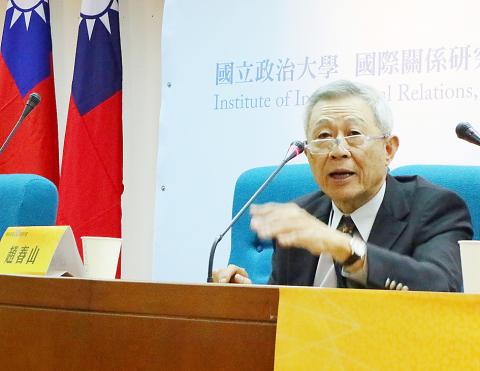
Photo: CNA
The CCP might look for more opportunities for contact with the Democratic Progressive Party in the future, he said.
Xi mentioned the “1992 consensus” four times while reflecting on the CCP’s efforts over the past five years toward unification, insisting on the “one China” principle as the basis for cross-strait relations and expressing determination in seeking “peaceful unification,” Tung said.
Xi also reiterated his “six anys,” which he first described last year as meaning that “[China] will not permit any person, any organization or any political party at any time, using any means to tear any part of Chinese territory away from the country.”
The “six anys” are China’s “bottom line” on moves toward Taiwanese independence, Chao added.
“However, Xi’s repeated calls for the peaceful development of cross-strait relations and peaceful unification means the CCP is hoping to avoid armed conflict with Taiwan,” Chao said.
Xi said the basis for cross-strait dialogue is an acknowledgment that both sides of the Taiwan Strait belong to the same “China,” and that no Taiwanese party or organization would be obstructed from exchanges with “the mainland.”
These comments indicate Xi’s prerequisite for the resumption of an official cross-strait dialogue, Chao said.
Xi’s remarks are only slightly different from President Tsai Ing-wen’s (蔡英文) inaugural address, in which she acknowledged that a cross-strait meeting took place in 1992, at which both sides reached some mutual understanding, Tung said.
“Although the governments on both sides use different words, the spirit of what they are saying is almost the same,” Tung said.
The government has been complying with public will in its approach to cross-strait relations, Tung said, adding that Xi’s remarks give the sense that he is conforming with this approach.
Xi said that he plans to expand cooperation on cross-strait economic and cultural exchanges and that he wants to provide “Taiwanese compatriots with equal treatment in the areas of study, entrepreneurship and lifestyle in the mainland.”
“If all the sons and daughters of China, including those of Hong Kong, Macau and Taiwan, follow the great tide of history, equally undertaking the virtuous cause of the Chinese people and firmly gripping the nation’s destiny within our hands, then together we can most certainly create a rejuvenation of the Chinese race and build a wonderful future,” the Chinese president said.
Chao said the speech indicates that Xi has tied unification into his vision for the “China dream.”
All favors shown Taiwan are with the sole intention of realizing this vision, Chao added.
Although Xi did not specify a timeline for unification, the CCP is most likely aiming to achieve its goal by 2049, the People’s Republic of China 100-year anniversary, Chao said.
“For the CCP, unification has no timetable, but it is of a pressing nature,” he said.
The “1992 consensus,” a term former Mainland Affairs Council chairman Su Chi (蘇起) in 2006 admitted making up in 2000, refers to a tacit understanding between the Chinese Nationalist Party (KMT) and the Chinese government that both sides of the Strait acknowledge there is “one China,” with each side having its own interpretation of what “China” means.

Trips for more than 100,000 international and domestic air travelers could be disrupted as China launches a military exercise around Taiwan today, Taiwan’s Civil Aviation Administration (CAA) said yesterday. The exercise could affect nearly 900 flights scheduled to enter the Taipei Flight Information Region (FIR) during the exercise window, it added. A notice issued by the Chinese Civil Aviation Administration showed there would be seven temporary zones around the Taiwan Strait which would be used for live-fire exercises, lasting from 8am to 6pm today. All aircraft are prohibited from entering during exercise, it says. Taipei FIR has 14 international air routes and
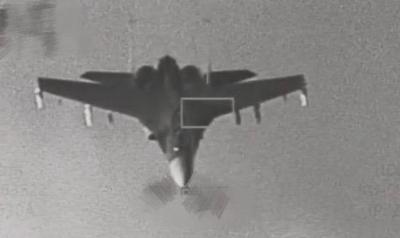
The Ministry of National Defense (MND) today released images of the military tracking China’s People's Liberation Army (PLA) movements during the latest round of Chinese drills around Taiwan. The PLA began "Justice Mission 2025" drills today, carrying out live-fire drills, simulated strikes on land and maritime targets, and exercises to blockade the nation's main ports. The exercises are to continue tomorrow, with the PLA announcing sea and air space restrictions for five zones around Taiwan for 10 hours starting from 8:30am. The ministry today released images showing a Chinese J-16 fighter jet tracked by a F-16V Block 20 jet and the

Snow fell on Yushan (Jade Mountain, 玉山) yesterday morning as a continental cold air mass sent temperatures below freezing on Taiwan’s tallest peak, the Central Weather Administration (CWA) said. Snowflakes were seen on Yushan’s north peak from 6:28am to 6:38am, but they did not fully cover the ground and no accumulation was recorded, the CWA said. As of 7:42am, the lowest temperature recorded across Taiwan was minus-5.5°C at Yushan’s Fengkou observatory and minus-4.7°C at the Yushan observatory, CWA data showed. On Hehuanshan (合歡山) in Nantou County, a low of 1.3°C was recorded at 6:39pm, when ice pellets fell at Songsyue Lodge (松雪樓), a
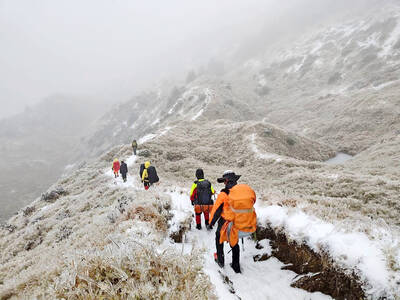
NO SHAME IN RETREAT: Hikers should consider turning back if the weather turns bad or if they do not have sufficient equipment, the Taroko park headquarters said Two people died of hypothermia over the weekend while hiking on Hsuehshan (雪山), prompting park authorities to remind hikers to bring proper equipment and consider their physical condition before setting out in the cold weather. Temperatures dropped over the weekend, bringing snow to high altitudes in Shei-pa National Park. One hiker, surnamed Lin (林), who on Friday was traveling with a group of six along the Hsuehshan west ridge trail, lost consciousness due to hypothermia and died, the Shei-pa National Park Headquarters said. On Saturday, another hiker, surnamed Tien (田), in a group of five on the southeast of the west


 RSS
RSS