

The Taipei District Prosecutors Office yesterday indicted a man suspected of attacking a military police officer with a samurai sword at the Presidential Office Building in August on charges of attempted murder.
The prosecution is seeking a seven-year prison term for 51-year-old Lu Chun-yi (呂軍億), the indictment said.
According to prosecutors, Lu had said that his main intention was to kill President Tsai Ing-wen (蔡英文) and that he “was prepared to attack anyone else if they tried to get in my way.”
On Aug. 18, Lu approached the west wing of the Presidential Office Building in Taipei and allegedly struck the neck of a military police officer surnamed Chou (周), who was on sentry duty by the entrance, with a Japanese sword.
Chou received cuts to his neck and hands, but managed to block Lu from getting further before being taken to the hospital.
Lu was overpowered by other military guards before he could enter the building, and police found a self-penned letter and a People’s Republic of China flag in his bag.
Investigators said Lu had strong pro-China political beliefs and had in June written online: “I want to pay my respect to the great chairman Mao Zedong (毛澤東)...”
It was later determined that Lu had stolen the sword from the nearby Armed Forces Museum on Guiyang Street by smashing the display case with a hammer.
Additional reporting by CNA

Starbucks Taiwan’s decision to charge for drink customization, which had been free, has sparked consumer backlash, highlighting the challenge of raising prices without making customers feel they are losing value, experts said. Since Oct. 12, customers who order drinks with less or no ice and ask to have the volume topped up with milk or other liquid have been charged an additional NT$15. Topping off drinks without ice was previously free, and disgruntled customers posted photos on social media showing that iced drinks ordered without ice were only half full if the extra NT$15 was not paid. The posts drew tens of thousands
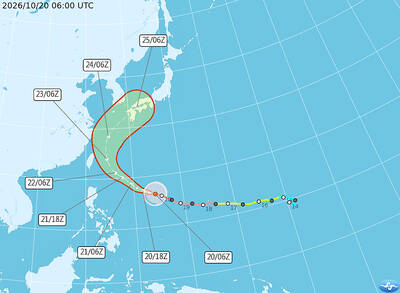
A sea warning for Typhoon Champi might be issued tonight, while the storm’s trajectory would determine whether a land warning is to be issued tomorrow night, the Central Weather Administration (CWA) said yesterday. As of 2pm yesterday, Champi was about 1,536km east-southeast of Taiwan proper’s southernmost point, Oluanpi (鵝鑾鼻), packing maximum sustained winds of 198kph, CWA forecaster Tseng Chao-cheng (曾昭誠) said. The storm was moving west-northwest at 23kph and was expected to strengthen over the next 24 hours before weakening slightly as it approaches cooler waters east of Taiwan, Tseng said. Champi is expected to turn north tomorrow, with the angle of the
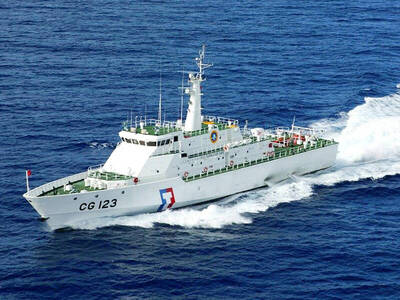
A patrol vessel donated by the Coast Guard Administration (CGA) to the Philippines would not be used in waters near Taiwan or areas where Taiwanese fishing vessels operate, Premier Cho Jung-tai (卓榮泰) said yesterday. The vessel, formerly the CGA's 500-tonne-class Kinmen (金門), was commissioned into the Philippine Coast Guard on Oct. 2. Speaking at the Legislative Yuan, Cho said the Philippines had pledged during the donation process that the vessel would be used only for designated missions and would not operate in waters related to Taiwan. The vessel could even provide assistance to Taiwan if needed, he added. Responding to questions from Chinese
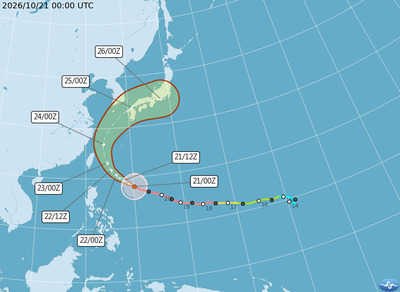
Stable weather in northern Taiwan is expected to give way to rain this evening, while other parts of the country are to remain cloudy to sunny, the Central Weather Administration (CWA) said today. Northern and northeastern Taiwan could see intermittent rain this afternoon as seasonal northeasterly winds strengthen, with heavy rain possible in the greater Taipei area and Yilan County into the evening, CWA forecaster Chu Mei-lin (朱美霖) said. Despite the approaching rain, daytime highs across Taiwan are to remain above 30°C, reaching 34°C in central and southern Taiwan, the CWA said. Starting tomorrow, seasonal northeasterly winds and the outer currents of Typhoon


 RSS
RSS