


The Ministry of Transportation and Communications (MOTC) is to draft regulations governing the testing of autonomous vehicles after the results of research by a third-party institution are published in January next year.
The nation has in the past few months intensified the testing of driverless vehicles.
The Kaohsiung City Government in June launched the nation’s first test run of a self-driving bus, named EZ-10, at the Pier-2 Art Center.
The city said the bus would be used to shuttle attendees at the EcoMobility World Festival beginning on Sunday.
National Taiwan University (NTU) in July tested the bus for a week on a closed section of Shuiyuan Road on its campus in Taipei.
Last month, the Taipei City Government tested the bus on a controlled lane on Xinyi Road from 1am to 4am for five days.
The Changhua County Government on Sunday announced that it would be working with an NTU research team and the bus’ manufacturer, 7 Starlake Co, to test the bus near the Changhua high-speed railway station next month.
After a visit to Silicon Valley, Minister Without Portfolio Audrey Tang (唐鳳) earlier this month told the Chinese-language Economic Daily News that the government plans to establish testing grounds for autonomous cars, provided that local governments help the central government achieve the goal.
The issues related to autonomous vehicles are open for debate on V Taiwan, an online platform set up by the government on which people can discuss how laws should be stipulated or amended.
The discussions are to be closed on Saturday next week.
The ministry has tasked a third-party institution with looking into how other nations regulate the testing of self-driving vehicles, Department of Railways and Highways section chief Michael Chao (趙晉緯) said.
The department would stipulate or amend the regulations after the institution publishes its findings in January, Chao said.
“Most nations only permit test runs of self-driving vehicles on regular roads along with human-driven vehicles. They inform the people or institutions running the tests about the rules they need to follow,” he said.
None of the nations have come to the point where they need major overhauls of traffic regulations to allow the operation of autonomous cars, as the technology is still in development,” Chao added.
The ministry is to ask people to submit plans for the testing of driverless vehicles specifying the vehicles’ use, the roads they would be allowed to access and the required liability insurances.
So far, only about 20 people have commented about the issue on V Taiwan.
Some said that the closed settings designed for the test runs must contain various scenarios.
It is not possible to know how the vehicles would react under emergency situations on regular roads if they are only tested during certain hours of the day or on controlled lanes, some of the commenters said, adding that test administrators should be required to propose plans on how to prevent accidents.
Others said that testing the vehicles on regular roads is unnecessary, because the nation lacks a well-established map system and sound road facilities.
The benefits generated by the technology would be limited, they said.
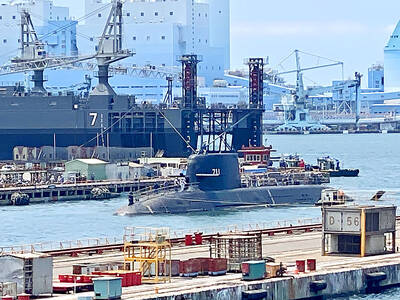
AGING: While Japan has 22 submarines, Taiwan only operates four, two of which were commissioned by the US in 1945 and 1946, and transferred to Taiwan in 1973 Taiwan would need at least 12 submarines to reach modern fleet capabilities, CSBC Corp, Taiwan chairman Chen Cheng-hung (陳政宏) said in an interview broadcast on Friday, citing a US assessment. CSBC is testing the nation’s first indigenous defense submarine, the Hai Kun (海鯤, Narwhal), which is scheduled to be delivered to the navy next month or in July. The Hai Kun has completed torpedo-firing tests and is scheduled to undergo overnight sea trials, Chen said on an SET TV military affairs program. Taiwan would require at least 12 submarines to establish a modern submarine force after assessing the nation’s operational environment and defense
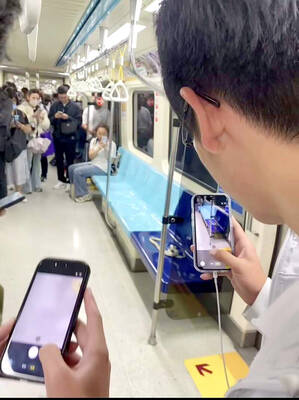
A white king snake that frightened passengers and caused a stir on a Taipei MRT train on Friday evening has been claimed by its owner, who would be fined, Taipei Rapid Transit Corp (TRTC) said yesterday. A person on Threads posted that he thought he was lucky to find an empty row of seats on Friday after boarding a train on the Bannan (Blue) Line, only to spot a white snake with black stripes after sitting down. Startled, he jumped up, he wrote, describing the encounter as “terrifying.” “Taipei’s rat control plan: Release snakes on the metro,” one person wrote in reply, referring
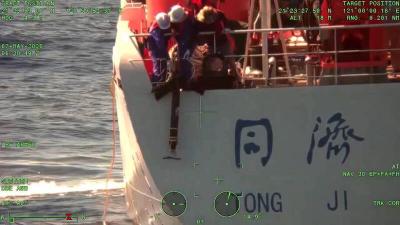
The coast guard today said that it had disrupted "illegal" operations by a Chinese research ship in waters close to the nation and driven it away, part of what Taipei sees a provocative pattern of China's stepped up maritime activities. The coast guard said that it on Thursday last week detected the Chinese ship Tongji (同濟號), which was commissioned only last year, 29 nautical miles (54km) southeast of the southern tip of Taiwan, although just outside restricted waters. The ship was observed lowering ropes into the water, suspected to be the deployment of scientific instruments for "illegal" survey operations, and the coast
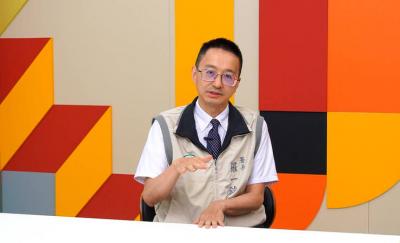
Taiwan’s two cases of hantavirus so far this year are on par with previous years’ case numbers, and the government is coordinating rat extermination work, so there should not be any outbreaks, Centers for Disease Control (CDC) Director-General Philip Lo (羅一鈞) said today in an interview with the Liberty Times (the Taipei Times’ sister newspaper). An increase in rat sightings in Taipei and New Taipei City has raised concerns about the spread of hantavirus, as rats can carry the disease. In January, a man in his 70s who lived in Taipei’s Daan District (大安) tested positive posthumously for hantavirus, Taiwan’s


 RSS
RSS