


A motion urging President Tsai Ing-wen (蔡英文) to pardon former president Chen Shui-bian (陳水扁) prepared by Democratic Progressive Party (DPP) representatives yesterday was not addressed at the party’s National Congress after they failed to reach the quorum needed.
More than 500 party representatives had endorsed the motion ahead of the congress.
Chen served more than six years of a 20-year sentence for corruption before being released on medical parole in 2015, but he still faces other criminal charges.
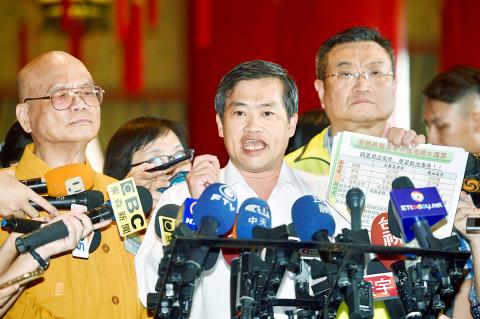
Photo: Peter Lo, Taipei Times
The opening of yesterday’s congress was attended by 366 party representatives, who reviewed five proposals before taking a short break.
However, the number of attendees dropped dramatically to 135 by the time the congress began to address the motion to pardon Chen and 16 other motions, leaving the congress short of the quorum of 295 out of 590 party representatives needed to pass them.
Tsai subsequently announced that all 17 proposals would be passed on to the DPP Central Executive Committee for deliberation while proponents of the motion, including Kaohsiung City Councilor Hsiao Jung-ta (蕭永達), shouted in opposition.
After Hsiao and others complained about the party’s decision to shelve the proposal and transfer it to the executive committee, Tsai said that she understood the complaints were directed against her, but insisted on the transfer.
Passing the motions to the committee was “for the harmony of the party” and “allowed the proposals to be discussed” later, she said.
It was expected that the motion would to be voted on or directly approved after it garnered overwhelming support, including endorsements by 11 of the 13 DPP mayors and county commissioners, but the unexpectedly high number of attendees dropping out of the meeting dealt a blow to Chen’s supporters.
Hsiao ahead of the congress said that if the proposal were not to be approved, “it means that the DPP is unwilling to take the political responsibility of pardoning Chen.”
Former DPP chairman Su Tseng-chang (蘇貞昌) yesterday also said that Chen should be granted amnesty, while former party chairman Hsu Hsin-liang (許信良) said a pardon would spark social conflict if it were granted by a DPP president.
Meanwhile, the congress approved a nomination mechanism for next year’s mayoral and councilor elections that left room to renew the party’s alliance with independent Taipei Mayor Ko Wen-je (柯文哲).
The nomination mechanism for mayoral and commissioner candidates includes a so-called “Ko Wen-je article,” which reserves the possibility of cooperating with the independent mayor again.
Taipei City Councilor Wang Shih-chien (王世堅) criticized the article, saying the DPP should not realign itself with Ko, who Wang said “lacks core values and is quick to shift blame to others.”
Wang’s remark was greeted with applause from DPP representatives, but the nomination mechanism was nonetheless approved.
The party also approved new rules for the nomination of councilor candidates that award first-time candidates, people aged younger than 35 and new immigrants a 10 percent boost in polling during the primary elections.
However, the 10 percent boosts are not to be granted to children or relatives of incumbent DPP mayors, commissioners, lawmakers or councilors if they choose to run in the same constituencies as their influential family members.

Kenting National Park service technician Yang Jien-fon (楊政峰) won a silver award in World Grand Prix Photography Awards Spring Season for his photograph of two male rat snakes intertwined in combat. Yang’s colleagues at Kenting National Park said he is a master of nature photography who has been held back by his job in civil service. The awards accept entries in all four seasons across six categories: architectural and urban photography, black-and-white and fine art photography, commercial and fashion photography, documentary and people photography, nature and experimental photography, and mobile photography. Awards are ranked according to scores and divided into platinum, gold and

The Chinese Nationalist Party (KMT) caucus yesterday said it opposes the introduction of migrant workers from India until a mechanism is in place to prevent workers from absconding. Minister of Labor Hung Sun-han (洪申翰) on Thursday told the Legislative Yuan that the first group of migrant workers from India could be introduced as early as this year, as part of a government program. The caucus’ opposition to the policy is based on the assessment that “the risk is too high,” KMT caucus secretary-general Lin Pei-hsiang (林沛祥) said. Taiwan has a serious and long-standing problem of migrant workers absconding from their contracts, indicating that

SPACE VETERAN: Kjell N. Lindgren, who helps lead NASA’s human spaceflight missions, has been on two expeditions on the ISS and has spent 311 days in space Taiwan-born US astronaut Kjell N. Lindgren is to visit Taiwan to promote technological partnerships through one of the programs organized by the US for its 250th national anniversary. Lindgren would be in Taiwan from Tuesday to Saturday next week as part of the US Bureau of Educational and Cultural Affairs’ US Speaker Program, organized to celebrate the 250th anniversary of the signing of the Declaration of Independence, the American Institute in Taiwan (AIT) said in a statement yesterday. Lindgren plans to engage with key leaders across the nation “to advance cutting-edge technological partnerships and inspire the next generation of scientists and engineers,”

TRADE-OFF: Beijing seeks to trade a bowl of tempura for a Chinese delicacy, an official said, while another said its promises were attempts to interfere in the polls The government must carefully consider the national security implications of building a bridge connecting Kinmen County and Xiamen, China, the Public Construction Commission (PCC) said yesterday. PCC Commissioner Derek Chen (陳金德), who is also a minister without portfolio, made the remarks in a meeting of the legislature’s Transportation Committee, after Democratic Progressive Party Legislator Hsu Fu-kuei (徐富癸) asked about China’s proposal of new infrastructure projects to further connect Kinmen and Lienchiang (Matsu) counties with Xiamen. China unveiled the bridge plan, along with nine other policies for Taiwan, on Sunday, the last day of Chinese Nationalist Party (KMT) Chairwoman Cheng Li-wun’s (鄭麗文) visit


 RSS
RSS