


China is embattled by tumults in the Asia-Pacific region, while cross-strait relations might undergo changes after the Chinese Communist Party’s (CCP) 19th National Congress, Central Police University professor Tung Li-wen (董立文) said yesterday.
Speaking at an international symposium in Taipei on the outlook for developments in the Asia-Pacific region, Tung, an expert on Chinese politics, said China is facing tumultuous situations in the Yellow Sea, the East China Sea, the South China Sea and the Taiwan Strait.
China-Japan relations are unlikely to improve due to a sovereignty dispute over the Diaoyutai Islands (釣魚台), while Beijing’s attempts at expanding its military presence have prompted Southeast Asian nations to prime their armed forces for a possible confrontation, Tung told the symposium hosted by the Taiwan National Security Institute.
Meanwhile, North Korea has incessantly conducted nuclear and missile tests, he said.
The unstable configuration of the region has invited newcomers to join the power struggle in the Asia-Pacific, Tung said, citing as an example the UK, which has participated in two military drills with the Japan and the US.
Meanwhile, China’s recent border dispute with India could have deep implications for the global arena in the long run, he added.
The tensions on the Korean Peninsula are likely to escalate, and a meeting between Chinese President Xi Jinping (習近平) and Japanese Prime Minister Shinzo Abe in July has presented new challenges for China, as will a third meeting between Xi and US President Donald Trump reportedly scheduled for November, Tung said.
He predicted that there could be some changes in cross-strait relations after the CCP congress next month, saying that he was optimistic about the possible changes.
While China’s Taiwan Affairs Office Minister Zhang Zijun (張志軍) and Chinese People’s Political Consultative Conference Chairman Yu Zhengsheng (俞正聲), who control China’s Taiwan policy, have repeated ad nauseam that “the two sides of the Taiwan Strait belong to ‘one China’” and “China is firmly against Taiwanese independence,” and have taken swipes at President Tsai Ing-wen (蔡英文) and Chinese Nationalist Party (KMT) Chairman Wu Den-yih (吳敦義) over their refusal to back unification with China, Xi has apparently refrained from criticizing Tsai or Wu, Tung said.
Zhang’s and Yu’s combative attitude has reportedly drawn criticism from CCP members, who said their handling of cross-strait affairs failed to serve Beijing’s interests, he said.
Their inability to outline plans for development in cross-strait relations signals that there is a “glitch” in China’s Taiwan policy, he added.
The two are to be replaced after the congress, which could mean that cross-strait relations will change for the better, Tung said.

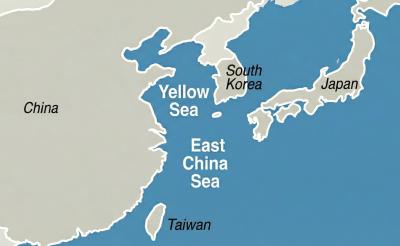
China has reserved offshore airspace in the Yellow Sea and East China Sea from March 27 to May 6, issuing alerts usually used to warn of military exercises, although no such exercises have been announced, the Wall Street Journal (WSJ) reported yesterday. Reserving such a large area for 40 days without explanation is an “unusual step,” as military exercises normally only last a few days, the paper said. These alerts, known as Notice to Air Missions (Notams), “are intended to inform pilots and aviation authorities of temporary airspace hazards or restrictions,” the article said. The airspace reserved in the alert is
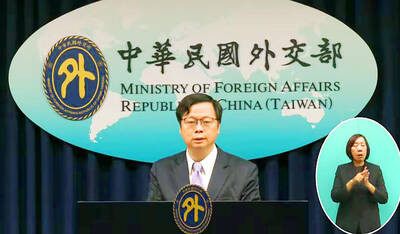
NAMING SPAT: The foreign ministry called on Denmark to propose an acceptable solution to the erroneous nationality used for Taiwanese on residence permits Taiwan has revoked some privileges for Danish diplomatic staff over a Danish permit that lists “Taiwan” as “China,” Eric Huang (黃鈞耀), head of the Ministry of Foreign Affairs’ Department of European Affairs, told a news conference in Taipei yesterday. Reporters asked Huang whether the Danish government had responded to the ministry’s request that it correct the nationality on Danish residence permits of Taiwanese, which has been listed as “China” since 2024. Taiwan’s representative office in Denmark continues to communicate with the Danish government, and the ministry has revoked some privileges previously granted to Danish representatives in Taiwan and would continue to review

More than 6,000 Taiwanese students have participated in exchange programs in China over the past two years, despite the Mainland Affairs Council’s (MAC) “orange light” travel advisory, government records showed. The MAC’s publicly available registry showed that Taiwanese college and university students who went on exchange programs across the Strait numbered 3,592 and 2,966 people respectively. The National Immigration Agency data revealed that 2,296 and 2,551 Chinese students visited Taiwan for study in the same two years. A review of the Web sites of publicly-run universities and colleges showed that Taiwanese higher education institutions continued to recruit students for Chinese educational programs without
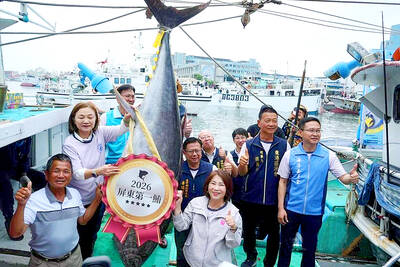
The first bluefin tuna of the season, brought to shore in Pingtung County and weighing 190kg, was yesterday auctioned for NT$10,600 (US$333.5) per kilogram, setting a record high for the local market. The auction was held at the fish market in Donggang Fishing Harbor, where the Siaoliouciou Island-registered fishing vessel Fu Yu Ching No. 2 delivered the “Pingtung First Tuna” it had caught for bidding. Bidding was intense, and the tuna was ultimately jointly purchased by a local restaurant and a local company for NT$10,600 per kilogram — NT$300 ,more than last year — for a total of NT$2.014 million. The 67-year-old skipper


 RSS
RSS