


The Legislative Yuan should initiate the final steps to abolish the Taiwan Provincial Government to follow up on a planned elimination of the Mongolian and Tibetan Affairs Commission, protesters said yesterday.
About a dozen members affiliated with the Economic Democracy Union and several other groups protested outside a Legislative Yuan side gate to demand that the Provincial Government’s budget be eliminated during the upcoming legislative session, followed by formal legal amendments to legislate it out of existence next year.
They also called for the Democratic Progressive Party (DPP) to make abolishing the Act Governing Relations Between the People of the Taiwan Area and the Mainland Area (臺灣地區與大陸地區人民關係條例) a platform plank during the next round of legislative elections.
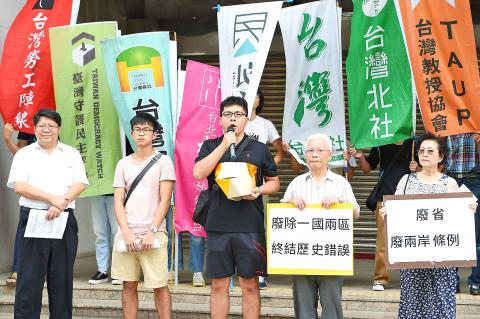
Photo: Liao Chen-huei, Taipei Times
“We hope to make the sovereign power of Taiwanese collide with our Republic of China Constitution,” union spokesman Chien Nien-yu (簡年佑) said. “Legal changes by the Legislative Yuan can challenge inappropriate constitutional restrictions and create new energy for a new constitution or sweeping reform.”
The Republic of China Constitution was adopted by the Chinese Nationalist Party (KMT) government in Nanjing in 1947, with amendments restricting its application to the nation’s “free area” following the KMT’s defeat in the Chinese Civil War.
The Constitution mandates the existence of a provincial government while allowing for legislation to define its specific function and organization.
In practice, the provincial government has been “frozen” and largely non-functional since 1998, when it was drastically downsized.
Protesters yesterday compared it to an “appendix.”
“Even though the provincial government has been frozen for almost 20 years, it still employees more than 100 people across several different bodies, while wasting NT$240 million [US$7.98 million] in taxpayer dollars last year,” said union secretary-general Chen Kuan-yu (陳冠宇), who also announced plans to burn a pile of paper “gold ingots” at a vigil at Liberty Square on Monday night.
Protesters said the vigil date was selected because it corresponded with the 25th anniversary of the promulgation of the Act Governing Relations between the People of the Taiwan Area and the Mainland Area.
“It would not be enough just to amend the act to change references to ‘mainland area’ to ‘China’ and references to the ‘Taiwan area’ to ‘our country,’” Lai Chung-chiang (賴中強) said, calling for restrictions on executive power to regulate Chinese trade and investment.
“The key characteristic of the act is numerous blank checks allowing the executive branch to do as it pleases on a variety of issues where they should be governed by specific laws,” Lai said.
The law should be replaced with a China Relations Act in the medium term to allow transition for articles governing behavior of Chinese citizens to be written into individual legislative acts to mirror passages “for foreigners.”
“Right now, Chinese are legally considered special nationals of the Republic of China, but we want to change that to their being considered special foreigners,” he said, adding that his group does not advocate using a referendum to abolish the act.
Referendums have “more important uses,” he said.
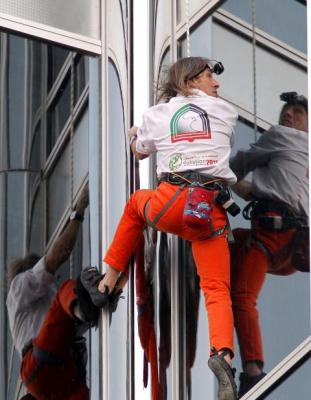
Alain Robert, known as the "French Spider-Man," praised Alex Honnold as exceptionally well-prepared after the US climber completed a free solo ascent of Taipei 101 yesterday. Robert said Honnold's ascent of the 508m-tall skyscraper in just more than one-and-a-half hours without using safety ropes or equipment was a remarkable achievement. "This is my life," he said in an interview conducted in French, adding that he liked the feeling of being "on the edge of danger." The 63-year-old Frenchman climbed Taipei 101 using ropes in December 2004, taking about four hours to reach the top. On a one-to-10 scale of difficulty, Robert said Taipei 101
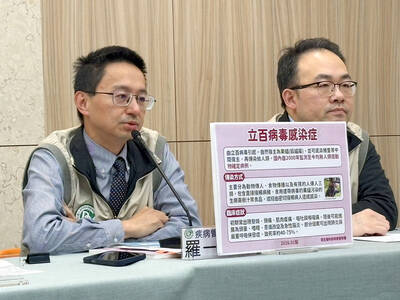
Nipah virus infection is to be officially listed as a category 5 notifiable infectious disease in Taiwan in March, while clinical treatment guidelines are being formulated, the Centers for Disease Control (CDC) said yesterday. With Nipah infections being reported in other countries and considering its relatively high fatality rate, the centers on Jan. 16 announced that it would be listed as a notifiable infectious disease to bolster the nation’s systematic early warning system and increase public awareness, the CDC said. Bangladesh reported four fatal cases last year in separate districts, with three linked to raw date palm sap consumption, CDC Epidemic Intelligence
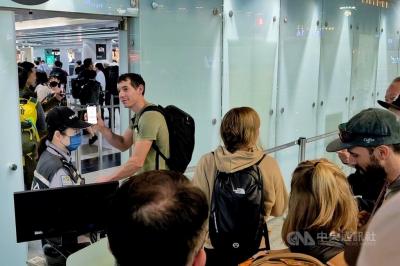
US climber Alex Honnold left Taiwan this morning a day after completing a free-solo ascent of Taipei 101, a feat that drew cheers from onlookers and gained widespread international attention. Honnold yesterday scaled the 101-story skyscraper without a rope or safety harness. The climb — the highest urban free-solo ascent ever attempted — took just more than 90 minutes and was streamed live on Netflix. It was covered by major international news outlets including CNN, the New York Times, the Guardian and the Wall Street Journal. As Honnold prepared to leave Taiwan today, he attracted a crowd when he and his wife, Sanni,

Taiwanese and US defense groups are collaborating to introduce deployable, semi-autonomous manufacturing systems for drones and components in a boost to the nation’s supply chain resilience. Taiwan’s G-Tech Optroelectronics Corp subsidiary GTOC and the US’ Aerkomm Inc on Friday announced an agreement with fellow US-based Firestorm Lab to adopt the latter’s xCell, a technology featuring 3D printers fitted in 6.1m container units. The systems enable aerial platforms and parts to be produced in high volumes from dispersed nodes capable of rapid redeployment, to minimize the risk of enemy strikes and to meet field requirements, they said. Firestorm chief technology officer Ian Muceus said


 RSS
RSS