


The army plans to spend NT$2.66 billion (US$88.6 million) over the next four years to buy equipment that would improve the artillery’s precision engagement and communication capabilities, sources at the Ministry of National Defense said on Saturday.
The army is to buy multiple-role observation systems and second-generation artillery fire command and control systems, and replace aging AN/VIC-1 intercom systems for tanks, armored carriers and artillery vehicles, they said.
Although the Executive Yuan had temporarily withdrawn the general budget bill for review after the Cabinet’s reorganization last week, the ministry is confident that the budget items for the army would be retained, they added.
The multiple-role, laser-equipped observation systems are designed for target acquisition and fire adjustment by artillery and mortar forward observers, the Chungshan Institute of Science and Technology said in a product brochure.
The observation system is an integrated platform that includes an integrated thermal imager, eye-safe laser rangefinder, azimuth-altitude instrument, GPS, digital compass and other equipment, it said.
The device is capable of operating in all weather conditions and can share digital targeting data, giving it additional battlefield surveillance capabilities, the institute said.
According to an internal army assessment, fielding the multiple-role observation system would augment the effectiveness of fire support, and reduce communication lags and human error, sources said.
The army is to buy 272 observation systems from next year to 2022 at an estimated cost of NT$1.96 billion, the sources said, adding that the first 14 units would be bought next year for NT$316 million.
The second-generation artillery fire command and control system has a monitor for improved data display, tactical and technical directors and a fire solution display.
The purchase of artillery fire command and control systems is to be carried out in the next two years and has been allocated a NT$47.46 million budget.
The AN/VIC-1 intercom systems with helmet-mounted headsets has been used by the army’s vehicle crews for nearly four decades and are worn out, the army said.
Declining performance and reliability, and scarcity of spare parts have made it necessary to completely retire and replace the AN/VIC-1 systems, it said.
An as-yet unspecified communication system will be obtained for tanks, armored carriers, self-propelled guns, AN/TWQ-1 Avenger air defense missile systems and Thunderbolt-2000 multiple-launch rocket systems, the army said.
The replacement would be purchased from next year to 2020 at an estimated cost of NT$644 million, it said.
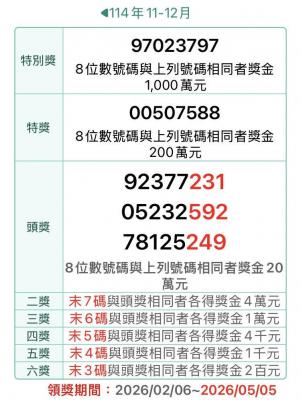
Seven of the 17 NT$10 million (US$311,604) winning receipts from the November-December uniform invoice lottery remain unclaimed as of today, the Ministry of Finance said, urging winners to redeem their prizes by May 5. The reminder comes ahead of the release of the winning numbers for the January-February lottery tomorrow. Among the unclaimed receipts was one for a NT$173 phone bill in Keelung, while others were for a NT$5,913 purchase at Costco in Taipei's Neihu District (內湖), a NT$49 purchase at a FamilyMart in New Taipei City's Tamsui District (淡水), and a NT$500 purchase at a tea shop in New Taipei City's
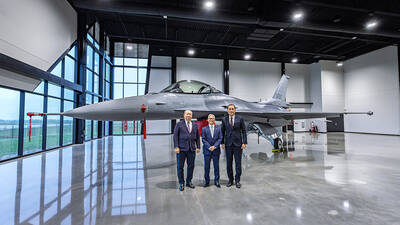
Taiwanese officials were shown the first of 66 F-16V fighter jets purchased by Taiwan from the United States, the Ministry of National Defense said yesterday, adding the aircraft has completed an initial flight test and is expected to be delivered later this year. A delegation led by Deputy Minister of National Defense Hsu Szu-chien (徐斯儉) visited Lockheed Martin’s F-16 C/D Block 70 (also known as F-16V) assembly line in South Carolina on March 16 to view the aircraft. The jet will undergo a final acceptance flight in the US before being delivered to Taiwan, the
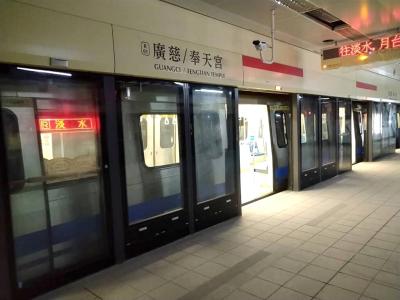
The New Taipei Metro's Sanyin Line and the eastern extension of the Taipei Metro's Tamsui-Xinyi Line (Red Line) are scheduled to begin operations in June, the National Development Council said today. The Red Line, which terminates at Xiangshan Station, would be connected by the 1.4km extension to a new eastern terminal, Guangci/Fengtian Temple Station, while the Sanyin Line would link New Taipei City's Tucheng and Yingge stations via Sanxia District (三峽). The council gave the updates at a council meeting reviewing progress on public construction projects for this year. Taiwan's annual public infrastructure budget would remain at NT$800 billion (US$25.08 billion), with NT$97.3
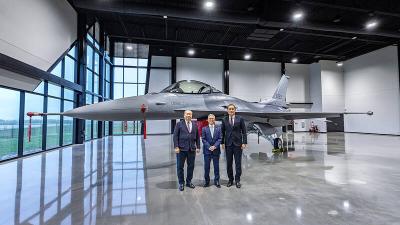
Deliveries of delayed F-16V jets are expected to begin in September, Minister of National Defense Wellington Koo (顧立雄) said today, after senior defense officials visited the US last week. The US in 2019 approved a US$8 billion sale of Lockheed Martin F-16 jets to Taiwan, a deal that would take the nation’s F-16 fleet to more than 200 jets, but the project has been hit by issues including software problems. Koo appeared today before a meeting of the legislature’s Foreign Affairs and National Defense Committee, which is discussing different versions of the special defense budget this week. The committee is questioning officials today,


 RSS
RSS