


Legislators across party lines yesterday commented on premier-designate William Lai (賴清德) ahead of his swearing-in today, suggesting issues that Lai should focus and publicly speculating about the chemistry between Lai and President Tsai Ing-wen (蔡英文).
Chinese Nationalist Party (KMT) caucus secretary-general Lin Wei-chou (林為洲) said the legislators were prepared to grant Lai a brief “honeymoon period” to familiarize himself with the job.
Provided no large issues — or power blackouts — occur between now and Lai’ s expected report to the Legislative Yuan on Sept. 22 to open its second session, the KMT would not attempt to block motions at the legislature, Lin said.
The KMT caucus is to meet with Lai next week and express its concerns about the “one fixed day-off and one flexible rest day” policy, energy policies and other matters, Lin said.
KMT caucus vice secretary-general Lee Yan-hsiu (李彥秀) also commented on the potential for conflict between Tsai and Lai, saying that Lai had his own mind and would not accept the role of executor of Tsai’s policy, as former premier Lin Chuan (林全) had.
Time would tell how the Democratic Progressive Party’s (DPP) “two suns” would work together, she said.
Now that Lai is the head of the executive branch, the KMT caucus would necessarily have to test Lai’s stance on cross-strait relations and foreign diplomacy, Lee said, adding: “We shall see if the new premier will stick to his stance that he ‘feels an affinity toward China while loving Taiwan’ or revert back to supporting Taiwan independence.”
Lai made the comment about China during an interview in July, adding that his stance on cross-strait relations is clear.
He was in favor of “Taiwanese independence and that stance will not change, no matter what position I hold,” Lai said in the interview.
Meanwhile, Deputy Legislative Speaker Tsai Chi-chang (蔡其昌) said interaction between Tsai Ing-wen and Lai was not as stiff as it is rumored, adding that the two simply had different personalities.
President Tsai has a softer personality and likes to make jokes, which contrasts with Lai’s seriousness, Tsai Chi-chang said.
However he said he was certain that Lai would stand “100 percent” behind Tsai Ing-wen and her policies, despite their different characters.
Responding to radio host Clara Chou (周玉蔻), who asked whether Lai’s “unyielding personality” would create communication problems with Tsai Ing-wen, Tsai Chi-chang used his interaction with his wife as a metaphor for what he believed interactions between the president and the new premier would be.
When he had a difference of opinion with his wife, he would state his reasoning on the subject, but would in the end concede to his wife, he said.

SECURITY: Starlink owner Elon Musk has taken pro-Beijing positions, and allowing pro-China companies to control Taiwan’s critical infrastructure is risky, a legislator said Starlink was reluctant to offer services in Taiwan because of the nation’s extremely high penetration rates in 4G and 5G services, the Ministry of Digital Affairs said yesterday. The ministry made the comments at a meeting of the legislature’s Transportation Committee, which reviewed amendments to Article 36 of the Telecommunications Management Act (電信管理法). Article 36 bans foreigners from holding more than 49 percent of shares in public telecommunications networks, while shares foreigners directly and indirectly hold are also capped at 60 percent of the total, unless specified otherwise by law. The amendments, sponsored by Chinese Nationalist Party (KMT) Legislator Ko
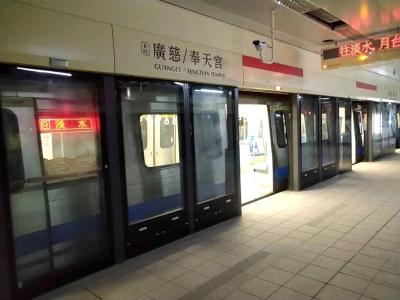
The eastern extension of the Taipei MRT Red Line could begin operations as early as late June, the Taipei Department of Rapid Transit Systems said yesterday. Taipei Rapid Transit Corp said it is considering offering one month of free rides on the new section to mark its opening. Construction progress on the 1.4km extension, which is to run from the current terminal Xiangshan Station to a new eastern terminal, Guangci/Fengtian Temple Station, was 90.6 percent complete by the end of last month, the department said in a report to the Taipei City Council's Transportation Committee. While construction began in October 2016 with an
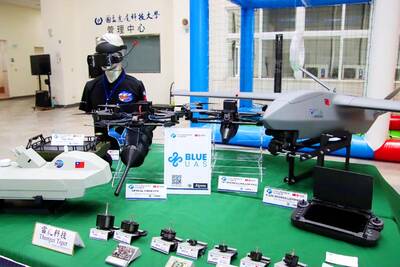
NON-RED SUPPLY: Boosting the nation’s drone industry is becoming increasingly urgent as China’s UAV dominance could become an issue in a crisis, an analyst said Taiwan’s drone exports to Europe grew 41.7-fold from 2024 to last year, with demand from Ukraine’s fight against Russian aggression the most likely driver of growth, a study showed. The Institute for Democracy, Society and Emerging Technology (DSET) in a statement on Wednesday said it found that many of Taiwan’s uncrewed aerial vehicle (UAV) sales were from Poland and the Czech Republic. These countries likely transferred the drones to Ukraine to aid it in its fight against the Russian invasion that started in 2022, it said. Despite the gains, Taiwan is not the dominant drone exporter to these markets, ranking second and fourth

Japanese Prime Minister Sanae Takaichi’s comment last year on Tokyo’s potential reaction to a Taiwan-China conflict has forced Beijing to rewrite its invasion plans, a retired Japanese general said. Takaichi told the Diet on Nov. 7 last year that a Chinese naval blockade or military attack on Taiwan could constitute a “survival-threatening situation” for Japan, potentially allowing Tokyo to exercise its right to collective self-defense. Former Japan Ground Self-Defense Force general Kiyofumi Ogawa said in a recent speech that the remark has been interpreted as meaning Japan could intervene in the early stages of a Taiwan Strait conflict, undermining China’s previous assumptions


 RSS
RSS