


Following mounting pressure from the party’s base, a faction of Chinese Nationalist Party (KMT) lawmakers favoring confrontation on the Forward-looking Infrastructure Development Program have prevailed over those who favor compromise, sources within the KMT said.
As a result, it is increasingly likely that conflict in the Legislative Yuan will intensify in the coming days, after negotiations about the program broke down on Friday, they said.
During internal discussions, KMT Legislator Lai Shyh-bao (賴士葆) proposed to engage in a hunger strike — a motion that was seconded by KMT Legislator William Tseng (曾銘宗), the sources said.
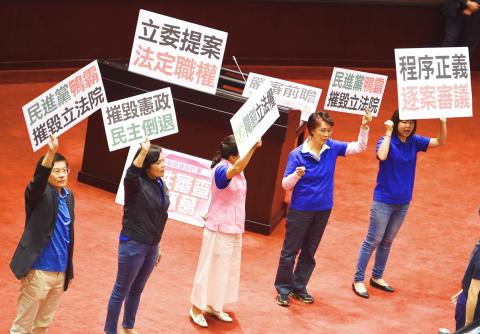
Photo: Liu Hsin-de, Taipei Times
After the legislature on July 5 passed the Act on the Forward-looking Infrastructure Development Program (前瞻基礎建設特別條例) during the legislature’s first provisional session, KMT supporters expressed their anger and disappointment with the KMT caucus’ 34 lawmakers by flooding their social media accounts, they said.
The KMT’s new hardline stance in response to calls from its voter base was discernible by the legislature’s second extraordinary legislative session, which began on July 13.
During the second session, KMT lawmakers physically blocked Premier Lin Chuan (林全) from assuming the rostrum to address the assembly and hurled water balloons at DPP lawmakers and officials.
The third extraordinary legislative session, which began on Friday, saw the KMT filing of more than 10,000 motions — later reduced to 1,200 — that would remove items from the infrastructure program’s budget, which KMT lawmakers said should be cut by NT$33 billion (US$1.09 billion).
KMT caucus secretary-general Lin Wei-chou (林為洲) yesterday acknowledged that the party has “hawks and doves,” but said they are in constant dialogue to coordinate their strategy.
The caucus had voted on how to proceed, Lin said.
“The KMT caucus has shown its willingness to talk, but the DPP caucus has made clear it will cut no more than 10 percent from the budget, causing negotiations to break down last week,” Lin said.
The KMT reducing its motions to 1,200 has shown the party’s goodwill, he added.
The DPP is to blame, because it refused to cut the infrastructure budget by NT$33 billion and has attempted to dismiss KMT motions by arguing that no second vote should be held on the same issue, Lin said.
“Throwing out the motions of our caucus is absolutely unacceptable to us,” he said.
KMT Legislator Alex Fei (費鴻泰) is one of the leading hawks of the party.
In a closed-door meeting last week, Fei called for confrontation with a table-slamming denunciation of the DPP, according to KMT sources who asked for anonymity.
Lai floated the idea of a hunger strike in the same meeting, while KMT Legislator Apollo Chen (陳學聖) proposed that the KMT boycott the upcoming general budget review, they said.
When asked for comments, Tseng said: “The DPP caucus had better not think it can walk over the KMT. I promise there is going to be a lot of opposition. We will sue Legislative Speaker Su Jia-chyuan (蘇嘉全); we are going to launch hunger strikes; we are going to storm the rostrum and call international press events. The ruling party can forget about passing the operating budgets or the second-phase budget for the infrastructure program.”
“President Tsai Ing-wen’s (蔡英文) approval rating is in the doldrums and most of the public thinks the infrastructure budget is bunk,” he added.
DPP caucus secretary-general Lee Chun-yi (李俊俋) reiterated the DPP’s position that the legislature should not deal with motions by the KMT caucus.
Lee cited Constitutional Interpretation No. 391 as supporting the DPP’s argument that no second vote should be held on the same issue.
“The law is clear. Budget bills are not in the same class as amendment bills and they cannot be reamended like amendment bills. Budget bills are deliberated according to the rules of procedure and in the sequence they are filed. The budget bill is a number. If you said yes, it is a done deal,” Lee said.
Lee said the KMT’s insistence on doing things its way contradicted its claims that it is willing to negotiate.
“It is the KMT that pulled the plug on the negotiations last week, not the DPP,” he said.
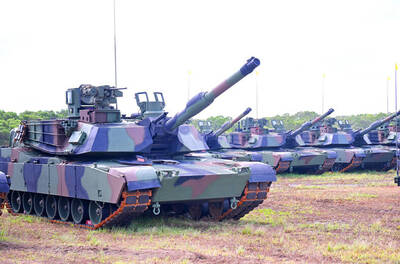
The manufacture of the remaining 28 M1A2T Abrams tanks Taiwan purchased from the US has recently been completed, and they are expected to be delivered within the next one to two months, a source said yesterday. The Ministry of National Defense is arranging cargo ships to transport the tanks to Taiwan as soon as possible, said the source, who is familiar with the matter. The estimated arrival time ranges from late this month to early next month, the source said. The 28 Abrams tanks make up the third and final batch of a total of 108 tanks, valued at about NT$40.5 billion

A group from the Taiwanese Designers in Australia association yesterday represented Taiwan at the Midsumma Pride March in Melbourne. The march, held in the St. Kilda suburb, is the city’s largest LGBTQIA+ parade and the flagship event of the annual Midsumma Festival. It attracted more than 45,000 spectators who supported the 400 groups and 10,000 marchers that participated this year, the association said. Taiwanese Designers said they organized a team to march for Taiwan this year, joining politicians, government agencies, professionals and community organizations in showing support for LGBTQIA+ people and diverse communities. As the first country in Asia to legalize same-sex
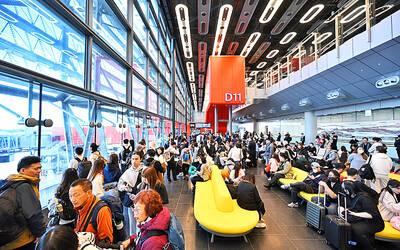
Travel agencies in Taiwan are working to secure alternative flights for travelers bound for New Zealand for the Lunar New Year holiday, as Air New Zealand workers are set to strike next week. The airline said that it has confirmed that the planned industrial action by its international wide-body cabin crew would go ahead on Thursday and Friday next week. While the Auckland-based carrier pledged to take reasonable measures to mitigate the impact of the workers’ strike, an Air New Zealand flight arriving at Taipei from Auckland on Thursday and another flight departing from Taipei for Auckland on Saturday would have to
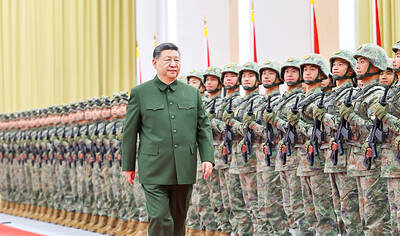
MOTIVES QUESTIONED The PLA considers Xi’s policies toward Taiwan to be driven by personal considerations rather than military assessment, the Epoch Times reports Chinese President Xi Jinping’s (習近平) latest purge of the Chinese People’s Liberation Army (PLA) leadership might have been prompted by the military’s opposition to plans of invading Taiwan, the Epoch Times said. The Chinese military opposes waging war against Taiwan by a large consensus, putting it at odds with Xi’s vision, the Falun Gong-affiliated daily said in a report on Thursday, citing anonymous sources with insight into the PLA’s inner workings. The opposition is not the opinion of a few generals, but a widely shared view among the PLA cadre, the Epoch Times cited them as saying. “Chinese forces know full well that


 RSS
RSS