


The National Freeway Bureau is scheduled to brief the Executive Yuan next month about its “freeway green corridor” project, which is proposed in part to honor film director Chi Po-lin (齊柏林), who drew attention to environmental problems in his documentary Beyond Beauty: Taiwan from Above (看見台灣).
The presentation would cover the problems identified in the documentary and explain how the bureau plans to incorporate environmental protection into its planning for freeway construction, the bureau said.
Taiwan has a complicated and fragile environment, but it does not mean that no construction can be done under such circumstances, Minister of Transportation and Communications Hochen Tan (賀陳旦) said.
“Construction projects should be undertaken after we learn about the environment and try to handle it with extra caution, particularly in choosing appropriate freeway routes and in maintaining freeways,” he said.
“The project would not only be a plan to balance freeway construction with the issues of drainage, agriculture and preservation of the ecosystem. It would also be done in remembrance of Mr Chi, who saw both the wonders and sadness of Taiwan from a higher ground,” Hochen added.
The nation’s development was moving in the east-west axis before freeways were built, the direction in which the nation’s rivers flow and its animals move, bureau Director-General Chao Hsin-hua (趙興華) said.
The freeways and railways were built along the north-south axis, which had to cut through animals’ habitats, he said.
The project would find a way for freeways and the ecosystem to coexist, Chao said.
The bureau has built many eco-passages along the Formosa Freeway (Freeway No. 3) because leopard cats and other animals would encroach on roads along the route, Chao said.
However, the freeway section in Yunlin County would be closed if there is a surge in the number of milkweed butterflies, which fly above the traffic with the safety nets installed along the road, Chao added.
Chi has detailed records about the construction on Freeway No. 3, in which he used aerial photographs to show how the environment was affected by the construction, Chao said.
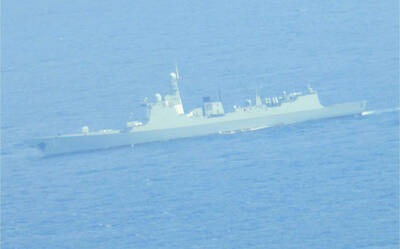
The military has spotted two Chinese warships operating in waters near Penghu County in the Taiwan Strait and sent its own naval and air forces to monitor the vessels, the Ministry of National Defense (MND) said. Beijing sends warships and warplanes into the waters and skies around Taiwan on an almost daily basis, drawing condemnation from Taipei. While the ministry offers daily updates on the locations of Chinese military aircraft, it only rarely gives details of where Chinese warships are operating, generally only when it detects aircraft carriers, as happened last week. A Chinese destroyer and a frigate entered waters to the southwest
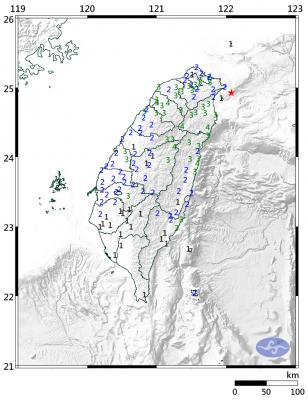
A magnitude 6.1 earthquake struck off the coast of Yilan County at 8:39pm tonight, the Central Weather Administration (CWA) said, with no immediate reports of damage or injuries. The epicenter was 38.7km east-northeast of Yilan County Hall at a focal depth of 98.3km, the CWA’s Seismological Center said. The quake’s maximum intensity, which gauges the actual physical effect of a seismic event, was a level 4 on Taiwan’s 7-tier intensity scale, the center said. That intensity level was recorded in Yilan County’s Nanao Township (南澳), Hsinchu County’s Guansi Township (關西), Nantou County’s Hehuanshan (合歡山) and Hualien County’s Yanliao (鹽寮). An intensity of 3 was

Japanese Prime Minister Sanae Takaichi’s comment last year on Tokyo’s potential reaction to a Taiwan-China conflict has forced Beijing to rewrite its invasion plans, a retired Japanese general said. Takaichi told the Diet on Nov. 7 last year that a Chinese naval blockade or military attack on Taiwan could constitute a “survival-threatening situation” for Japan, potentially allowing Tokyo to exercise its right to collective self-defense. Former Japan Ground Self-Defense Force general Kiyofumi Ogawa said in a recent speech that the remark has been interpreted as meaning Japan could intervene in the early stages of a Taiwan Strait conflict, undermining China’s previous assumptions
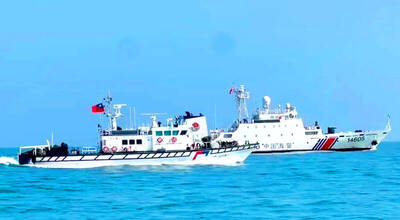
Instead of focusing solely on the threat of a full-scale military invasion, the US and its allies must prepare for a potential Chinese “quarantine” of Taiwan enforced through customs inspections, Stanford University Hoover fellow Eyck Freymann said in a Foreign Affairs article published on Wednesday. China could use various “gray zone” tactics in “reconfiguring the regional and ultimately the global economic order without a war,” said Freymann, who is also a nonresident research fellow at the US Naval War College. China might seize control of Taiwan’s links to the outside world by requiring all flights and ships entering or leaving Taiwan


 RSS
RSS