


The Democratic Progressive Party (DPP) has promoted an agricultural apprenticeship program in Taichung to finance young people to join and rejuvenate the nation’s aging agricultural labor forces.
The Taichung City Government apprenticeship program has recruited about 100 young people to apprentice with seasoned farmers, with the city government paying each apprentice NT$30,000 per month for a year, Taichung Mayor Lin Chia-lung (林佳龍) said yesterday, adding that the program would help attract more young people to the nation’s aging agricultural sector.
Lin reported on the initiative at a DPP Central Executive Committee meeting, introducing some of the apprentices and farmers in the program.

Photo: Fang Pin-chao, Taipei Times
The apprenticeship program, in a bid to train 30,000 new farmers in 10 years, was introduced in 2015 to connect experienced farmers with aspiring new farmers, Lin said.
About 90 percent of apprentices have continued farming after their one-year apprenticeship ended, he added.
President Tsai Ing-wen (蔡英文) praised the program for passing farming methods from generation to generation.
“What experienced farmers teach is not simply farming methods. Their social connection and experiences outside of farms are more important assets,” Tsai said.
She asked officials of DPP-ruled cities and counties to propose new policies to develop local agriculture, while instructing the Council of Agriculture to support local governments that are underfinanced.
Ku Ming-hung (古明弘), a former apprentice of the program, said many people view agriculture as a declining business, adding that his parents opposed his decision to take up farming, as there were more financially rewarding options.
The program, which offers stable monthly salaries and new marketing strategies to improve the public perception of farmers, has helped turn around people’s preconceptions of farming, Ku said.
Separately, the DPP said it is to hold three forums starting today on occupational education to encourage a dialogue on reforming the nation’s vocational education system.
DPP deputy secretary-general Hsu Chia-ching (徐佳青) said the nation’s education has overemphasized higher education over the past 20 years, but vocational education, which has trained middle-rank workers who are the backbone of the economy, is in decline, with new graduates lacking practical skills.
“Businesses are in urgent need of [skilled] workers, and it is necessary to integrate hands-on learning and creativity in the educational environment,” Hsu said.
The first forum, at National Cheng Kung University in Tainan, is to feature Deputy Minister of Education Yao Leeh-ter (姚立德), vocational education advocacy group director Huang Wei-hsiang (黃偉翔), businesspeople and educators to discuss measures to reform occupational education to narrow the distance between the classroom and the real work environment.
The forum is in its second year and is in line with the DPP’s objectives to reform the education system and promote vocational training, the party said.

AGING: While Japan has 22 submarines, Taiwan only operates four, two of which were commissioned by the US in 1945 and 1946, and transferred to Taiwan in 1973 Taiwan would need at least 12 submarines to reach modern fleet capabilities, CSBC Corp, Taiwan chairman Chen Cheng-hung (陳政宏) said in an interview broadcast on Friday, citing a US assessment. CSBC is testing the nation’s first indigenous defense submarine, the Hai Kun (海鯤, Narwhal), which is scheduled to be delivered to the navy next month or in July. The Hai Kun has completed torpedo-firing tests and is scheduled to undergo overnight sea trials, Chen said on an SET TV military affairs program. Taiwan would require at least 12 submarines to establish a modern submarine force after assessing the nation’s operational environment and defense

A white king snake that frightened passengers and caused a stir on a Taipei MRT train on Friday evening has been claimed by its owner, who would be fined, Taipei Rapid Transit Corp (TRTC) said yesterday. A person on Threads posted that he thought he was lucky to find an empty row of seats on Friday after boarding a train on the Bannan (Blue) Line, only to spot a white snake with black stripes after sitting down. Startled, he jumped up, he wrote, describing the encounter as “terrifying.” “Taipei’s rat control plan: Release snakes on the metro,” one person wrote in reply, referring
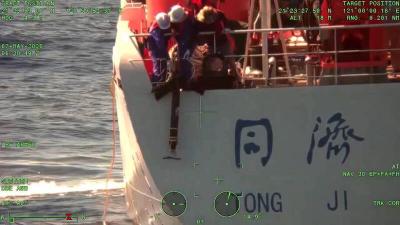
The coast guard today said that it had disrupted "illegal" operations by a Chinese research ship in waters close to the nation and driven it away, part of what Taipei sees a provocative pattern of China's stepped up maritime activities. The coast guard said that it on Thursday last week detected the Chinese ship Tongji (同濟號), which was commissioned only last year, 29 nautical miles (54km) southeast of the southern tip of Taiwan, although just outside restricted waters. The ship was observed lowering ropes into the water, suspected to be the deployment of scientific instruments for "illegal" survey operations, and the coast
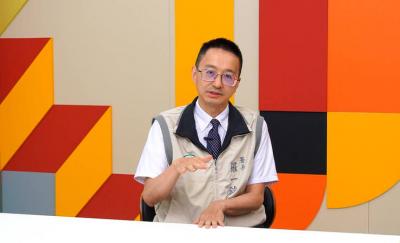
Taiwan’s two cases of hantavirus so far this year are on par with previous years’ case numbers, and the government is coordinating rat extermination work, so there should not be any outbreaks, Centers for Disease Control (CDC) Director-General Philip Lo (羅一鈞) said today in an interview with the Liberty Times (the Taipei Times’ sister newspaper). An increase in rat sightings in Taipei and New Taipei City has raised concerns about the spread of hantavirus, as rats can carry the disease. In January, a man in his 70s who lived in Taipei’s Daan District (大安) tested positive posthumously for hantavirus, Taiwan’s


 RSS
RSS