


Regulations allow exploitative overtime hours to be imposed on transportation workers, labor groups said yesterday in a protest outside the Ministry of Transportation and Communications building in Taipei on the one-year anniversary of the China Airlines strike.
More than 100 members of several transportation unions shouted slogans and threw balloons filled with red water at the ministry’s doors to symbolize the “blood and sweat” they say ministry rules force them to give to their employers.
“Last year, we fought for the right to rest and we are still fighting today, because the government’s and China Airlines’ promises of reform have fallen through,” Taoyuan Flight Attendants’ Union director Lin Hsin-yi (林馨怡) said.
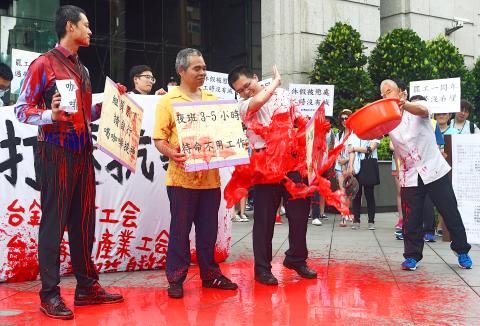
Photo: Chien Jung-fong, Taipei Times
Union board director Chu Liang-chun (朱良駿) cited a decision by China Airlines to cut employees’ rest time between transoceanic flights, along with rumors that the Civil Aeronautics Administration is considering reducing the ratio of flight attendants to passengers.
“The law should be a minimum standard that you are allowed to occasionally cross,” he said, adding that while the cuts had sometimes led to illegally short rest time, China Airlines’ proactive reporting of violations had spared it from being fined.
Union president Chao Kang (趙剛) also criticized the ministry for sending a request to the Ministry of Labor asking it to tighten notification requirements for strikes.
“It wants us to be required to report the date, duration and number of people involved in any strike beforehand to enable corporations to take responsive measures,” he said. “We can already only strike after winning approval in a formal union vote — is that not a clear enough notification?”
After winning approval in an open vote, the unions last year called a snap strike earlier than expected on the same day that China Airlines’ leadership was replaced, swiftly extracting salary concessions in the subsequent chaos.
“Since last year’s strike, the problem of overwork in the transportation sector has gotten worse,” Taiwan Railways Union president Wang Jieh (王傑) said, citing attempts by the Taiwan Railways Administration to discipline union members for taking a “legal holiday” without permission during the Lunar New Year.
Administration officials have continued to refuse to hold talks with the union on changing the rotating shift system, under which employees work long overtime hours in lieu of standard weekly days off, he said.
Taipei Rapid Transit Corp has progressively reduced the rest-to-work time allotted to employees during long shifts, Metro Train Drivers’ Union president Chen Chung-wei (陳崇瑋) said, also criticizing the firm’s definition of “rest” as including time employees are required to be on standby.
Taiwan Motor Transport Industrial Union director Chang Li-tsung (張立宗) criticized bus firms for only paying drivers for time behind the wheel and denying overtime pay through the use of “flexible working hours.”
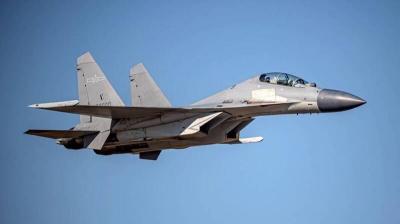
Eight Chinese naval vessels and 24 military aircraft were detected crossing the median line of the Taiwan Strait between 6am yesterday and 6am today, the Ministry of National Defense said this morning. The aircraft entered Taiwan’s northern, central, southwestern and eastern air defense identification zones, the ministry said. The armed forces responded with mission aircraft, naval vessels and shore-based missile systems to closely monitor the situation, it added. Eight naval vessels, one official ship and 36 aircraft sorties were spotted in total, the ministry said.
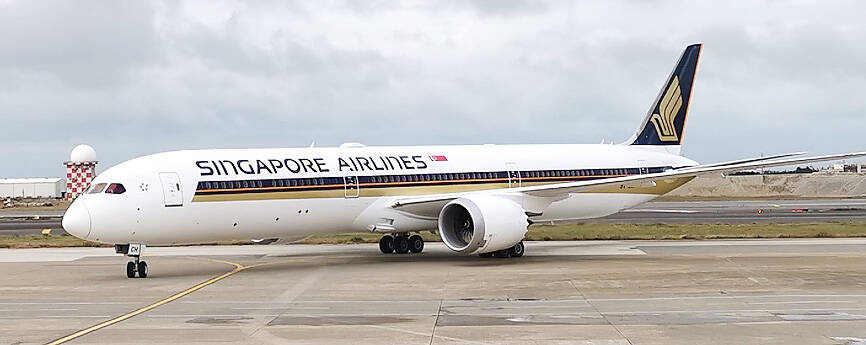
INCREASED CAPACITY: The flights on Mondays, Wednesdays, Fridays and Sundays would leave Singapore in the morning and Taipei in the afternoon Singapore Airlines is adding four supplementary flights to Taipei per week until May to meet increased tourist and business travel demand, the carrier said on Friday. The addition would raise the number of weekly flights it operates to Taipei to 18, Singapore Airlines Taiwan general manager Timothy Ouyang (歐陽漢源) said. The airline has recorded a steady rise in tourist and business travel to and from Taipei, and aims to provide more flexible travel arrangements for passengers, said Ouyang, who assumed the post in July last year. From now until Saturday next week, four additional flights would depart from Singapore on Monday, Wednesday, Friday
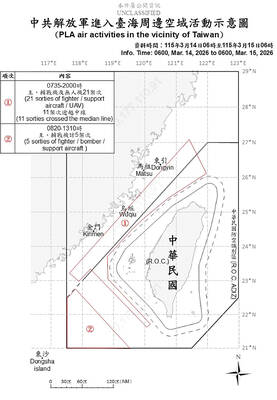
The Ministry of National Defense yesterday reported the return of large-scale Chinese air force activities after their unexplained absence for more than two weeks, which had prompted speculation regarding Beijing’s motives. China usually sends fighter jets, drones and other military aircraft around the nation on a daily basis. Interruptions to such routine are generally caused by bad weather. The Ministry of National Defense said it had detected 26 Chinese military aircraft in the Taiwan Strait over the previous 24 hours. It last reported that many aircraft on Feb. 25, when it spotted 30 aircraft, saying Beijing was carrying out another “joint combat

Taiwan successfully defended its women’s 540 kilogram title and won its first-ever men’s 640 kg title at the 2026 World Indoor Tug of War Championships in Taipei yesterday. In the women’s event, Taiwan’s eight-person squad reached the final following a round-robin preliminary round and semifinals featuring teams from Ukraine, Japan, Thailand, Vietnam, the Basque Country and South Korea. In the finals, they swept the Basque team 2-0, giving the team composed mainly of National Taiwan Normal University students and graduates its second championship in a row, and its fourth in five years. Team captain


 RSS
RSS