


Taiwan’s first domestically designed satellite, Formosat-5, is scheduled for launch in late August, according to sources.
It is believed that Elon Musk’s Space Exploration Technologies Corp (SpaceX), the company contracted to launch it, will soon send official confirmation of the launch date to Taiwan, sources said.
The satellite cost about NT$3.7 billion (US$121.71 million) to make and is to embark on a five-year observation mission around Earth.

Photo courtesy of the National Space Organization
The satellite’s launch was initially scheduled for May 2015, but has been repeatedly delayed.
The satellite missed its latest launch date, in October last year, one month after a SpaceX rocket for an Israeli satellite exploded during a static test-fire, temporarily halting all launches.
After lifting the halt on missions this year, SpaceX informed the National Applied Research Laboratories (NARL) that Formosat-5 would launch in late August, and Taiwan should begin preparations, a source familiar with the project said.
Personnel involved in the project are under orders to clear their schedules for that period, the source added.
Taiwan is expecting to receive SpaceX’s confirmation for the launch date imminently because according to SpaceX’s schedule, Formosat-5 must be shipped to the US at least 40 days prior to its lift-off, another source said.
When asked for comment, NARL refused to confirm or deny the launch date, but said it will inform the public via the proper channels once it receives official notification from SpaceX.
The satellite is second on SpaceX’s launch schedule from Vandenberg Air Force Base in California, after its launch later this month of Iridium NEXT satellites for Iridium Communications Inc.
Under the terms of its contract, SpaceX is allowed a six-month grace period for delays, after which it is obliged to pay 1.25 percent of the contract for each month of delays up to a maximum of eight months.
SpaceX’s six-month grace period finished in August last year.
National Space Organization Deputy Director-General Yu Shiann-jen (余憲政) said the agency is focused on launching Formosat-5 as soon as possible, and would address the issue of compensation at a later time.
The Falcon 9 rocket that is to deliver the Formosat-5 into orbit will have “Taiwan” printed on its side along with the names of governmental organizations and other groups involved in its launch, he said.
A painting submitted by a student at New Taipei City’s Chengong Elementary School, Chu Chia-yi (朱嘉尹), that features the Formosan blue magpie and Taipei 101 is also to be painted on Falcon 9 prior to the launch, Yu added.
After entering orbit, Formosat-5 is to pass over Taiwan once every two days, and the data it obtains will be invaluable for scientific research, disaster prevention and relief, national security, environmental monitoring and international technological exchanges, he said.
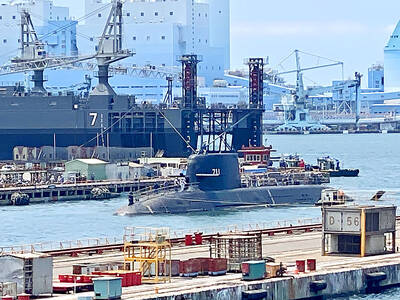
AGING: While Japan has 22 submarines, Taiwan only operates four, two of which were commissioned by the US in 1945 and 1946, and transferred to Taiwan in 1973 Taiwan would need at least 12 submarines to reach modern fleet capabilities, CSBC Corp, Taiwan chairman Chen Cheng-hung (陳政宏) said in an interview broadcast on Friday, citing a US assessment. CSBC is testing the nation’s first indigenous defense submarine, the Hai Kun (海鯤, Narwhal), which is scheduled to be delivered to the navy next month or in July. The Hai Kun has completed torpedo-firing tests and is scheduled to undergo overnight sea trials, Chen said on an SET TV military affairs program. Taiwan would require at least 12 submarines to establish a modern submarine force after assessing the nation’s operational environment and defense

A white king snake that frightened passengers and caused a stir on a Taipei MRT train on Friday evening has been claimed by its owner, who would be fined, Taipei Rapid Transit Corp (TRTC) said yesterday. A person on Threads posted that he thought he was lucky to find an empty row of seats on Friday after boarding a train on the Bannan (Blue) Line, only to spot a white snake with black stripes after sitting down. Startled, he jumped up, he wrote, describing the encounter as “terrifying.” “Taipei’s rat control plan: Release snakes on the metro,” one person wrote in reply, referring
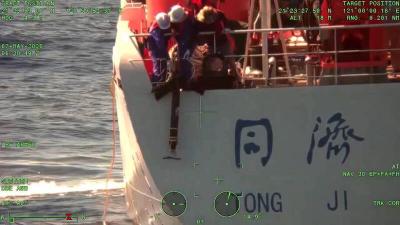
The coast guard today said that it had disrupted "illegal" operations by a Chinese research ship in waters close to the nation and driven it away, part of what Taipei sees a provocative pattern of China's stepped up maritime activities. The coast guard said that it on Thursday last week detected the Chinese ship Tongji (同濟號), which was commissioned only last year, 29 nautical miles (54km) southeast of the southern tip of Taiwan, although just outside restricted waters. The ship was observed lowering ropes into the water, suspected to be the deployment of scientific instruments for "illegal" survey operations, and the coast

Taiwan’s two cases of hantavirus so far this year are on par with previous years’ case numbers, and the government is coordinating rat extermination work, so there should not be any outbreaks, Centers for Disease Control (CDC) Director-General Philip Lo (羅一鈞) said today in an interview with the Liberty Times (the Taipei Times’ sister newspaper). An increase in rat sightings in Taipei and New Taipei City has raised concerns about the spread of hantavirus, as rats can carry the disease. In January, a man in his 70s who lived in Taipei’s Daan District (大安) tested positive posthumously for hantavirus, Taiwan’s


 RSS
RSS