


With 150 million users worldwide, photograph editing app PicCollage is a global best-seller whose success has surprised its Taiwan-based developer Cardinal Blue Software.
The app is used by 50 million people in the US, 80 percent of whom are women, John Fan (樊立勳), the Taiwanese-American cofounder of Cardinal Blue Software, said on Tuesday last week.
Downloads of the app spike over holidays such as Mother’s Day, when people use it to create personalized collages to send their best wishes to friends or family, Fan said.
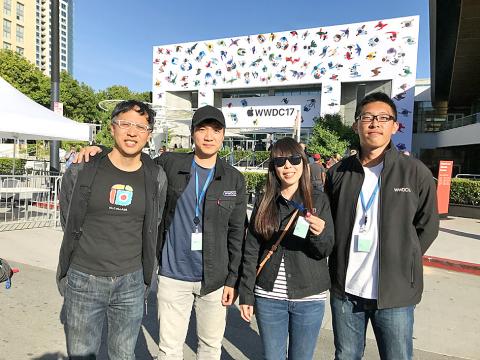
Photo: Chen Ping-hung, Taipei Times
On such holidays, it is not unusual for PicCollage to become the fourth-most popular app download worldwide after YouTube, Instagram and Snapchat, he said.
One in three US women uses the app, and one in six Americans has PicCollage on at least one of their devices, Fan said.
A team at the firm developed the app with the 9.7-inch iPad in mind, because members thought its monitor was well-suited for photograph-editing and one member enjoyed the activity, he said.
The initial version of the app was a simple affair that took only one month to make, he said, adding that the team made a test version available online, hoping it would garner 100 downloads.
The team was stunned when there were 3,000 downloads of the app on the first day and 400,000 in the first month, putting the app among the top-10 most popular downloads of the period in the UK, the US, Canada and Mexico.
The first iteration of the app did not allow users to add text or make collages, but it was stable and easy to use, Fan said.
PicCollage is continuously improved to keep it popular with new users and an update adding extra editing tools is introduced every week, or 50 updates per year, he said.
Since then, the number of users has increased by an average of 50 million every two years, he said.
“PicCollage now has 150 million users because we have constantly added new functions while keeping it easy to use,” he said.
The app’s success has spawned many imitators, including copyright violators who copied PicCollage’s function names and icons, Fan said.
The firm encourages users to report such behavior, but it is not too disturbed by such activities because copycats “cannot copy the essence of our company’s innovation,” he said.
PicCollage’s main purpose is to provide users with the tools to create personalized and meaningful images for their friends and family and since everyone has friends and family, the demand for the app will always remain, he said.
Apple Inc has launched Core ML, a machine-learning app, but PicCollage already began testing a similar concept with the “magic” mode of its Android version, Fan said.
The mode enables a machine-learning program that automatically selects a user’s photographs for color adjustment and editing, encouraging users’ creativity by making collages easier to make, he said.
The development team has been encouraged by meaningful uses of the app, such as an animal shelter that uses PicCollage to advertise animals that are open for adoption, he said.
The team also received a thank-you note after Valentine’s Day from a grateful user, who said his girlfriend was pleased by a collage he had made, Fan said.
“The team is very happy when things like that happen; we feel that making an app that brings people together and contributes to good causes is a meaningful pursuit,” he said.

Kenting National Park service technician Yang Jien-fon (楊政峰) won a silver award in World Grand Prix Photography Awards Spring Season for his photograph of two male rat snakes intertwined in combat. Yang’s colleagues at Kenting National Park said he is a master of nature photography who has been held back by his job in civil service. The awards accept entries in all four seasons across six categories: architectural and urban photography, black-and-white and fine art photography, commercial and fashion photography, documentary and people photography, nature and experimental photography, and mobile photography. Awards are ranked according to scores and divided into platinum, gold and

More than half of the bamboo vipers captured in Tainan in the past few years were found in the city’s Sinhua District (新化), while other districts had smaller catches or none at all. Every year, Tainan captures about 6,000 snakes which have made their way into people’s homes. Of the six major venomous snakes in Taiwan, the cobra, the many-banded krait, the brown-spotted pit viper and the bamboo viper are the most frequently captured. The high concentration of bamboo vipers captured in Sinhua District is puzzling. Tainan Agriculture Bureau Forestry and Nature Conservation Division head Chu Chien-ming (朱健明) earlier this week said that the

The Chinese Nationalist Party (KMT) caucus yesterday said it opposes the introduction of migrant workers from India until a mechanism is in place to prevent workers from absconding. Minister of Labor Hung Sun-han (洪申翰) on Thursday told the Legislative Yuan that the first group of migrant workers from India could be introduced as early as this year, as part of a government program. The caucus’ opposition to the policy is based on the assessment that “the risk is too high,” KMT caucus secretary-general Lin Pei-hsiang (林沛祥) said. Taiwan has a serious and long-standing problem of migrant workers absconding from their contracts, indicating that

SPACE VETERAN: Kjell N. Lindgren, who helps lead NASA’s human spaceflight missions, has been on two expeditions on the ISS and has spent 311 days in space Taiwan-born US astronaut Kjell N. Lindgren is to visit Taiwan to promote technological partnerships through one of the programs organized by the US for its 250th national anniversary. Lindgren would be in Taiwan from Tuesday to Saturday next week as part of the US Bureau of Educational and Cultural Affairs’ US Speaker Program, organized to celebrate the 250th anniversary of the signing of the Declaration of Independence, the American Institute in Taiwan (AIT) said in a statement yesterday. Lindgren plans to engage with key leaders across the nation “to advance cutting-edge technological partnerships and inspire the next generation of scientists and engineers,”


 RSS
RSS