


In the first quarter of the year, the nation’s average Internet connection speed was 16.9 megabits per second (Mbps), the 16th-fastest in the world and fifth-fastest in the Asia-Pacific region, a quarterly report on global Internet speeds said.
The figure represents a 7.9 percent increase from the 15.6Mbps recorded in the fourth quarter of last year, according to content delivery network Akamai’s State of the Internet report, published on May 31.
South Korea remained at the top of the rankings with an average connection speed of 28.6Mbps, followed by Norway (23.5Mbps), Sweden (22.5Mbps), Hong Kong (21.9Mbps) and Switzerland (21.7Mbps).
After these in the rankings came Finland with an average speed of 20.5Mbps, then Singapore, Japan, Denmark and the US.
The report compiled by Akamai Intelligent Platform included data on average connection speeds, average peak connection speeds, broadband adoption rates and mobile connectivity, the company said.
It showed that in the first quarter, the global average connection speed rose 15 percent year-on-year to 7.2Mbps.
“Increases in connection speeds and broadband penetration have helped enable the Internet to support levels of traffic that even just a few years ago would have been unimaginable,” report editor David Belson said.
In terms of average peak connection speeds, Taiwan ranked 13th in the world with 94.7Mbps, a figure that represents a 14 percent surge from the same period last year.
The top five in that category were Singapore (184.5Mbps), Macao (132.0Mbps), Mongolia (131.1Mbps), Hong Kong (129.5Mbps) and South Korea (121.0Mbps).
They were followed by Jersey in the Channel Islands (108.4Mbps), and Qatar, Thailand, Israel and Sweden (95.3Mbps).
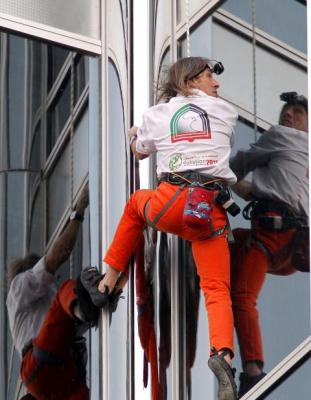
Alain Robert, known as the "French Spider-Man," praised Alex Honnold as exceptionally well-prepared after the US climber completed a free solo ascent of Taipei 101 yesterday. Robert said Honnold's ascent of the 508m-tall skyscraper in just more than one-and-a-half hours without using safety ropes or equipment was a remarkable achievement. "This is my life," he said in an interview conducted in French, adding that he liked the feeling of being "on the edge of danger." The 63-year-old Frenchman climbed Taipei 101 using ropes in December 2004, taking about four hours to reach the top. On a one-to-10 scale of difficulty, Robert said Taipei 101

A preclearance service to facilitate entry for people traveling to select airports in Japan would be available from Thursday next week to Feb. 25 at Taiwan Taoyuan International Airport, Taoyuan International Airport Corp (TIAC) said on Tuesday. The service was first made available to Taiwanese travelers throughout the winter vacation of 2024 and during the Lunar New Year holiday. In addition to flights to the Japanese cities of Hakodate, Asahikawa, Akita, Sendai, Niigata, Okayama, Takamatsu, Kumamoto and Kagoshima, the service would be available to travelers to Kobe and Oita. The service can be accessed by passengers of 15 flight routes operated by

Taiwanese and US defense groups are collaborating to introduce deployable, semi-autonomous manufacturing systems for drones and components in a boost to the nation’s supply chain resilience. Taiwan’s G-Tech Optroelectronics Corp subsidiary GTOC and the US’ Aerkomm Inc on Friday announced an agreement with fellow US-based Firestorm Lab to adopt the latter’s xCell, a technology featuring 3D printers fitted in 6.1m container units. The systems enable aerial platforms and parts to be produced in high volumes from dispersed nodes capable of rapid redeployment, to minimize the risk of enemy strikes and to meet field requirements, they said. Firestorm chief technology officer Ian Muceus said

MORE FALL: An investigation into one of Xi’s key cronies, part of a broader ‘anti-corruption’ drive, indicates that he might have a deep distrust in the military, an expert said China’s latest military purge underscores systemic risks in its shift from collective leadership to sole rule under Chinese President Xi Jinping (習近平), and could disrupt its chain of command and military capabilities, a national security official said yesterday. If decisionmaking within the Chinese Communist Party has become “irrational” under one-man rule, the Taiwan Strait and the regional situation must be approached with extreme caution, given unforeseen risks, they added. The anonymous official made the remarks as China’s Central Military Commission Vice Chairman Zhang Youxia (張又俠) and Joint Staff Department Chief of Staff Liu Zhenli (劉振立) were reportedly being investigated for suspected “serious


 RSS
RSS