


Filmmaker Chi Po-lin (齊柏林) gave up many things to pursue his dream of documenting Taiwan through aerial photography.
He mortgaged his house, borrowed money from friends and quit his job as a civil servant at the age of 47 — just three years before qualifying for a lifetime pension — all to make his 2013 documentary Beyond Beauty: Taiwan From Above (看見台灣), which became the highest-grossing documentary in Taiwanese history.
On June 10, the acclaimed director lost his life at the age of 52 while doing what he loved most — shooting images of his homeland from a helicopter.
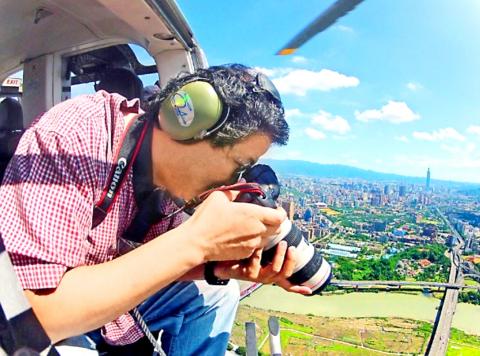
Photo courtesy of Taiwan Aerial Imaging
The aircraft that carried the father of two and his 25-year-old assistant photographer, Chen Kuan-chi (陳冠齊), crashed while filming in Hualien County, resulting in their death and that of pilot Chang Chi-kuang (張志光). The team was filming for the sequel to Beyond Beauty when the accident happened.
News of Chi’s death shocked film and cultural circles.
“Contemporary Taiwan has just lost someone like Chi Po-lin — a man of conscience who was willing to sacrifice himself,” said commercial director Lu Chien-chang (盧建彰), who shot a short film featuring Chi for Google Inc in 2012.

Photo courtesy of Taiwan Aerial Imaging
Lu, who later became close friends with Chi, described the director as a warm and kind person.
“He always had a smile on his face and almost never got angry with people, whether he was dealing with work or other challenges,” Lu said. “I never saw him say mean words to others. He was always a warm person.”
“He risked his life in the air for every photograph he took. My heart aches tremendously,” TV commentator Sisy Chen (陳文茜), another friend, wrote on Facebook.
Chi, who had more than 20 years of experience filming from helicopters, appeared to be fully aware of the risk involved.
In writings and interviews, the director recounted some of the scarier moments he had experienced, especially when filming over mountainous areas.
One time, filming at Yushan (玉山), Chi’s helicopter pilot lost control of the aircraft after encountering a turbulence, Chi wrote in one of his books. “My mind went blank. Before I could say my prayers, I screamed and shouted instinctively. In those seconds, I really believed the chopper was going to go down.”
“That was not the only time...fortunately, we were always able to pull off a narrow escape, but no matter how many times this has occurred, I am still frightened when it does. I never dare tell my family these things because I am afraid they would worry,” he wrote.
Every time something like this happened, Chi told himself to quit flying and not take the risk, he said.
“However, after I wake up the next day, or after some time has passed and I see the good weather and good visibility, I always want to fly again,” he wrote.
Chi’s passion for aerial photography began while he was an employee at the Ministry of Transportation and Communications, where he was responsible for documenting major construction projects such as highway construction from the air.
As his interest grew, Chi rented helicopters in his spare time to take pictures of Taiwan’s mountains, coastline and other scenery.
In 2009, after witnessing the damage inflicted by Typhoon Morakot, which triggered the worst flooding in Taiwan in half a century, Chi purchased his own filming equipment for about NT$30 million (US$996,413), quit his job and set off to make a film to warn people about the importance of environmental protection.
“At the age of 47, just three years before I became eligible for retirement, I quit my civil servant job to become a full-time aerial photographer. I will be dedicating the rest of my life to what I love the most. I am very frightened, but very happy,” he wrote in his book.
Beyond Beauty cost NT$90 million and took three years to make, 400 hours of which were spent in the air. It is widely considered to have played an important role in making people more aware of the beauty of Taiwan, as well as the human-caused environmental destruction caused by decades of rapid economic growth.
The film won the best documentary award at the 50th Golden Horse Awards in Taipei, Taiwan’s most important film awards.
It also led to a government crackdown on environmental offenses such as illegally built guesthouses in mountainous areas, industrial pollution in rivers and illegal mining operations.
In a 2011 video, in which Chi was filmed speaking with then-president Ma Ying-jeou (馬英九), the director said he hoped to become Taiwanese people’s “pair of eyes in the sky” and to show the nation’s natural beauty to its people.
Following Chi’s death on Saturday, Chi’s son wrote in an online post that his father “loved [Taiwan] so much he was prepared to give up his life.”
Speaking at a news conference on Thursday, World Oceans Day, Chi, wearing a blue suit, announced his ambition for the sequel to be released in 2019.
The director said he had visited more than 30 countries to scout for locations and planned to film it mostly in Taiwan, but also in other countries, such as Japan, New Zealand, Malaysia and China, because he wanted people to recognize that environmental problems know no borders.
In addition to filming from the air, the new documentary would also take viewers into the ocean and discuss problems such as marine waste, Chi said.
The film would also trace the footsteps of Taiwan’s ancestors and teach people about the plate collision that formed Taiwan, he said.
“I hope the sequel will allow more people to get to know the past, present and future of Taiwan. I especially hope that it will give our young people an international perspective ... and allow the world to see more of Taiwan, and Taiwan more of the world,” he said.
In a concert in Tainan on Saturday night, the Vox Nativa children’s choir, which appeared in an iconic scene on top of Yushan mountain in Beyond Beauty, performed Chi’s favorite song, the Japanese song Kikyuu ni Notte Dokomade mo (“Fly Away on a Balloon”), to remember the director.
“He is free now. He will truly fly in the sky forever,” Vox Nativa Association executive member Akuan Liao (廖達珊) said.

Nipah virus infection is to be officially listed as a category 5 notifiable infectious disease in Taiwan in March, while clinical treatment guidelines are being formulated, the Centers for Disease Control (CDC) said yesterday. With Nipah infections being reported in other countries and considering its relatively high fatality rate, the centers on Jan. 16 announced that it would be listed as a notifiable infectious disease to bolster the nation’s systematic early warning system and increase public awareness, the CDC said. Bangladesh reported four fatal cases last year in separate districts, with three linked to raw date palm sap consumption, CDC Epidemic Intelligence

Two Taiwanese prosecutors were questioned by Chinese security personnel at their hotel during a trip to China’s Henan Province this month, the Mainland Affairs Council (MAC) said yesterday. The officers had personal information on the prosecutors, including “when they were assigned to their posts, their work locations and job titles,” MAC Deputy Minister and spokesman Liang Wen-chieh (梁文傑) said. On top of asking about their agencies and positions, the officers also questioned the prosecutors about the Cross-Strait Joint Crime-Fighting and Judicial Mutual Assistance Agreement, a pact that serves as the framework for Taiwan-China cooperation on combating crime and providing judicial assistance, Liang

Reports of Taiwanese going missing, being detained or interrogated, or having their personal liberties restricted in China increased about fourfold annually last year, the Mainland Affairs Council (MAC) said yesterday. Last year, 221 Taiwanese who traveled to China were reported missing, were detained and interrogated, or otherwise had their personal freedom restricted, up from 55 the previous year, the council said. Reopening group tours to China would be risky, as it would leave travelers with no way to seek help through official channels after Beijing shut down dialogue between the associations tasked with handling cross-strait tourism, the MAC said. Taipei’s Taiwan Strait Tourism

SHIFT: Taiwan is evolving from a transit stop into a tourist destination, with more international travelers willing to spend on tours, dining and cultural activities Taiwan rose three places in the World Tourism Barometer to 36th globally in 2024, with international tourism revenue of US$10.028 billion, the Tourism Administration said on Monday. The UN Tourism Organization publication said that its focus has switched from whether a country has returned to pre-COVID-19 levels of tourism to the amount spent by a tourist during an overseas trip. The nation last year welcomed 8.57 million international tourists, about 9 percent more than in 2024, with most tourists coming from Japan, South Korea, and Hong Kong and Macau, all of which accounted for at least 1 million tourists each. During the first


 RSS
RSS