


A new baseline pension should be passed to guarantee the rights of women and other disadvantaged groups, rights advocates said yesterday, as the Legislative Yuan prepares to begin an extraordinary session next week to address pension reform.
More than 20 people from civic groups such as the Awakening Foundation and Taiwan Higher Education Union gathered outside the side gates of the legislative compound, calling for retirement guarantees and the realization of redistributive justice.
“The current pension system is mainly built on the premise that people will be employed, and receive promotions and wage increases until they retire. However, that premise is male-oriented and ignores the fact that women often have gaps in their employment, because they are forced to act as caregivers to children, older people and disabled people,” Awakening Foundation secretary-general Chyn Yu-rong (覃玉蓉) said.
Women on average receive only 66 to 88 percent of the national labor insurance payments men receive upon retirement, depending on the payment system used, Chyn said.
The national labor insurance is divided into “old” and “new” systems, with workers using the “old system” allowed to withdraw a lump sum upon retirement.
There needs to be a minimum monthly payment of NT$8,000 available to all citizens upon retirement to avoid replicating the inequities of the workplace, she said, blaming the prevalence of employment gaps among women on the government’s failure to establish public systems to care for children and older people.
“If we put all of the burden of providing for older people on individuals and families, where is the guaranteed economic security going to come from for disadvantaged groups like family caregivers, nontraditional labor, part-time workers, single parent families and those who become unemployed during middle age?” Awakening Foundation senior researcher Tseng Chao-yuan (曾昭媛) said, adding that statistics showed that 44.6 percent of female senior citizens receive their support mainly from their children and grandchildren.
More than 46 percent of retirees only receive a monthly pension from the National Pension Fund — which averages NT$3,791 — rather than the Labor Insurance Fund — which averages NT$16,179 — because they do not possess the necessary seniority in terms of years worked to be eligible for the more substantial payment, she said.
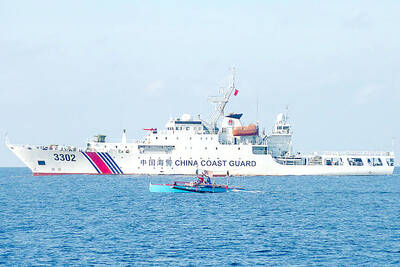
EXPANSIONIST: China deploys an average of 40 to 50 warships and coast guard vessels daily in the South China Sea, despite pledges not to militarize the region, an official said China is attempting to expand its influence across the First Island Chain and increase pressure on Japan by sending coast guard vessels into waters off of Taiwan under the pretext of maritime negotiations with Japan and the Philippines, a national security official said yesterday. China’s recent actions in the waters east of Taiwan and Japan and the Philippines’ exclusive economic zones (EEZ) are attempts to establish dominance in First Island Chain waters, said the official who declined to be named, adding that this is “expansion disguised as law enforcement.” Framing China’s actions solely as a cross-strait issue is a serious misjudgment that
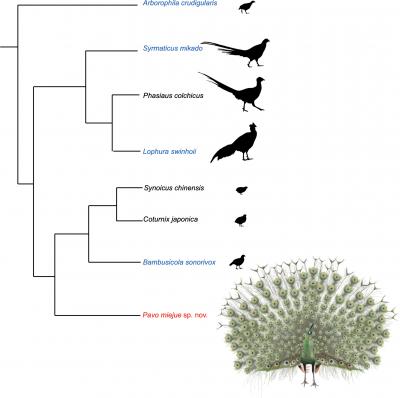
Through analyzing fossil evidence, a research team at National Taiwan University (NTU) discovered the largest endemic bird to have lived in Taiwan, naming it Pavo miejue, or extinct peafowl (滅絕孔雀). The Mikado pheasant, which is printed on the back of the NT$1,000 bank note, was previously believed to be the biggest endemic bird to Taiwan. The research team’s findings suggest that Pavo miejue lived during the Pleistocene epoch tens of thousands of years ago. It is the first endemic extinct bird species discovered and formally named in Taiwan. The study was coauthored by NTU Institute of Ecology and Evolutionary Biology professor Tsai Cheng-hsiu (蔡政修),
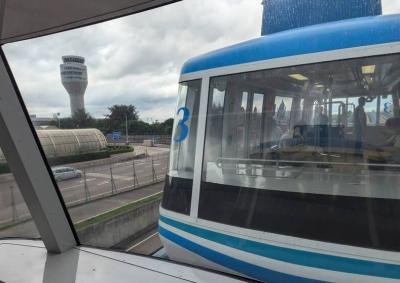
Taiwan Taoyuan International Airport is to suspend its automated Skytrain service connecting Terminal 1 and Terminal 2 starting on July 1 to facilitate connection works for the upcoming Terminal 3, the airport operator said today. Passengers and staff who need to travel between the two terminals after the suspension can instead use the Taoyuan MRT or the airport's 24-hour shuttle bus service, Taoyuan International Airport Corp said. The Taoyuan MRT Airport Line directly links the two terminals, while the shuttle buses are to operate around the clock, the company added. The Skytrain provides free transportation between the airport’s two terminals for travelers and
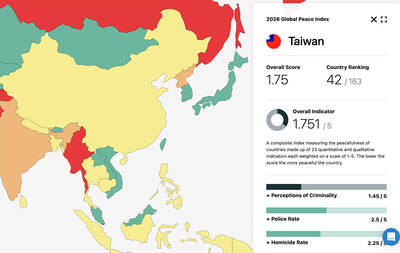
Taiwan ranked 42nd in terms of peacefulness among 163 countries, down five places from last year, according to this year’s Global Peace Index. With an overall score of 1.751, Taiwan dropped from 37th last year, the report published by the global Institute for Economics and Peace showed. The overall score measures a country’s level of peacefulness using 23 quantitative and qualitative indicators across three domains — ongoing domestic and international conflict, societal safety and security, and militarization. While Taiwan ranked 42nd worldwide, it was listed in ninth place among the 19 Asian-Pacific countries in the report, after New Zealand, Singapore, Japan, Malaysia,


 RSS
RSS