


Representatives from 15 healthcare associations yesterday announced a joint statement, urging the WHO to formally invite Taiwan to attend the upcoming World Health Assembly (WHA) in Geneva, Switzerland, this month.
“WHA needs Taiwan, Taiwan needs WHA,” healthcare professionals chanted at a news conference in Taipei yesterday morning, at which they strongly expressed their desire to contribute their professional skills to the world and not to be left out of global health issues.
The Ministry of Health and Welfare on Tuesday confirmed that Taiwan had not yet received an official invitation to attend the WHA this year, after eight years of being invited as an observer under the name “Chinese Taipei.”
“On behalf of nearly 300,000 professionals in 15 healthcare associations, we express deep disappointment over the situation,” Taiwan Medical Association president Chiu Tai-yuan (邱泰源) said. “As active participants in the global healthcare community, we have much to give.”
Taiwan contributes much to the global immunization initiative and is among the leaders in healthcare and medicine in Asia and worldwide. Many academic and humanitarian goals have been accomplished by the long-term efforts of the nation’s healthcare professionals.
“We believe our experience in healthcare is valuable for other countries and the issues we are facing merit attention and assistance from the rest of the world,” Chiu said. “We are very disappointed. It is unfair for the people of Taiwan and the rest of the world.”
The nation’s pharmaceutical care system allows National Health Insurance-covered pharmacists to provide care to communities and households, and that experience should be shared with the global community, Taiwan Pharmacist Association chairman Yang Ying-bi (楊瑛碧) said.
Health is a fundamental human right, and based on the principle of reciprocity, Taiwan should not be excluded from an international health organization, Taiwan Dental Association chairman Albert Chen (陳義聰) said.
“Health professionals should be respected,” he said. “Excluding Taiwan from participating will cause a gap in the global disease prevention network.”
Taiwan has one of the best health-insurance systems in the world, and leaders of other nations should consider the importance of their people’s health, and allow Taiwan, which has many outstanding medical achievements, to attend the WHA, to prevent a shortfall in global disease prevention,” National Union of Chinese Medical Doctors’ Association of Republic of China chairman Chen Wang-chuan (陳旺全) said.

LOUD AND PROUD Taiwan might have taken a drubbing against Australia and Japan, but you might not know it from the enthusiasm and numbers of the fans Taiwan might not be expected to win the World Baseball Classic (WBC) but their fans are making their presence felt in Tokyo, with tens of thousands decked out in the team’s blue, blowing horns and singing songs. Taiwanese fans have packed out the Tokyo Dome for all three of their games so far and even threatened to drown out home team supporters when their team played Japan on Friday. They blew trumpets, chanted for their favorite players and had their own cheerleading squad who dance on a stage during the game. The team struggled to match that exuberance on the field, with
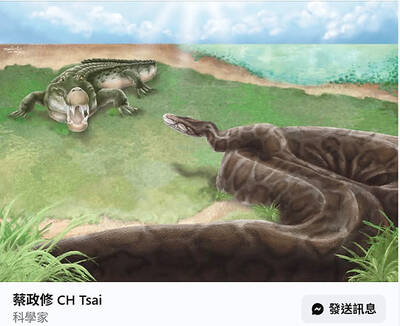
Taiwanese paleontologists have discovered fossil evidence that pythons up to 4m long inhabited Taiwan during the Pleistocene epoch, reporting their findings in the international scientific journal Historical Biology. National Taiwan University (NTU) Institute of Ecology and Evolutionary Biology associate professor Tsai Cheng-hsiu (蔡政修) led the team that discovered the largest snake fossil ever found in Taiwan. The single trunk vertebra was discovered in Tainan at the Chiting Formation, dated to between 400,000 and 800,000 years ago in the Middle Pleistocene, the paper said. The area also produced Taiwan’s first avian fossil, as well as crocodile, mammoth, saber-toothed cat and rhinoceros fossils, it said. Discoveries

Taiwanese paleontologists have discovered fossil evidence that pythons up to 4m long inhabited Taiwan during the Pleistocene epoch, reporting their findings in the international scientific journal Historical Biology. National Taiwan University (NTU) Institute of Ecology and Evolutionary Biology associate professor Tsai Cheng-hsiu (蔡政修) led the team that discovered the largest snake fossil ever found in Taiwan. A single trunk vertebra was discovered in Tainan at the Chiting Formation, dated to between 800,000 to 400,000 years ago in the Middle Pleistocene, the paper said. The area also produced Taiwan’s first avian fossil, as well as crocodile, mammoth, sabre-toothed cat and rhinoceros fossils, it said. Discoveries

Whether Japan would help defend Taiwan in case of a cross-strait conflict would depend on the US and the extent to which Japan would be allowed to act under the US-Japan Security Treaty, former Japanese minister of defense Satoshi Morimoto said. As China has not given up on the idea of invading Taiwan by force, to what extent Japan could support US military action would hinge on Washington’s intention and its negotiation with Tokyo, Morimoto said in an interview with the Liberty Times (sister paper of the Taipei Times) yesterday. There has to be sufficient mutual recognition of how Japan could provide


 RSS
RSS