


Liberty Times (LT): How does the council view the series of food security incidents including the avian flu outbreak, pesticide abuse and excessive dioxin in eggs? How does it plan to improve the situation?
Lin Tsung-hsien (林聰賢): There are rumors that the council is about to relax regulations on more than 100 kinds of pesticides; this is a severe misunderstanding. The pesticides are not additional ones, but rather an expanded list of allowed pesticides.
The nation’s limited agricultural space has caused different kinds of crops to be planted in close proximity to each other. In such circumstances, pesticides originally intended for rice might be carried over to nearby vegetable patches or fruit orchards. While the pesticides will not necessarily be harmful to humans, it would prevent farmers from being able to sell their products, leading to losses.
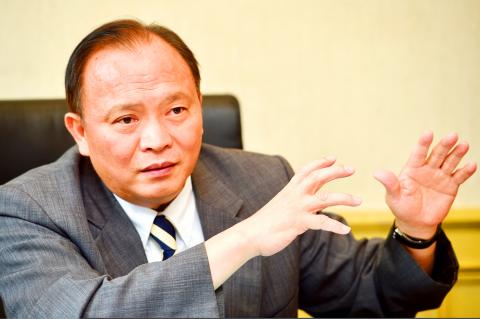
Photo: Peter Lo, Taipei Times
To address this issue, former council minister Chen Bao-ji (陳保基) issued a directive to look into amendments that would allow for residues of legal pesticides on other agricultural products.
This is a continuing policy that is not affected by party affiliation, and the prime goal is to protect the rights and benefits of farmers. It will not affect food security.
Regarding excessive dioxin in eggs, preliminary findings are not excluding that farmers have added dirt to the feed of their own volition. The council will soon have results on the source of the contamination.
Regardless if this is an isolated incident, there is limited land and fields are often side-by-side with industrial zones and even residential areas. Therefore, agricultural products are threatened with pollution by industrial waste or materials.
The council must admit that responsibility for agricultural products and pollution control cannot be divided clearly among governmental agencies. Instead, a joint effort between the council, the Ministry of Health and Welfare and the Environmental Protection Administration should seek to prevent illegal materials from entering the production chain of agricultural foodstuffs.
The council is seeking to establish a “production resume” for agricultural products that would provide more in-depth information while stepping up the responsibility of product control for production, logistics and sales.
Certificates such as the Certified Agricultural Standard and the Good Agricultural Practice certificate will be integrated into a nationwide Taiwan Good Agricultural Practice certificate as early as 2020.
The new certificate will provide checkpoints for all processes, including environment, use of pesticides, packaging and delivery, and rebuild consumers’ faith in agricultural products.
LT: Pollution is as numerous as there are sources, and it seems the government is always playing catch-up. Is there a method to address pollution at its root?
Lin: We hope to tackle the issue at its source by reducing pesticide usage, or in some cases by not using pesticide at all. We also hope to promote the concept of biological prevention, such as dealing with agricultural pests like channeled applesnail by introducing predators, such as ducks or fish. Such methods would help drive off pests while ensuring less environmental pollution.
The council is also hoping to introduce a “plant doctor” act that would give doctors the task of supervising the purchase and usage of pesticides by handing out “prescriptions,” thereby addressing the issue of farmers’ being able to buy and use pesticides of their own volition.
The council is also looking to increase the consumption of agricultural products by mandating the use of “excellent materials” in military messes and student lunches.
In addition, the council is looking to introduce an act promoting organic farming, as well as an act encouraging education about the relations between food and agriculture to ensure the elevation of product quality due to increased consumption.
LT: Is impractical use of farmland — such as the illegal occupation of fields by factories and the excessive building of farmhouses — the biggest challenge to the government’s proposed “new agricultural paradigm”?
Lin: The nation needs to promote a new agricultural industry that emphasizes quality and food safety.
The council’s first step is to take stock of farmland nationwide, which it expects to complete by the end of next month. It will determine whether there actually is 750,000 to 810,000 hectares of arable farmland for growing grains [as estimated] and integrate all of that land into a “designated production zone.” Of that total, 270,000 hectares will be improved and opened to the public for diversified farming.
To take a 2,850-hectare farmland improvement project in Tainan as an example, 287 hectares has sat idle for the short or long term and about 1,300 hectares is owned by uninsured farmers.
On a national scale, there is a large amount of land that is either sitting idle or not being used for what it was intended.
What is more important is raising farmers’ incomes, improving agricultural insurance coverage and improving access to subsidies for farming implements like netting. In this way, farmers’ profits can be improved. Our goal is to raise farmers’ household annual income from NT$1.3 million to NT$1.8 million (US$43,072 to US$59,638). That way, we can tackle the problem of skilled people leaving farming communities.
There are about 1,000 people nationwide who farm on a part-time basis. We hope to attract up to 40,000 people into the industry.
LT: How will the agricultural industry respond to US pork and other foreign agricultural products entering Taiwan?
Lin: Only if the industry and farmers are competitive will there be the capital to deal with challenges from foreign products. International trade means exporting, but it also means importing.
Therefore, the decision by the former president Ma Ying-jeou’s (馬英九) administration to import US beef containing the leanness-enhancing drug ractopamine means that importing beef is an unavoidable part of trade. Whether it poses a health risk will have to be left to the Ministry of Health and Welfare to evaluate.
If the council wants to improve the competitiveness of [domestic] pork, it should avoid the use of ractopamine. Taiwanese love domestic pork, so there should be no need to fear the import of US pork.
Foreign producers of soybean, millet and corn also want to enter the market. If plans for a large reserve granary are to be realized, farmers in the south should be encouraged to switch from rice cultivation to growing grains that consume less water. The nation’s self-sufficiency could be increased from 36 percent to 40 percent within three years, making it easier for Taiwanese to buy domestic grain products.
The nation must also take on the international market. The edamame bean market has already been targeted, of which Japan accounts for nearly 50 percent. The nation aims to also take on the banana, sugar apple, pineapple and mango markets, as well as markets for high-priced flowers such as the Oncidium flexuosum and the moth orchid, but the industry needs to modernize to deal with supply and quality problems so transactions can be customized and high-value markets can be tackled.
Translated by Jake Chung and William Hetherington

Taiwan has received more than US$70 million in royalties as of the end of last year from developing the F-16V jet as countries worldwide purchase or upgrade to this popular model, government and military officials said on Saturday. Taiwan funded the development of the F-16V jet and ended up the sole investor as other countries withdrew from the program. Now the F-16V is increasingly popular and countries must pay Taiwan a percentage in royalties when they purchase new F-16V aircraft or upgrade older F-16 models. The next five years are expected to be the peak for these royalties, with Taiwan potentially earning
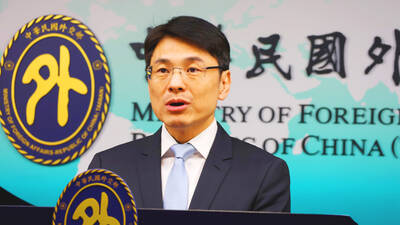
STAY IN YOUR LANE: As the US and Israel attack Iran, the ministry has warned China not to overstep by including Taiwanese citizens in its evacuation orders The Ministry of Foreign Affairs (MOFA) yesterday rebuked a statement by China’s embassy in Israel that it would evacuate Taiwanese holders of Chinese travel documents from Israel amid the latter’s escalating conflict with Iran. Tensions have risen across the Middle East in the wake of US and Israeli airstrikes on Iran beginning Saturday. China subsequently issued an evacuation notice for its citizens. In a news release, the Chinese embassy in Israel said holders of “Taiwan compatriot permits (台胞證)” issued to Taiwanese nationals by Chinese authorities for travel to China — could register for evacuation to Egypt. In Taipei, the ministry yesterday said Taiwan
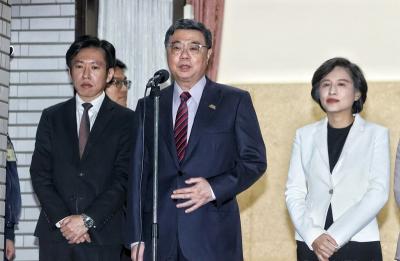
Taiwan is awaiting official notification from the US regarding the status of the Agreement on Reciprocal Trade (ART) after the US Supreme Court ruled US President Donald Trump's global tariffs unconstitutional. Speaking to reporters before a legislative hearing today, Premier Cho Jung-tai (卓榮泰) said that Taiwan's negotiation team remains focused on ensuring that the bilateral trade deal remains intact despite the legal challenge to Trump's tariff policy. "The US has pledged to notify its trade partners once the subsequent administrative and legal processes are finalized, and that certainly includes Taiwan," Cho said when asked about opposition parties’ doubts that the ART was
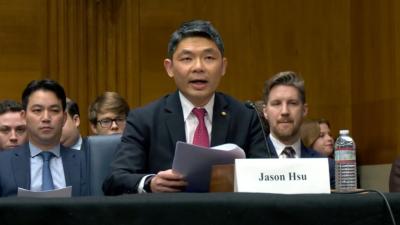
If China chose to invade Taiwan tomorrow, it would only have to sever three undersea fiber-optic cable clusters to cause a data blackout, Jason Hsu (許毓仁), a senior fellow at the Hudson Institute and former Chinese Nationalist Party (KMT) legislator, told a US security panel yesterday. In a Taiwan contingency, cable disruption would be one of the earliest preinvasion actions and the signal that escalation had begun, he said, adding that Taiwan’s current cable repair capabilities are insufficient. The US-China Economic and Security Review Commission (USCC) yesterday held a hearing on US-China Competition Under the Sea, with Hsu speaking on


 RSS
RSS