


Conflict over an Aboriginal occupation of a portion of Ketagalan Boulevard in front of the Presidential Office Building in Taipei continued yesterday, as police moved in to clear away new obstructions.
“We respect your freedom of speech, but please respect Taipei citizens’ right of way,” police loudspeakers blared as more than 100 officers swept the protesters’ stools and umbrellas from the road before swiftly wiring together a line of metal fences to confine the demonstrators to their tents on the sidewalk.
Police also cut down a line of posters hanging from the tents before leveling one tent on the grounds that it could not be considered part of protesters’ “living space.”
Works of art, painted rocks and tents in the road were cleared away earlier this week, but protesters renewed their sit-in afterward.
Protesters were surrounded and hauled to the sidewalk, but throughout the day, they repeatedly attempted to resume their protest in the road before being forced off by police officers.
A handful of Aborigines affiliated with the Aboriginal Transitional Justice Classroom have been occupying the site since February to protest the government’s decision to exclude privately owned land from the demarcations of “traditional Aboriginal areas.”
The stipulation effectively denies local tribes the right to exercise development vetoes and other rights over the affected land.
Road occupation has been a key part of their strategy to raise awareness of Aboriginal land rights, which previously saw them break into a forbidden zone outside the Presidential Office Building.
They have since been charged with violating the Assembly and Parade Act (集會遊行法) and the Road Traffic Management and Penalty Act (道路交通管理處罰條例) after failing to apply to occupy Ketagalan Boulevard.
“The Republic of China did not apply before it came to Taiwan,” said a protester named Nabu, a Bunun, adding that the protest is part of a long-running struggle on attitudes on Aboriginal relations.
“The idea is that our lifestyle has to be in accordance with their ideas and we can only survive in the circle they draw around us,” he said.
He attributed the police action to the scheduled celebrations of the one-year anniversary of President Tsai Ing-wen’s (蔡英文) inauguration on May 20.
“Tsai does not want her guests to see us here — she wants this space clean so she does not have to face what she has failed to do,” he said, adding that the protesters intend to imitate the year-long occupation by the Alliance of Referendum for Taiwan outside the Legislative Yuan.
“Don’t the police know that we will keep coming back? If we have to force our way back, they will look even worse,” he said.
While the alliance has conducted an on-going occupation since 2008, its tents do not block the road, and are instead pitched on the sidewalk and in parking spaces.

FUKUOKA SITUATION: Japanese media reported that the pathogen is expected to be identified by the summer, while the CDC downplayed the idea that it was hMPV A “mysterious cold-like illness” reported in Japan’s Fukuoka Prefecture does not seem to be a new disease, but Japanese authorities have been asked about the situation, the Centers for Disease Control (CDC) said yesterday. The Fukuoka Prefectural Medical Association on Wednesday told a news conference that a “mystery cold” that has become a hot topic on social media is “highly likely to be caused by some kind of viral infection,” Japan’s KBC News reported. “Many people are experiencing symptoms starting with a sore throat, followed by a runny nose, phlegm and a severe cough,” KBC News reported, citing association officials. Health authorities are

Nvidia Corp CEO Jensen Huang (黃仁勳) arrived in Taiwan yesterday ahead of upcoming AI and technology events, saying he plans to meet with clients and Taiwan Semiconductor Manufacturing Co Chairman C.C. Wei (魏哲家) during his visit. After landing at Taipei Songshan Airport, Huang posed for photos with fans and handed out Yakult drinks to reporters and supporters waiting at the scene, saying he has “a lot to do” during the trip. Asked about reports that Nvidia’s planned headquarters site in Taipei’s Beitou Shilin Technology Park could break ground on May 27, Huang said that if the company holds an event, he would

Carrefour Taiwan is to begin using a new name from the start of July, but it cannot divulge the name until then, the chairman of the supermarket chain's parent company said today. President Chain Store Co chairman Lo Chih-hsien (羅智先) was asked by reporters after a shareholders' meeting to confirm whether the company has settled on a new name for the supermarket brand. In March, the government-registered name of two Carrefour Taiwan branches was quietly changed to "Le Chia Kang" (樂家康) in Chinese, raising speculation that has been selected as the name. Lo said that because of local regulations and contractual obligations, the
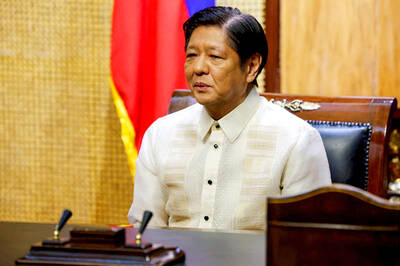
The Philippines would likely be involved in any conflict over Taiwan due to its proximity to the democracy claimed by China, President Ferdinand Marcos Jr said, reiterating a stance that risks angering Beijing. “In the Philippines, we do not have a choice because Taiwan is so close to the Philippines and we have almost 200,000 Filipino nationals living and working in Taiwan,” Marcos said in an interview with Japanese media in Manila on Monday. The Philippine leader’s comments come ahead of a state visit to Japan next week, where he is to meet with Japanese Prime Minister Sanae Takaichi to discuss security


 RSS
RSS