


Chinese Nationalist Party (KMT) Chairwoman Hung Hsiu-chu (洪秀柱) yesterday downplayed the low number of valid signatures she collected for the May 20 party chairperson election, saying the only figure that matters is the number of votes she would receive on election day.
Hung made the remarks in response to media queries about six chairperson candidates submitting a total of about 720,000 signatures from KMT members even though there are only 470,000 party members.
The discrepancy led to a low validity rate for collected signatures, with only 19 percent, or 24,848, of the 128,888 signatures submitted by Hung deemed valid by the KMT headquarters.
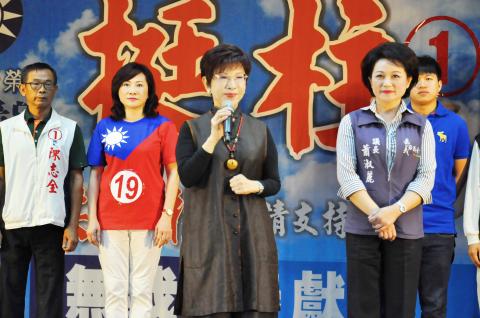
Photo: Wang Shan-yen, Taipei Times
The signatures collected by the other five candidates had validity rates ranging between 18 and 35 percent.
“The outcome was expected and I am not surprised,” Hung said during a trip to Chiayi city and county for her re-election campaign, adding that possible reasons for the inflated numbers might be party members signing for more than one candidate, or candidates copying and submitting fake signatures.
Hung said the reason why her campaign staff reacted strongly to her low validity rate was because they personally collected about 50,000 of the signatures, but only about 20,000 were considered valid and the rest were rejected, as they overlapped with signatures submitted by other candidates.
The number of valid signatures is not important and what matters is whether the numbers will match the votes each candidate receives in the chairperson election, Hung said.
“It would not look good for candidates with a large gap between the signatures they submitted and the votes they received,” Hung said.
She said that the KMT’s signature requirement policy needs to be reformed and that her camp will put forward reform proposals at the party’s next national congress.
The KMT requires each party chairperson candidate to collect signatures of at least 3 percent of party members, or about 13,322 people, to make their nomination official.
The other candidates have also passed the signature threshold. Former vice president Wu Den-yih (吳敦義) collected the highest number of valid signatures at 67,520, followed by former KMT vice chairman Steve Chan (詹啟賢) with 29,306 signatures, KMT Vice Chairman Hau Lung-bin (郝龍斌) with 26,418 signatures, former Taipei Agricultural Products Marketing Corp president Han Kuo-yu (韓國瑜) with 20,028 signatures, and former KMT legislator Pan Wei-kang (潘維剛) with 18,347 signatures.
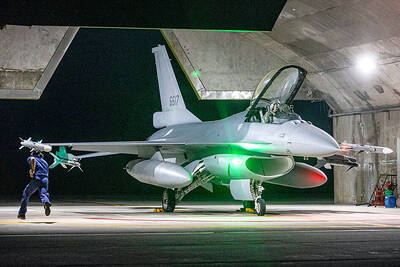
Taiwan has received more than US$70 million in royalties as of the end of last year from developing the F-16V jet as countries worldwide purchase or upgrade to this popular model, government and military officials said on Saturday. Taiwan funded the development of the F-16V jet and ended up the sole investor as other countries withdrew from the program. Now the F-16V is increasingly popular and countries must pay Taiwan a percentage in royalties when they purchase new F-16V aircraft or upgrade older F-16 models. The next five years are expected to be the peak for these royalties, with Taiwan potentially earning
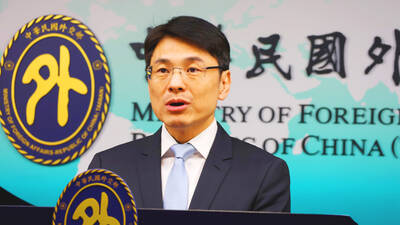
STAY IN YOUR LANE: As the US and Israel attack Iran, the ministry has warned China not to overstep by including Taiwanese citizens in its evacuation orders The Ministry of Foreign Affairs (MOFA) yesterday rebuked a statement by China’s embassy in Israel that it would evacuate Taiwanese holders of Chinese travel documents from Israel amid the latter’s escalating conflict with Iran. Tensions have risen across the Middle East in the wake of US and Israeli airstrikes on Iran beginning Saturday. China subsequently issued an evacuation notice for its citizens. In a news release, the Chinese embassy in Israel said holders of “Taiwan compatriot permits (台胞證)” issued to Taiwanese nationals by Chinese authorities for travel to China — could register for evacuation to Egypt. In Taipei, the ministry yesterday said Taiwan
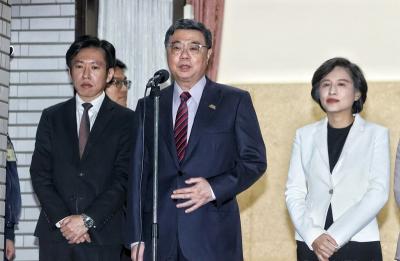
Taiwan is awaiting official notification from the US regarding the status of the Agreement on Reciprocal Trade (ART) after the US Supreme Court ruled US President Donald Trump's global tariffs unconstitutional. Speaking to reporters before a legislative hearing today, Premier Cho Jung-tai (卓榮泰) said that Taiwan's negotiation team remains focused on ensuring that the bilateral trade deal remains intact despite the legal challenge to Trump's tariff policy. "The US has pledged to notify its trade partners once the subsequent administrative and legal processes are finalized, and that certainly includes Taiwan," Cho said when asked about opposition parties’ doubts that the ART was
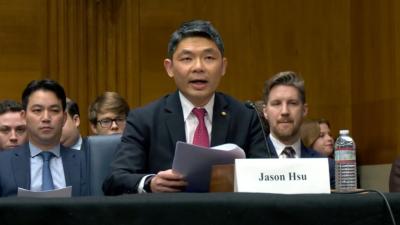
If China chose to invade Taiwan tomorrow, it would only have to sever three undersea fiber-optic cable clusters to cause a data blackout, Jason Hsu (許毓仁), a senior fellow at the Hudson Institute and former Chinese Nationalist Party (KMT) legislator, told a US security panel yesterday. In a Taiwan contingency, cable disruption would be one of the earliest preinvasion actions and the signal that escalation had begun, he said, adding that Taiwan’s current cable repair capabilities are insufficient. The US-China Economic and Security Review Commission (USCC) yesterday held a hearing on US-China Competition Under the Sea, with Hsu speaking on


 RSS
RSS