


Civic groups yesterday expressed concern that the government’s Forward-Looking Infrastructure Development Program could degenerate into a pork barrel, as debate over the plan continues.
“The problem is that in the past there have been many examples of projects that started out with good intentions, but ended with tragic results,” National Chengchi University’s Department of Land Economics professor Hsu Shih-jung (徐世榮) said at a forum organized by the Economic Democracy Union.
“There is absolutely not enough ‘forward-lookingness’ in the entire program, which amounts to throwing away money,” union spokesman Hsu Po-jen (許博任) said, adding that there is danger that grants would degenerate into pork barrel aimed at securing votes from local constituencies unless civic groups are given a greater role in review.
Citing a “mixed bag” of railway construction projects, he said the proposal had been drafted too hastily and called for the Executive Yuan to require ministries to resubmit project proposals after it drafts a clear definition of “forward-looking.”
National Taiwan University’s Societal Risk and Policy Research Center postdoctoral researcher Chao Chia-wei (趙家緯) commended plans to expand railway lines as necessary for reducing carbon emissions, but said that some elements of the government proposals were contradictory and seemed to reflect a lack of review.
He cited plans to construct additional water reservoirs to guarantee water supplies as an example, saying that replacing old pipes to reduce leakage would be more cost-effective.
“The crucial issue is not whether we should pursue these projects — the question is how,” National Development Council Deputy Minister Tseng Shu-cheng (曾旭正) said, adding that the project’s genesis was originally geared at speeding up existing infrastructure construction plans.
He said that he “agreed” with complaints that the program had been proposed hastily and lacked civil participation, while dodging a question about whether it could be temporarily withdrawn for reformulation.
“The formulation of the policy involves a bunch of tangled issues including legislative formulation and budget drafting,” he said. “Whether it can be withdrawn is not a question I can answer.”
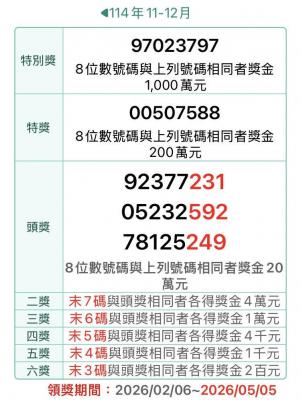
Seven of the 17 NT$10 million (US$311,604) winning receipts from the November-December uniform invoice lottery remain unclaimed as of today, the Ministry of Finance said, urging winners to redeem their prizes by May 5. The reminder comes ahead of the release of the winning numbers for the January-February lottery tomorrow. Among the unclaimed receipts was one for a NT$173 phone bill in Keelung, while others were for a NT$5,913 purchase at Costco in Taipei's Neihu District (內湖), a NT$49 purchase at a FamilyMart in New Taipei City's Tamsui District (淡水), and a NT$500 purchase at a tea shop in New Taipei City's

Taiwanese officials were shown the first of 66 F-16V fighter jets purchased by Taiwan from the United States, the Ministry of National Defense said yesterday, adding the aircraft has completed an initial flight test and is expected to be delivered later this year. A delegation led by Deputy Minister of National Defense Hsu Szu-chien (徐斯儉) visited Lockheed Martin’s F-16 C/D Block 70 (also known as F-16V) assembly line in South Carolina on March 16 to view the aircraft. The jet will undergo a final acceptance flight in the US before being delivered to Taiwan, the
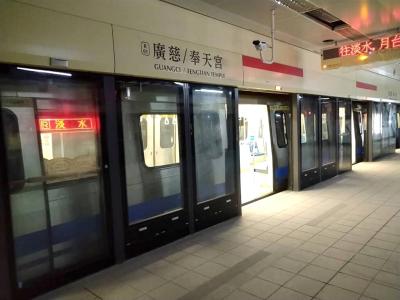
The New Taipei Metro's Sanyin Line and the eastern extension of the Taipei Metro's Tamsui-Xinyi Line (Red Line) are scheduled to begin operations in June, the National Development Council said today. The Red Line, which terminates at Xiangshan Station, would be connected by the 1.4km extension to a new eastern terminal, Guangci/Fengtian Temple Station, while the Sanyin Line would link New Taipei City's Tucheng and Yingge stations via Sanxia District (三峽). The council gave the updates at a council meeting reviewing progress on public construction projects for this year. Taiwan's annual public infrastructure budget would remain at NT$800 billion (US$25.08 billion), with NT$97.3
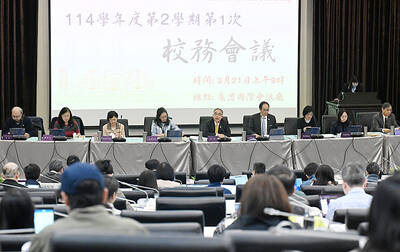
TALENT SCOUTING: The university is investing substantial funds in its future to bring in the kind of researchers that would keep the college internationally competitive National Taiwan University (NTU) plans to invest NT$2 billion (US$62.6 million) to launch two programs aimed at attracting and retaining top research talent, university president Chen Wen-chang (陳文章) said yesterday. The funding would support the “Palm Grove Scholars Project,” which targets academics aged 40 to 55. Up to 20 scholars would be selected, each receiving as much as NT$10 million annually, Chen said. The initiative is designed to attract leading researchers to Taiwan and strengthen NTU’s global competitiveness by fostering a more research-friendly environment and expanding international collaboration, he said. NTU is also introducing a “Hong Hu” chair grant, which would provide Palm


 RSS
RSS