


The Chinese Nationalist Party (KMT) yesterday urged prosecutors to appeal two court rulings that acquitted some Sunflower movement members who stormed the Legislative Yuan and Executive Yuan buildings in 2014, to help restore the public’s faith in the justice system.
KMT Culture and Communications Committee deputy director Hung Meng-kai (洪孟楷) said that the verdicts have raised questions on whether the judges made the decisions because they were afraid of convicting “criminals” who have been painted “heroes” by the media.
“Taiwan is a nation ruled by law and it has taken great pride in it. However, the court’s decision to acquit defendants in the March 18 case under the pretext of civil disobedience is not only unconstitutional, but also ran counter to the principles that a court ruling should be free of undue interference,” Hung said at a news conference in Taipei.
Hung was referring to the Taipei District Court’s decision on March 31 to acquit 22 defendants who broke into the Legislative Yuan on the night of March 18, 2014, based on the principle of “civil disobedience.”
Hung said as the term “civil disobedience” is nowhere to be found in the nation’s legal code, using it to absolve Sunflower movement participants from guilt risks undermining judicial credibility.
The ruling was followed by another verdict handed down by the district court on Monday that acquitted 10 of the 21 Sunflower members who stormed the Executive Yuan on March 23 that year, including Dennis Wei (魏揚).
However, eight defendants were found guilty of obstructing official business and three others were found guilty of damaging public property.
Monday’s verdict left the public puzzled about judicial review standards, as some defendants were found guilty while others were not, Hung said.
“It might not only prompt more people to follow suit and occupy government buildings, but also encourage them to do whatever it takes to become famous if they want to be acquitted of their crimes in the future,” Hung said.
Urging President Tsai Ing-wen (蔡英文) to respect the principle of separation of powers, Hung said the KMT hoped the prosecutors would appeal the rulings to restore the public’s faith in the judicial system.
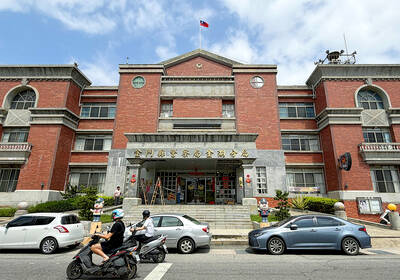
NATIONAL SECURITY: Authorities are working to confirm the identities of the military personnel involved and investigating possible illegal conduct and regulatory violations Authorities are probing possible national security implications after Kinmen police and immigration officers on Sunday found a Chinese woman allegedly posing as a tourist while engaging in prostitution involving more than 10 military personnel. The woman, surnamed Chen (陳), has since been deported, authorities said, adding that investigators are still working to confirm the identities of those implicated, as the records only listed code names and aliases. The case stemmed from a report received by the Kinmen District Prosecutors’ Office on Friday last week from the Jinhu Precinct of the Kinmen County Police Bureau. On Sunday, police, along with the National Immigration

GLOBALGIVING: ‘ Caving to external pressure is not acceptable for an organization that has cultivated justice reform and human rights for 30 years,’ one NGO said A slew of non-government organizations (NGOs) have withdrawn from the GlobalGiving fundraising platform after it announced it would use “Chinese Taipei” instead of “Taiwan” from next month. The Taiwan Good Rice Association wrote on Facebook on Friday that it was informed on April 28 via a teleconference call of the change, which was made because the platform wanted to operate in China. Taiwan Good Rice is to terminate all cooperative relationships with GlobalGiving in response to the platform’s “unilateral and non-negotiable” decision to remove references to Taiwan, the NGO said. “Taiwan is in the official name of Taiwan Good Rice Association and the
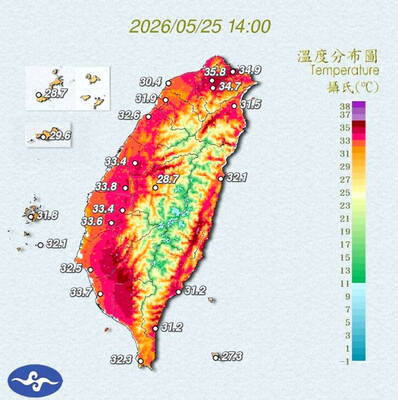
STAY COOL: The HPA recommended that people stay hydrated, use air-conditioning or fans while indoors, wear loose-fitting clothes and walk in the shade while outdoors Employers must implement measures such as installing cooling equipment, and providing drinking water and rest breaks for outdoor workers starting from Monday next week, the Taipei Department of Labor said on Sunday. Employers who fail to comply could face fines of NT$30,000 to NT$300,000 under the Occupational Safety and Health Act (職業安全衛生法), the department said. Businesses in Taipei employing fewer than 100 workers, as well as registered self-employed workers with labor insurance coverage, could receive on-site assessments and guidance from occupational safety consultants to help them apply for central government subsidies to implement or improve heat-protection measures, it said. Under the Ministry of

Chinese Nationalist Party (KMT) Chairwoman Cheng Li-wun (鄭麗文) yesterday briefed her party’s Central Standing Committee regarding her scheduled visit to the US between Monday next week and June 16, saying that her purpose would be to persuade the US that the Republic of China (ROC) Constitution was a “one China” constitution that would foster stable and peaceful cross-strait relations. The ROC Constitution is the most important defense for all Taiwanese citizens, as it upholds our democracy and has contributed to our robust economy, which aligns with international and US interests, she said. “We would not be troublemakers and drag the US under,”


 RSS
RSS