


Taiwanese political and financial institutions are likely to be targeted by sophisticated hacker operations with pecuniary or political agendas, US-based cybersecurity company FireEye said on Tuesday.
Due to rising political uncertainty on a global scale, cyberespionage would intensify with the aim of obtaining high-value intelligence and information that could serve as leverage in political negotiations, FireEye director of cybersecurity training Patrick Walsh, a retired US admiral and former commander of the US Pacific Fleet, said in Taipei.
Taiwan’s geopolitical position and high-tech industries are tempting targets for Internet-based attacks that might exploit the security gaps in the nation’s Internet of Things, Walsh said.
The hacking of First Commercial Bank automated teller machines and securities traders are likely to be followed by more sophisticated and targeted attacks, as cybercrime proves more lucrative than the drug trade, he said.
The attacks on US targets perpetrated by a Russia-based hacker group, which FireEye designated as Advanced Persistent Threat-28 (APT28), during the US presidential election last year highlighted the extent of the threat posed by cyberespionage, Walsh said.
Security experts have been observing APT28 for the past decade and believe that it had used “spear phishing” — or the targeted sending of messages containing viral links or trojans to infiltrate computer networks — to access secret information, which is then disseminated to the media for the purposes of manipulating political events, Walsh said.
He said that the hacker group’s targets include entities in the aerospace, defense, media and entertainment industries; political dissidents and opposition parties; and foreign affairs establishments of other governments in every part of the world.
“It is a matter of time before other hacker groups replicate its tactics in their own attacks,” he said.
The increasing reliance on networked sensors and platforms for modern armies will heighten the risks of cyberwarfare, and armed forces need to learn from the private sector to bolster information security, he said.
FireEye North Asia regional director Hsu Kuo-hai (徐國海) said 27 percent of its Taiwanese clients were targeted by Internet-based attacks between January and June last year.
Since 2014, at least five hacker groups involved in attacks against Taiwanese entities were rated as advanced persistent threats, with an additional 13 that were rated advanced threats, Hsu said.
Local entities that are most frequently targeted by attacks are telecommunications companies, government agencies, educational institutions, high-tech enterprises and consultancies or other service industries, Hsu said, adding that Taiwan has a reputation in the black hat hacker community as a target with a potential for lucrative payoffs.
As cross-strait tension is likely to persist, China will step up its cyberattacks, improve their efficiency and professionalism, possibly adopting different tactics, but without changing their strategic aims, Walsh said, adding that governments must continuously improve their information security expertise, operating procedures, techniques and technology to combat the threat.
“Rely not on the likelihood of the enemy’s not coming, but on our own readiness to receive him; not on the chance of his not attacking, but rather on the fact that we have made our position unassailable,” Walsh said, quoting Chinese military philosopher Sun Tzu (孫子).
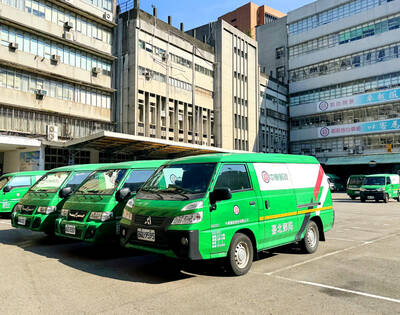
SHIPS, TRAINS AND AUTOMOBILES: The ministry has announced changes to varied transportation industries taking effect soon, with a number of effects for passengers Beginning next month, the post office is canceling signature upon delivery and written inquiry services for international registered small packets in accordance with the new policy of the Universal Postal Union, the Ministry of Transportation and Communications said yesterday. The new policy does not apply to packets that are to be delivered to China, the ministry said. Senders of international registered small packets would receive a NT$10 rebate on postage if the packets are sent from Jan. 1 to March 31, it added. The ministry said that three other policies are also scheduled to take effect next month. International cruise ship operators

NUMBERS IMBALANCE: More than 4 million Taiwanese have visited China this year, while only about half a million Chinese have visited here Beijing has yet to respond to Taiwan’s requests for negotiation over matters related to the recovery of cross-strait tourism, the Tourism Administration said yesterday. Taiwan’s tourism authority issued the statement after Chinese-language daily the China Times reported yesterday that the government’s policy of banning group tours to China does not stop Taiwanese from visiting the country. As of October, more than 4.2 million had traveled to China this year, exceeding last year. Beijing estimated the number of Taiwanese tourists in China could reach 4.5 million this year. By contrast, only 500,000 Chinese tourists are expected in Taiwan, the report said. The report
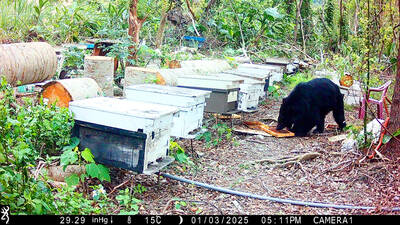
The Forestry and Nature Conservation Agency yesterday launched a gift box to market honey “certified by a Formosan black bear” in appreciation of a beekeeper’s amicable interaction with a honey-thieving bear. Beekeeper Chih Ming-chen (池明鎮) in January inspected his bee farm in Hualien County’s Jhuosi Township (卓溪) and found that more than 20 beehives had been destroyed and many hives were eaten, with bear droppings and paw prints near the destroyed hives, the agency said. Chih returned to the farm to move the remaining beehives away that evening when he encountered a Formosan black bear only 20m away, the agency said. The bear
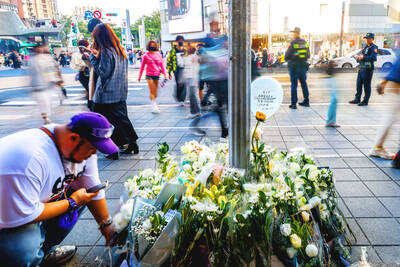
HORROR STORIES: One victim recounted not realizing they had been stabbed and seeing people bleeding, while another recalled breaking down in tears after fleeing A man on Friday died after he tried to fight the knife-wielding suspect who went on a stabbing spree near two of Taipei’s busiest metro stations, Taipei Mayor Chiang Wan-an (蔣萬安) said. The 57-year-old man, identified by his family name, Yu (余), encountered the suspect at Exit M7 of Taipei Main Station and immediately tried to stop him, but was fatally wounded and later died, Chiang said, calling the incident “heartbreaking.” Yu’s family would receive at least NT$5 million (US$158,584) in compensation through the Taipei Rapid Transit Corp’s (TRTC) insurance coverage, he said after convening an emergency security response meeting yesterday morning. National


 RSS
RSS