


National Taiwan University (NTU) should disclose the names of its ad hoc investigation committee’s members to prove that its probe into allegedly falsified journal papers cowritten by NTU president Yang Pan-chyr (楊泮池) and professor Kuo Min-liang (郭明良) was conducted in a fair and objective manner, Academia Sinica research fellow Juan Li-jung (阮麗蓉) said yesterday.
At a news conference in Taipei, Juan said that Yang could have acquiesced to Kuo’s academic misconduct over the past 10 years, citing a close working relationship between the two.
Yang, who in 2007 became dean of the university’s College of Medicine, hired Kuo as the college’s vice dean that year, Juan said.
In 2009, Kuo was appointed as director-general of the Department of Life Science of the then-National Science Council — now the Ministry of Science of Technology — on a referral by Yang.
Yang was the second author of a 2006 paper published by leading journal Cancer Cell, while Kuo was the supervisor for the paper’s research.
The paper underwent three “major” corrections in 2007 and 2008, but not only did Yang not take heed of the mistakes, he allowed Kuo to eventually become dean of the university’s College of Life Science in 2012 and supervise a string of allegedly falsified research, Juan said.
The paper has been under a spotlight after academic fraud scandals allegedly involving Kuo erupted late last year.
However, despite facing questions from academics over problematic data originally cited by the paper, all Yang has said is that it has been corrected.
To ensure that there is no undue influence on the investigations under way by the ministries of science and technology and education, Yang should recuse himself of his duties, Juan said, adding that former Academia Sinica president Lee Yuan-tseh (李遠哲) last month made the same suggestion to Yang.
If Yang is reluctant about a suspension, the university should publish the list of ad hoc committee members to back its claim that there were no conflicts of interest in its investigation, she said.
Juan said the ministries’ investigations are based on conclusions by the school, which found that Yang is innocent and bears no responsibility for the problematic papers.
As Yang’s academic achievements far outweigh those of Minister of Science and Technology Chen Liang-gee (陳良基) — a former NTU vice president and Yang’s former colleague — and Minister of Education Pan Wen-chung (潘文忠), Juan said that the two ministries might collude to protect Yang.
The ministries should recall research grants issued to subsidize potentially falsified research by Kuo and Yang and form an intergovernmental supervisory mechanism to prevent academic fraud, Juan said.
Ministry of Education Department of Higher Education Director Nicole Lee (李彥儀) rejected Juan’s claim that its investigation would be based on the results of the NTU committee’s probe.
The investigation committees of both ministries are to review 17 potentially problematic papers by Kuo’s research team submitted by NTU and reach a unified conclusion after discussions, Lee said.
Academics linked to the problematic papers are to be summoned by the committees for questioning before any conclusions are made, Pan said.
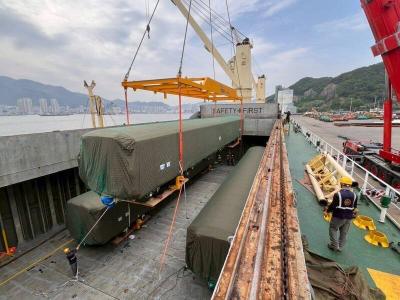
The first of 10 new high-capacity trains purchased from South Korea’s Hyundai Rotem arrived at the Port of Taipei yesterday to meet the demands of an expanding metro network, Taipei Rapid Transit Corp (TRTC) said yesterday. The train completed a three-day, 1,200km voyage from the Port of Masan in South Korea, the company said. Costing NT$590 million (US$18.79 million) each, the new six-carriage trains feature a redesigned interior based on "human-centric" transportation concepts, TRTC said. The design utilizes continuous longitudinal seating to widen the aisles and optimize passenger flow, while also upgrading passenger information displays and driving control systems for a more comfortable
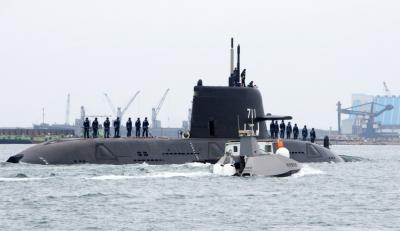
Taiwan's first indigenous defense submarine, the SS-711 Hai Kun (海鯤, or Narwhal), departed for its 13th sea trial at 7am today, marking its seventh submerged test, with delivery to the navy scheduled for July. The outing also marked its first sea deployment since President William Lai (賴清德) boarded the submarine for an inspection on March 19, drawing a crowd of military enthusiasts who gathered to show support. The submarine this morning departed port accompanied by CSBC Corp’s Endeavor Manta (奮進魔鬼魚號) uncrewed surface vessel and a navy M109 assault boat. Amid public interest in key milestones such as torpedo-launching operations and overnight submerged trials,
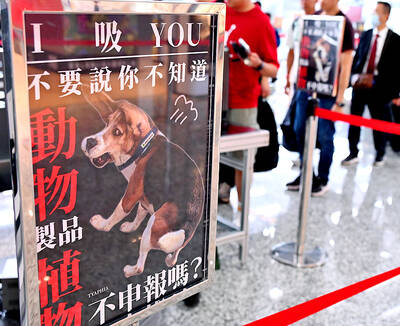
Quarantine awareness posters at Taiwan Taoyuan International Airport have gone viral for their use of wordplay. Issued by the airport branch of the Animal and Plant Health Inspection Agency, the posters feature sniffer dogs making a range of facial expressions, paired with advisory messages built around homophones. “We update the messages for holidays and campaign needs, periodically refreshing materials to attract people’s attention,” quarantine officials said. “The aim is to use the dogs’ appeal to draw focus to quarantine regulations.” A Japanese traveler visiting Taiwan has posted a photo on X of a poster showing a quarantine dog with a
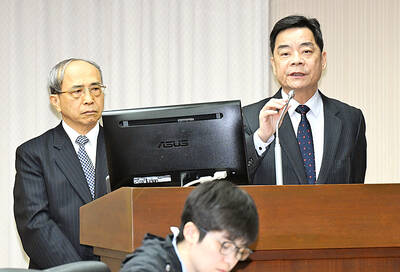
SECURITY RISK: A university student sent a general alarm signal to THSRC’s control center on April 5, causing four operating trains to temporarily halt services The Ministry of Transportation and Communications yesterday pledged to submit a report on ways to harden the communication security of railway systems after a university student hacked into Taiwan High Speed Rail Corp’s (THSRC) radio communications system and disrupted operations of four high-speed rail trains last month. Investigation by the police and prosecutors found that the university student and radio enthusiast, surnamed Lin (林), first used a software-defined radio (SDR) filter to analyze THSRC signals, downloaded the data to a computer, cracked the parameters and then programmed the codes into his radio devices. Lin then sent a general alarm signal to


 RSS
RSS