


Former American Institute in Taiwan (AIT) director William Stanton yesterday urged Taiwan to “overcome [its] protectionist feelings” in trade agreements and negotiations, because “you’ve got to give if you’re gonna get.”
Stanton was speaking on a panel organized by the Columbia Alumni Association of Taiwan exploring “Taiwan’s crises and opportunities” in a “new world order in the [US President Donald] Trump era.”
Democratic Progressive Party (DPP) Legislator Hsiao Bi-khim (蕭美琴) and Chinese Nationalist Party (KMT) Legislator Jason Hsu (許毓仁) were also on the panel.
“Taiwan should always be working toward a bilateral trade agreement with the US even if the Trans-Pacific Partnership [TPP] falls through the floor,” Stanton said. “You’ve got to expand your diversity.”
“Taiwan’s GDP is less than 1 percent dependent on agriculture,” he said. “You are a trading nation; 70 percent of your GDP depends on export of goods and services, so you have to export, but it’s not pigs or pork that you’re exporting. You have to think realistically about what your strengths and weaknesses are.”
Stanton said he did not speak on the behalf of the US government, but as a friend of Taiwan.
Hsiao earlier said the greatest challenge for Taiwan in trade and economic relations with the US is the change in the US’ general strategy regarding Asia, which has led to the end of US participation in the TPP.
“The US’ withdrawal from the TPP compels us to rethink our strategy and refocus on bilateral trade relations, not only with the US, but also with China, Japan and other TPP members in Southeast Asia,” Hsiao said.
“In terms of bilateral trade possibilities [with the US], it is not clear even after we visited Washington to figure out what was happening there,” Hsiao said, referring to a cross-party delegation of legislators who visited the US in the middle of last month.
There is indeed a degree of uncertainty over the Trump administration’s Asia policy, “but a few things are clear, that is that we have not been ruled out as a partner for the US as it considers a new set of bilateral trade negotiations. It is important for us to grasp that opportunity,” she said.
“It is a two-way street” in that potential bilateral agreements with the US would not only rely on Washington to make Taiwan a priority on the negotiation list, but also “certain regulatory adjustments in our domestic infrastructure, as well as our dealings with politically sensitive issues such as agricultural products and other less politically fumed, but equally difficult issues such as pharmaceutical, digital economy and technology services,” she said.
Hsu said that during the delegation’s visit, “we asked if Taiwan could be at the table for the next round of trade negotiations, but there are several factors that play into this, for example the pork import issue, which is I think the most significant factor.”
“However, during one of our meetings it was suggested that Taiwan should come up with its own trade framework instead of waiting” on Trump, Hsu said.
Another opportunity for Taiwan Stanton raised was an “increased likelihood of arms sales.”
“I think Taiwan now has the best chance ever to get whatever it wants if it goes for it,” Stanton said. “Why? Well you may remember [what Trump said on Twitter] after he got criticized for his phone call with President Tsai Ing-wen [蔡英文]: ‘Interesting how the US sells Taiwan billions of dollars of military equipment, but I should not accept a congratulatory call.’”
“It’s on his mind that [the US] is making money in Taiwan,” Stanton said.
“And, if it comes as predicted as [former AIT head] Steve Young said [that] there is a new AIT facility, and I think it’s a great opportunity that Taiwan should seize to celebrate and promote Taiwan-US relations to invite high-level US visitors from all walks, but also initiate new initiatives,” he added.
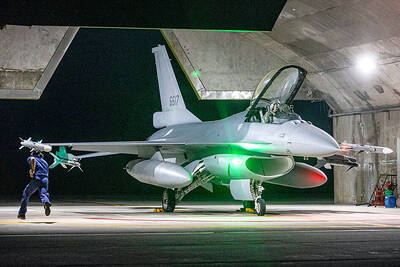
Taiwan has received more than US$70 million in royalties as of the end of last year from developing the F-16V jet as countries worldwide purchase or upgrade to this popular model, government and military officials said on Saturday. Taiwan funded the development of the F-16V jet and ended up the sole investor as other countries withdrew from the program. Now the F-16V is increasingly popular and countries must pay Taiwan a percentage in royalties when they purchase new F-16V aircraft or upgrade older F-16 models. The next five years are expected to be the peak for these royalties, with Taiwan potentially earning
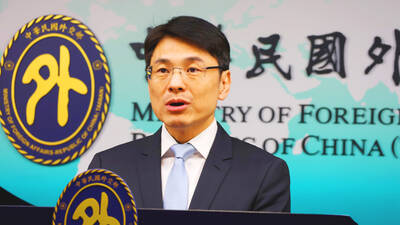
STAY IN YOUR LANE: As the US and Israel attack Iran, the ministry has warned China not to overstep by including Taiwanese citizens in its evacuation orders The Ministry of Foreign Affairs (MOFA) yesterday rebuked a statement by China’s embassy in Israel that it would evacuate Taiwanese holders of Chinese travel documents from Israel amid the latter’s escalating conflict with Iran. Tensions have risen across the Middle East in the wake of US and Israeli airstrikes on Iran beginning Saturday. China subsequently issued an evacuation notice for its citizens. In a news release, the Chinese embassy in Israel said holders of “Taiwan compatriot permits (台胞證)” issued to Taiwanese nationals by Chinese authorities for travel to China — could register for evacuation to Egypt. In Taipei, the ministry yesterday said Taiwan
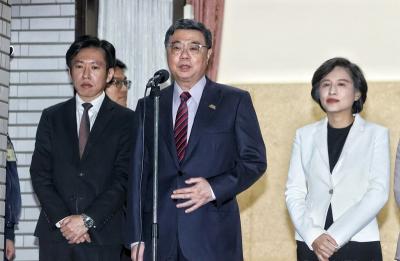
Taiwan is awaiting official notification from the US regarding the status of the Agreement on Reciprocal Trade (ART) after the US Supreme Court ruled US President Donald Trump's global tariffs unconstitutional. Speaking to reporters before a legislative hearing today, Premier Cho Jung-tai (卓榮泰) said that Taiwan's negotiation team remains focused on ensuring that the bilateral trade deal remains intact despite the legal challenge to Trump's tariff policy. "The US has pledged to notify its trade partners once the subsequent administrative and legal processes are finalized, and that certainly includes Taiwan," Cho said when asked about opposition parties’ doubts that the ART was
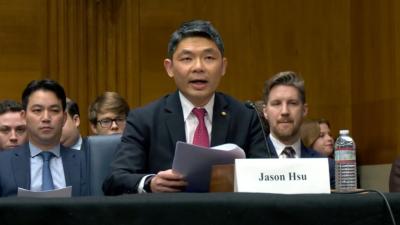
If China chose to invade Taiwan tomorrow, it would only have to sever three undersea fiber-optic cable clusters to cause a data blackout, Jason Hsu (許毓仁), a senior fellow at the Hudson Institute and former Chinese Nationalist Party (KMT) legislator, told a US security panel yesterday. In a Taiwan contingency, cable disruption would be one of the earliest preinvasion actions and the signal that escalation had begun, he said, adding that Taiwan’s current cable repair capabilities are insufficient. The US-China Economic and Security Review Commission (USCC) yesterday held a hearing on US-China Competition Under the Sea, with Hsu speaking on


 RSS
RSS