


The sixth meeting of a fishing commission established by Taiwan and Japan yesterday opened in Tokyo to discuss fishing in waters near the Diaoyutai Islands (釣魚台) and other issues, the Ministry of Foreign Affairs said.
During the three-day meeting, the two sides are to address unresolved issues related to fishing rules and guidelines in the waters around the disputed islands in the East China Sea that were covered by a bilateral agreement signed in 2013, the ministry said in a statement.
Association of East Asian Relations Secretary-General Peter Tsai (蔡明耀) is leading Taiwan’s delegation, which includes officials from other government agencies and fishermen, it said.
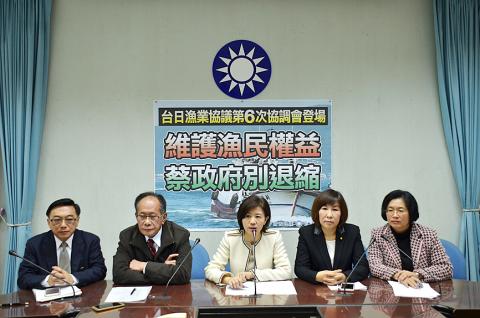
Photo: Courtesy of the KMT legislative caucus
The Japan-Taiwan Exchange Association also issued a statement saying that the meeting is being held ahead of the fishing season so that the two sides can exchange views on whether the existing rules need to be adjusted.
The Taiwan-Japan fishing commission was established as part of an agreement signed in April 2013 by the two nations on fishing rights in the East China Sea near the islands, known as the Senkakus in Japan.
Under the terms of the agreement, Taiwanese and Japanese boats can operate freely in a 74,300km2 area around the uninhabited islets.
The Diaoyutais, which are about 100 nautical miles (185km) northeast of Taiwan, have been under Japan’s administrative control since 1972, but are also claimed by Taiwan and China.
The Japan-controlled Okinotori atoll is another place where fishing disputes between Taiwan and Japan have occurred, and Chinese Nationalist Party (KMT) Legislator Alicia Wang (王育敏) yesterday urged the government to bring up the Okinotori dispute at the meeting.
However, the ministry said the commission only deals with issues related to waters near the Diaoyutais.
The government has in the past vowed to hold talks with Japan to protect the fishing rights of Taiwanese fishermen near Okinotori, which is about 1,600km from Taiwan’s southern tip.
It has said that while Japan has sovereignty over Okinotori, the definition of Okinotori — whether it is an island or an atoll — is unclear.
Until the international community reaches a consensus on the issue, Japan should respect the freedom of Taiwan and other nations to fish in waters near Okinotori, the ministry has said.
Taiwan and Japan decided to establish a dialogue on maritime cooperation issues on May 23 last year in response to a dispute over a Taiwanese fishing boat being detained by Japan the previous month on the high seas near Okinotori.
The first meeting of the dialogue took place in Tokyo in October and the Okinotori issue was raised but the two sides failed to reach a consensus as Taiwan reiterated that Taiwanese fishermen have the right to operate in waters near Okinotori, while Japan repeated its stance that Okinotori is an island, which means it is entitled to a 200 nautical mile exclusive economic zone.

LOUD AND PROUD Taiwan might have taken a drubbing against Australia and Japan, but you might not know it from the enthusiasm and numbers of the fans Taiwan might not be expected to win the World Baseball Classic (WBC) but their fans are making their presence felt in Tokyo, with tens of thousands decked out in the team’s blue, blowing horns and singing songs. Taiwanese fans have packed out the Tokyo Dome for all three of their games so far and even threatened to drown out home team supporters when their team played Japan on Friday. They blew trumpets, chanted for their favorite players and had their own cheerleading squad who dance on a stage during the game. The team struggled to match that exuberance on the field, with

Whether Japan would help defend Taiwan in case of a cross-strait conflict would depend on the US and the extent to which Japan would be allowed to act under the US-Japan Security Treaty, former Japanese minister of defense Satoshi Morimoto said. As China has not given up on the idea of invading Taiwan by force, to what extent Japan could support US military action would hinge on Washington’s intention and its negotiation with Tokyo, Morimoto said in an interview with the Liberty Times (sister paper of the Taipei Times) yesterday. There has to be sufficient mutual recognition of how Japan could provide
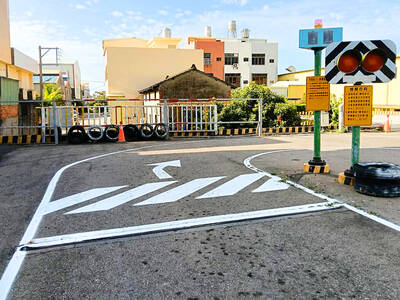
UPDATED TEST: The new rules aim to assess drivers’ awareness of risky behaviors and how they respond under certain circumstances, the Highway Bureau said Driver’s license applicants who fail to yield to pedestrians at intersections or to check blind spots, or omit pointing-and-calling procedures would fail the driving test, the Highway Bureau said yesterday. The change is set to be implemented at the end of the month, and is part of the bureau’s reform of the driving portion of the test, which has been criticized for failing to assess whether drivers can operate vehicles safely. Sedan drivers would be tested regarding yielding to pedestrians and turning their heads to check blind spots, while drivers of large vehicles would be tested on their familiarity with pointing-and-calling

A Taiwanese man apologized on Friday after saying in a social media post that he worked with Australia to provide scouting reports on Taiwan’s team, enabling Australia’s victory in this year’s World Baseball Classic (WBC), saying it was a joke and that he did not hold any position with foreign teams or Taiwan’s sports training center. Chen Po-hao (陳柏豪) drew the rage of many Taiwan baseball fans when he posted online on Thursday night, claiming credit for Australia’s 3-0 win over Taiwan in the opening game for Pool C, saying he worked as a physical therapist with the national team and


 RSS
RSS