


Though seismologists have proven the existence of a magma chamber under the Datun Volcanic Group (大屯火山群), the Central Weather Bureau said yesterday that the finding does not mean that the volcanoes in the group are active.
The Datun Volcanic Group is located within Yangmingshan National Park in Taipei and it consists of about 20 volcanoes near the north coast of the nation, including Datunshan (大屯山) and Cisingshan (七星山).
Academia Sinica researcher Lam Ching-hung (林正洪), who is also the director of the seismic observation station on Datunshan, published his research at the end of last year in the journal Scientific Reports.
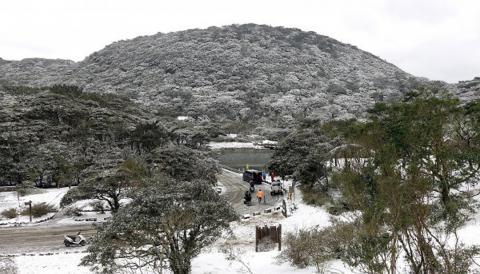
Photo: Fang Pin-chao, Taipei Times
The research showed that there is a magma chamber about 20km beneath the Datun Volcanic Group and that the chamber, a large underground pool of liquid rock, is about one-fourth the size of Taipei.
Media reports of Lam’s research triggered fears of the possibility that one of the Datun Volcanic Group could erupt, particularly because the group is so close to the largest metropolitan area in the nation, as well as two nuclear power plants.
Central Weather Bureau Director-General Shin Tzay-chyn (辛在勤) yesterday said Lam’s studies only prove that there is a magma chamber underneath Taipei, adding that Lam concluded his study by saying that more research is required to understand the characteristics of the magma chamber.
Shin was puzzled that people would think Lam’s research means that the Datun Volcanic Group is active and would erupt, since Lam mentioned none of this in his paper.
“One cannot say that the Datun Volcanic Group contains active volcanoes simply because there is a magma chamber underneath it, because all the volcanoes that have erupted in the past would have had magma chambers underneath them or else they would not have erupted in the first place,” Shin said. “We did not dispute the existence of such a magma chamber, we just did not know where it was. Lam’s research specifically pointed out that the chamber is about 20km under the ground. However, the point is whether the volcanoes would evolve to become active or extinct. Both outcomes are possible.”
Shin said a few years ago scientists pointed to some evidence that showed that the Datun Volcanic Group had erupted 5,000 years ago, although the theory was not accepted by all seismologists.
However, they all agreed that the Datun Volcanic Group had erupted approximately 100,000 to 200,000 years ago, he said.
Asked what signs would show that a volcano is becoming increasingly active, Shin said that one sign to observe is if small earthquakes happen more frequently, because it shows that the magma chamber is gradually moving close to the surface.
“Another sign would be the depth of the epicenters of the earthquakes, whether they are getting closer to the surface. These two factors would help determine if the magma chamber is moving upward,” he said.
So far, the bureau has yet to detect any increase in the frequency of small earthquakes or other seismic activity in the Datun Volcanic Group that would point to the development of an active volcano, Shin said.
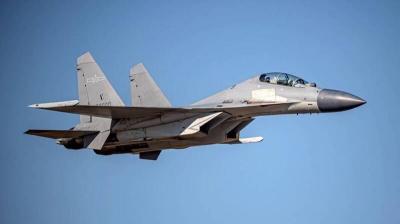
Eight Chinese naval vessels and 24 military aircraft were detected crossing the median line of the Taiwan Strait between 6am yesterday and 6am today, the Ministry of National Defense said this morning. The aircraft entered Taiwan’s northern, central, southwestern and eastern air defense identification zones, the ministry said. The armed forces responded with mission aircraft, naval vessels and shore-based missile systems to closely monitor the situation, it added. Eight naval vessels, one official ship and 36 aircraft sorties were spotted in total, the ministry said.
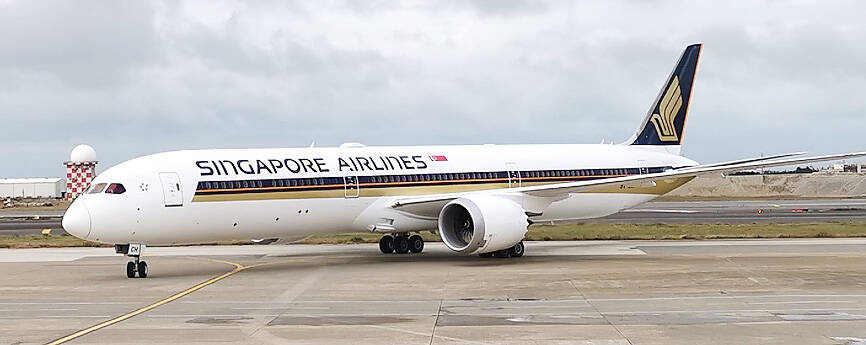
INCREASED CAPACITY: The flights on Mondays, Wednesdays, Fridays and Sundays would leave Singapore in the morning and Taipei in the afternoon Singapore Airlines is adding four supplementary flights to Taipei per week until May to meet increased tourist and business travel demand, the carrier said on Friday. The addition would raise the number of weekly flights it operates to Taipei to 18, Singapore Airlines Taiwan general manager Timothy Ouyang (歐陽漢源) said. The airline has recorded a steady rise in tourist and business travel to and from Taipei, and aims to provide more flexible travel arrangements for passengers, said Ouyang, who assumed the post in July last year. From now until Saturday next week, four additional flights would depart from Singapore on Monday, Wednesday, Friday
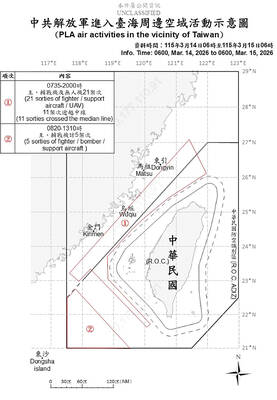
The Ministry of National Defense yesterday reported the return of large-scale Chinese air force activities after their unexplained absence for more than two weeks, which had prompted speculation regarding Beijing’s motives. China usually sends fighter jets, drones and other military aircraft around the nation on a daily basis. Interruptions to such routine are generally caused by bad weather. The Ministry of National Defense said it had detected 26 Chinese military aircraft in the Taiwan Strait over the previous 24 hours. It last reported that many aircraft on Feb. 25, when it spotted 30 aircraft, saying Beijing was carrying out another “joint combat

Taiwan successfully defended its women’s 540 kilogram title and won its first-ever men’s 640 kg title at the 2026 World Indoor Tug of War Championships in Taipei yesterday. In the women’s event, Taiwan’s eight-person squad reached the final following a round-robin preliminary round and semifinals featuring teams from Ukraine, Japan, Thailand, Vietnam, the Basque Country and South Korea. In the finals, they swept the Basque team 2-0, giving the team composed mainly of National Taiwan Normal University students and graduates its second championship in a row, and its fourth in five years. Team captain


 RSS
RSS