


Authorities yesterday confirmed that a turkey farm in Tainan has been infected with the H5N6 avian influenza virus and that a cull has been carried out.
Other poultry farms within a 3km to 5km radius of the infected farm in Lioujia District (六甲) are to be monitored, but so far no other cases have been reported, the Bureau of Animal and Plant Health Inspection and Quarantine said.
It was the second confirmed case in the nation after Hualien County on Feb. 5 reported a dead gosling infected with the H5N6 virus at a Yuli Township (玉里) farm and the infection in that case was confirmed on Saturday.
A ban prohibiting the transportation of waterfowl from Hualien County to other parts of the nation was imposed on Monday last week and is to run through Tuesday next week.
However, the ban came a day too late for scores of workers in Yilan County.
Ducks from a farm within a 3km radius of where the infected gosling was found were transported to an Yilan slaughterhouse the day before the ban was announced.
That batch of ducks tested positive for the H5N6 virus and authorities said that all 3,787 frozen duck carcasses have been destroyed.
Centers for Disease Control (CDC) Deputy Director-General Philip Lo (羅一鈞) said that 245 people who had been within a 3km radius of where the dead gosling was found had been monitored for possible H5N6 avian flu infection last week, and 244 were removed from the watch list yesterday.
However, another 74 people are being monitored, Lo said.
The new group includes a farmer from Hualien who was a holdover from the first group, three drivers that transported the batch of ducks from that man’s farm to a slaughterhouse in Yilan County and 70 others, including slaughterhouse workers, veterinarians and disease-prevention personnel who took part in destroying duck carcasses at the slaughterhouse, Lo said.
They are to be monitored until Tuesday next week, he said.
Council of Agriculture Deputy Minister Chen Chi-chung (陳吉仲) yesterday said the council has suggested to the Executive Yuan that it establish a “Central Epidemic Response Center” to prevent the virus from spreading.
The H5N6 avian flu virus has been reported in humans in China, which has prompted the CDC to remind people who work with poultry and birds to enhance disease prevention measures, wear surgical masks and seek medical attention immediately if flu-like symptoms occur.
In addition, the public should avoid touching live birds or picking up dead birds, and remember to cook eggs and poultry meat thoroughly, and wash hands thoroughly with soap after handling raw poultry or eggs, the agency said.
Additional reporting by Lin Yan-tung

LOUD AND PROUD Taiwan might have taken a drubbing against Australia and Japan, but you might not know it from the enthusiasm and numbers of the fans Taiwan might not be expected to win the World Baseball Classic (WBC) but their fans are making their presence felt in Tokyo, with tens of thousands decked out in the team’s blue, blowing horns and singing songs. Taiwanese fans have packed out the Tokyo Dome for all three of their games so far and even threatened to drown out home team supporters when their team played Japan on Friday. They blew trumpets, chanted for their favorite players and had their own cheerleading squad who dance on a stage during the game. The team struggled to match that exuberance on the field, with
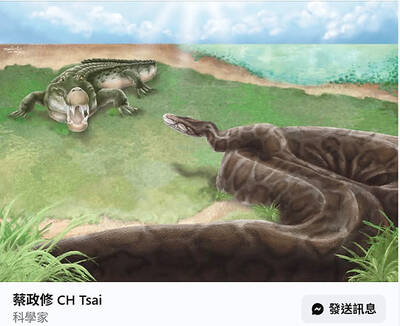
Taiwanese paleontologists have discovered fossil evidence that pythons up to 4m long inhabited Taiwan during the Pleistocene epoch, reporting their findings in the international scientific journal Historical Biology. National Taiwan University (NTU) Institute of Ecology and Evolutionary Biology associate professor Tsai Cheng-hsiu (蔡政修) led the team that discovered the largest snake fossil ever found in Taiwan. The single trunk vertebra was discovered in Tainan at the Chiting Formation, dated to between 400,000 and 800,000 years ago in the Middle Pleistocene, the paper said. The area also produced Taiwan’s first avian fossil, as well as crocodile, mammoth, saber-toothed cat and rhinoceros fossils, it said. Discoveries

Taiwanese paleontologists have discovered fossil evidence that pythons up to 4m long inhabited Taiwan during the Pleistocene epoch, reporting their findings in the international scientific journal Historical Biology. National Taiwan University (NTU) Institute of Ecology and Evolutionary Biology associate professor Tsai Cheng-hsiu (蔡政修) led the team that discovered the largest snake fossil ever found in Taiwan. A single trunk vertebra was discovered in Tainan at the Chiting Formation, dated to between 800,000 to 400,000 years ago in the Middle Pleistocene, the paper said. The area also produced Taiwan’s first avian fossil, as well as crocodile, mammoth, sabre-toothed cat and rhinoceros fossils, it said. Discoveries

Whether Japan would help defend Taiwan in case of a cross-strait conflict would depend on the US and the extent to which Japan would be allowed to act under the US-Japan Security Treaty, former Japanese minister of defense Satoshi Morimoto said. As China has not given up on the idea of invading Taiwan by force, to what extent Japan could support US military action would hinge on Washington’s intention and its negotiation with Tokyo, Morimoto said in an interview with the Liberty Times (sister paper of the Taipei Times) yesterday. There has to be sufficient mutual recognition of how Japan could provide


 RSS
RSS