


Mongolian and Tibetan Affairs Commission Minister Lin Mei-chu’s (林美珠) appointment as minister of labor drew a mixed reaction from labor rights advocates yesterday, with calls for her to show independence as the government moves forward with pension reform.
“While I certainly would not say that she has been promoted or gained unfair advancement because she is President Tsai Ing-wen’s (蔡英文) cousin, I am concerned with whether she would side with workers against presidential directives,” Taipei City Confederation of Trade Unions executive director Chen Shu-lun (陳淑綸) said.
While Lin is a career bureaucrat who served as deputy minister of the interior in former president Chen Shui-bian’s (陳水扁) administration, that she is Tsai’s cousin has led to speculation that she will be closer to the president than a typical labor minister.
“In protecting workers’ interests, the labor minister often has to engage in a tug of war with the business community and the Ministry of Economic Affairs, so always standing with the president could create problems,“ Chen said, adding that Lin’s response to the government’s proposed cuts to labor pensions would be a key challenge.
“She is immediately going to run into the issue of pension reform — which is extremely vast and complex, and that makes it extremely worrying that she has been selected to take over the ministry, because she does not have any related background,” she said, adding that while Lin has a legal background, the new minister lacks both knowledge and exposure to labor issues and the technicalities of labor law.
“The Ministry of Labor does not lack legal expertise and one of the deputy ministers used to be a lawyer. What the ministry’s leadership does lack is people familiar specifically with labor law who also understand the present situation of workers,” she said, calling for Lin to push back against proposed pension cuts.
Rather than cutting benefits, workers should be required to pay more into pension funds, while new corporate taxes should be used to fund a universal basic benefit, she said.
Taiwan Confederation of Trade Unions secretary-general Tai Kuo-jung (戴國榮) said that while Lin was a surprising choice, her relationship with Tsai might prove an asset because of her access to the president, potentially making it easier for her to address policy hold-ups.
He called for her to focus on raising salaries and increasing job opportunities for young people, as well as addressing the “responsibility system,” “flexible working hours” and other “loopholes” that he said allow employers to avoid overtime regulations.
Additional reporting by Huang Pang-ping
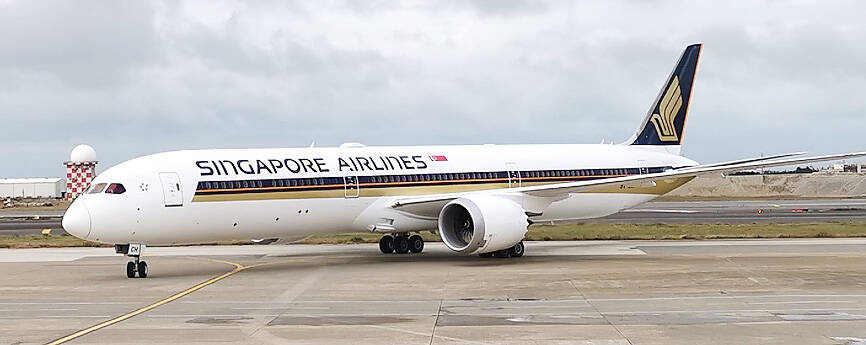
INCREASED CAPACITY: The flights on Mondays, Wednesdays, Fridays and Sundays would leave Singapore in the morning and Taipei in the afternoon Singapore Airlines is adding four supplementary flights to Taipei per week until May to meet increased tourist and business travel demand, the carrier said on Friday. The addition would raise the number of weekly flights it operates to Taipei to 18, Singapore Airlines Taiwan general manager Timothy Ouyang (歐陽漢源) said. The airline has recorded a steady rise in tourist and business travel to and from Taipei, and aims to provide more flexible travel arrangements for passengers, said Ouyang, who assumed the post in July last year. From now until Saturday next week, four additional flights would depart from Singapore on Monday, Wednesday, Friday

Taiwan’s three major international carriers are increasing booking fees, with EVA Airways having already increased the charge to US$28 per flight segment from US$25, while China Airlines (CAL) and Starlux Airlines are set to follow suit. Booking fees are charged by airlines through a global distribution system (GDS) and passed on to passengers. Carriers that apply the fees include CAL, EVA, Starlux and Tigerair Taiwan. A GDS is a computerized network operated by a company that connects airlines with travel agents and ticketing platforms, allowing reservations to be made and processed in real time. Major players include Amadeus, Sabre and Travelport. EVA Air began
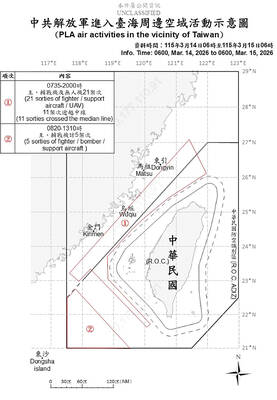
The Ministry of National Defense yesterday reported the return of large-scale Chinese air force activities after their unexplained absence for more than two weeks, which had prompted speculation regarding Beijing’s motives. China usually sends fighter jets, drones and other military aircraft around the nation on a daily basis. Interruptions to such routine are generally caused by bad weather. The Ministry of National Defense said it had detected 26 Chinese military aircraft in the Taiwan Strait over the previous 24 hours. It last reported that many aircraft on Feb. 25, when it spotted 30 aircraft, saying Beijing was carrying out another “joint combat
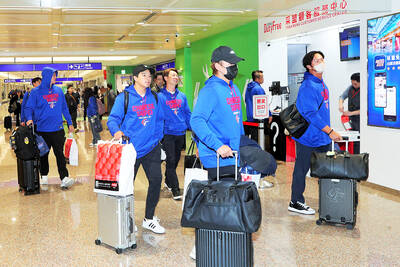
WATCH FOR HITCHHIKERS: The CDC warned those returning home from Japan to be alert for any contagious diseases that might have come back with them People who have returned from Japan following the World Baseball Classic (WBC) games during the weekend are recommended to watch for symptoms of infectious gastroenteritis, flu and measles for two weeks, the Centers for Disease Control (CDC) said. Flu viruses remain the most common respiratory pathogen in Taiwan in the past four weeks and the influenza B virus accounted for 55.7 percent of the tested cases, exceeding the percentage of influenza A (H3N2) infections and becoming the local dominant strain, CDC Epidemic Intelligence Center Deputy Director Lee Chia-lin (李佳琳) said at a news conference on Tuesday. There were 82,187 hospital visits for


 RSS
RSS