


Chinese Ambassador to Washington Cui Tiankai (崔天凱) on Tuesday characterized Taiwanese officials as having a “lackey mentality” after a Taiwanese delegation met with US politicians.
Led by former premier Yu Shyi-kun (游錫堃), the delegation visited the US to attend US President Donald Trump’s inauguration ceremony in Washington on Friday last week.
Cui said on the sidelines of a Lunar New Year reception at the Chinese embassy that “there have been some opportunistic politicians from Taiwan making some petty moves” while the US is undergoing an administration change.
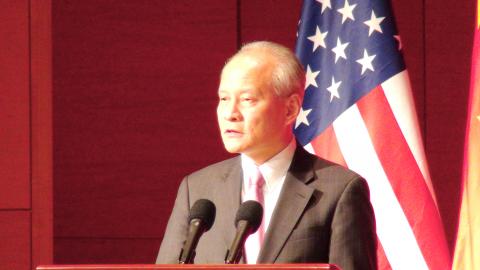
Photo: CNA
“Some people think that they have met somebody after coming to the US and felt self-complacent about it; I consider it a kind of lackey mentality,” Cui said.
When asked about the possibility of Trump revisiting the “one China” policy and Taiwan’s concern about becoming a bargaining chip in China-US deals, Cui said that if Taipei wants to avoid becoming a bargaining chip, “just return to the foundation of the [so-called] ‘1992 consensus’ and recognize that the two sides of the Taiwan Strait belong to ‘one China’ and the people on both sides are Chinese.”
“Once this great principle of the nation is understood, [Taiwan] has nothing to worry about, as it would be standing with the 1.3 billion Chinese,” he said.
“However, if you have to separate yourself from or pit yourself against the 1.3 billion Chinese, then there is more for you to worry about” other than becoming a bargaining chip, Cui said.
He said that the “one China” policy is the political foundation for China-US relations.
“We firmly uphold the ‘one China’ principle; it is unshakable and nonnegotiable,” he said.
Democratic Progressive Party Legislator Lo Chih-cheng (羅致政) said in Taipei yesterday that interactions between Taiwanese and US officials are precisely the “product of Chinese oppression.”
Cui’s words “were merely sour grapes, because a meeting of any kind between our people and US officials is a breakthrough,” Lo said.
Chinese Nationalist Party (KMT) caucus convener Sufin Siluko (廖國棟) said “it is up to us to decide whether [we are being] lackeys; it is none of [China’s] business and it should focus on taking care of its own business.”
New Power Party Legislator Freddy Lim (林昶佐), a member of the delegation, said China should not be taken aback by other nations engaging in exchanges, “which is perfectly normal.”
Regarding South China Sea issues, Cui said that there are territorial and maritime disputes between China and some ASEAN members, but it is not an issue of geopolitical strategy or competition, nor is it a problem between China and the US, as the latter has no territorial claims in the region.
Things are improving between China and ASEAN members that China has disputes with, he said, adding that “against this backdrop, any country from outside the region should promote regional cooperation to return peace and stability back to the South China Sea, rather than doing the opposite.”
He reiterated that China cares about navigational safety and freedom in the region more than anyone else, as the South China Sea is “right on China’s footstep” and it relies on passage through it for trade.
He said as the China-US trade relationship is based on achieving mutual interests and a win-win situation, China is firmly opposed to a trade war with Washington, because both sides would suffer as a result.
The US should develop a strong and stable economic and trade relationship with China if it wants to make gains in this big market, Cui said.
Additional reporting by Alison Hsiao
Fast food chain McDonald's is to raise prices by up to NT$5 on some products at its restaurants across Taiwan, starting on Wednesday next week, the company announced today. The prices of all extra value meals and sharing boxes are to increase by NT$5, while breakfast combos and creamy corn soup would go up by NT$3, the company said in a statement. The price of the main items of those meals, if ordered individually, would remain the same. Meanwhile, the price of a medium-sized lemon iced tea and hot cappuccino would rise by NT$3, extra dipping sauces for chicken nuggets would go up

Yangmingshan National Park’s Qingtiangang (擎天崗) nature area has gone viral after a park livestream camera observed a couple in the throes of intimate congress, which was broadcast live on YouTube, drawing large late-night crowds and sparking a backlash over noise, bright lights and disruption to wildlife habitat. The area’s livestream footage appeared to show a couple engaging in sexual activity on a picnic table in the park on Friday last week, with the uncensored footage streamed publicly online. The footage quickly spread across social media, prompting a tide of visitors to travel to the site to “check in” and recreate the

Minister of Digital Affairs Lin Yi-ching (林宜敬) yesterday cited regulatory issues and national security concerns as an expert said that Taiwan is among the few Asian regions without Starlink. Lin made the remarks on Facebook after funP Innovation Group chief executive officer Nathan Chiu (邱繼弘) on Friday said Taiwan and four other countries in Asia — China, North Korea, Afghanistan and Syria — have no access to Starlink. Starlink has become available in 166 countries worldwide, including Ukraine, Malaysia, the Philippines and Vietnam, in the six years since it became commercial, he said. While China and North Korea block Starlink, Syria is not
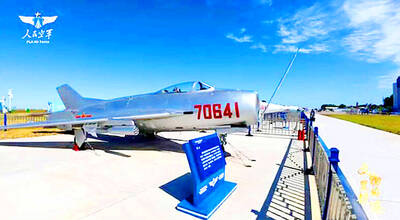
GROUNDED: A KMT lawmaker proposed eliminating drone development programs and freezing funding for counterdrone systems, despite China’s adoption of the technology China has deployed attack drones at air bases near the Taiwan Strait in a strategy aimed at overwhelming Taiwan’s air defense systems through saturation attacks, the Mainland Affairs Council (MAC) said. The council’s latest quarterly report on China said that satellite imagery and open-source intelligence indicate that the Chinese People’s Liberation Army (PLA) had converted retired J-6 fighter jets into J-6W drones, which the PLA has stationed at six air bases near Taiwan, five in China’s Fujian Province and one in Guangdong Province. The report cited J. Michael Dahm, a senior fellow at the US-based Mitchell Institute, as saying that China has


 RSS
RSS