


Former vice president Wu Den-yih (吳敦義) yesterday said that Beijing, “if wise,” would want to maintain the so-called “1992 consensus” as there is no point of taking Taiwan by force, which would cost billions of dollars and incite Taiwanese hatred.
In a radio interview with Clara Chou (周玉蔻), Wu was asked whether he has received any calls from Beijing inquiring about his Chinese Nationalist Party (KMT) chairmanship bid, “like former KMT vice chairman Steve Chan (詹啟賢) said he had.”
Chou was referring to Chan’s revelation on Monday last week — before he announced his candidacy for KMT chairman in the May 20 election — that China’s Taiwan Affairs Office had wanted to know whether he planned to vie for the post.
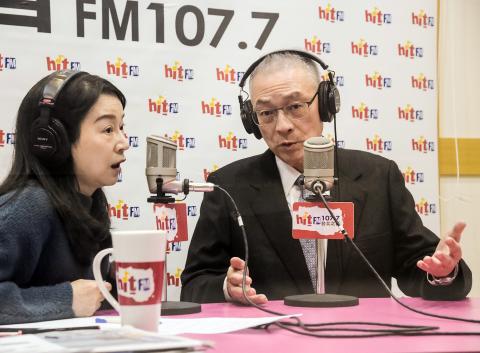
Photo: Huang Yao-cheng, Taipei Times
Wu said he does not know whether Beijing has concerns about the KMT election.
“I did not ask and it is not appropriate for me to ask either,” Wu said, adding that the election is an intraparty affair.
Asked whether he thinks Beijing would prefer a candidate who is more “unification-oriented” and supports “one China, same interpretation,” the former vice president said that “with enough wisdom, Beijing would definitely want to keep ‘one China, different interpretations,’ and maintain a peaceful and stable cross-strait relationship.”
“There is no point waging war on Taiwan. Even if China were to successfully take Taiwan by force, it would probably cost 30 trillion to 50 trillion US dollars to rebuild and it would pay dearly for the public hatred it had incited, but Beijing might not be able to put up with what it cannot put up with,” Wu said. “When the floodwater comes up to your nose, you would probably take some action.”
While Wu did not specify what it was Beijing would not put up with, Chou suggested that it would be declaring Taiwan independent.
“So the best approach is the 1992 consensus with ‘one China, different interpretations,’” Wu said.
With five aspirants, including Wu, having announced their bids, Chou asked whether Wu would be deprived of votes as “young party members might vote for Taipei Agricultural Products Marketing Corp president Han Kuo-yu (韓國瑜), the old ones could support Chairwoman Hung Hsiu-chu (洪秀柱), KMT Vice Chairman Hau Lung-bin (郝龍斌) has the backing of his father, former premier Hau Pei-tsun (郝柏村), and Chan would attract the party’s local faction.”
Wu said he would receive votes from “all the above-mentioned groups.”
Separately yesterday, Hung alleged that Chan told her that he would run for chairman when he tendered his resignation on Jan. 7, an allegation that Chan denied.
In a separate radio interview, Chan said he did not quit in order to run for KMT chairman and that he did indeed hold a different view about how to deal with the party’s assets than other KMT officials, but that was “not the only reason I resigned.”
Chan said before he announced his resignation he felt “discontented and puzzled” after Hung told reporters that “nobody supported the signing of an administrative contract with the Ill-gotten Party Assets Settlement Committee except Chan,” when he had Hung’s authorization to negotiate with the committee.
It was reported that the committee and Chan, representing the KMT, had agreed to sign an administrative contract that would allow the handover of the party’s shares in Central Investment Co and its subsidiary, Hsinyutai Co, to the state, even though 45 percent of the shares would have to be transferred in the form of a donation.
The contract also had provisions concerning what would be done with the funds garnered from the disposal of Central Investment Co’s assets.
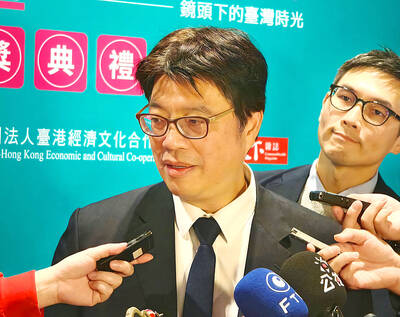
Taiwanese can file complaints with the Tourism Administration to report travel agencies if their activities caused termination of a person’s citizenship, Mainland Affairs Council Minister Chiu Chui-cheng (邱垂正) said yesterday, after a podcaster highlighted a case in which a person’s citizenship was canceled for receiving a single-use Chinese passport to enter Russia. The council is aware of incidents in which people who signed up through Chinese travel agencies for tours of Russia were told they could obtain Russian visas and fast-track border clearance, Chiu told reporters on the sidelines of an event in Taipei. However, the travel agencies actually applied
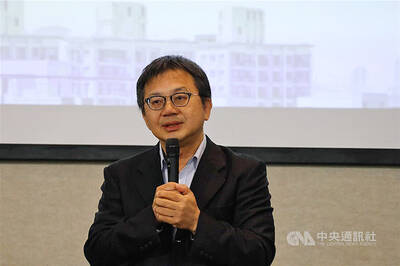
New measures aimed at making Taiwan more attractive to foreign professionals came into effect this month, the National Development Council said yesterday. Among the changes, international students at Taiwanese universities would be able to work in Taiwan without a work permit in the two years after they graduate, explainer materials provided by the council said. In addition, foreign nationals who graduated from one of the world’s top 200 universities within the past five years can also apply for a two-year open work permit. Previously, those graduates would have needed to apply for a work permit using point-based criteria or have a Taiwanese company
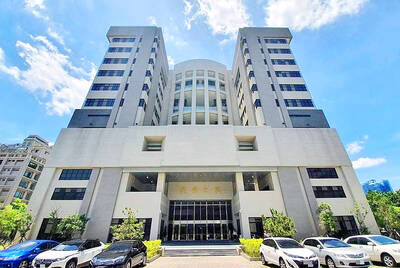
The Shilin District Prosecutors’ Office yesterday indicted two Taiwanese and issued a wanted notice for Pete Liu (劉作虎), founder of Shenzhen-based smartphone manufacturer OnePlus Technology Co (萬普拉斯科技), for allegedly contravening the Act Governing Relations Between the People of the Taiwan Area and the Mainland Area (臺灣地區與大陸地區人民關係條例) by poaching 70 engineers in Taiwan. Liu allegedly traveled to Taiwan at the end of 2014 and met with a Taiwanese man surnamed Lin (林) to discuss establishing a mobile software research and development (R&D) team in Taiwan, prosecutors said. Without approval from the government, Lin, following Liu’s instructions, recruited more than 70 software

Taiwanese singer Jay Chou (周杰倫) plans to take to the courts of the Australian Open for the first time as a competitor in the high-stakes 1 Point Slam. The Australian Open yesterday afternoon announced the news on its official Instagram account, welcoming Chou — who celebrates his 47th birthday on Sunday — to the star-studded lineup of the tournament’s signature warm-up event. “From being the King of Mandarin Pop filling stadiums with his music to being Kato from The Green Hornet and now shifting focus to being a dedicated tennis player — welcome @jaychou to the 1 Point Slam and #AusOpen,” the


 RSS
RSS