


The Democratic Progressive Party (DPP) and the Chinese Nationalist Party (KMT) caucuses yesterday reached a compromise on the ongoing extraordinary legislative session, with the two sides agreeing to cut the session by six days and that it would only deal with general budget bills and two other draft amendments.
The DPP caucus initially planned to hold the extraordinary session from yesterday through Jan. 26, the day before Lunar New Year’s Eve, but agreed to shorten the session to Jan. 20 after a meeting with other party caucuses yesterday morning.
The meeting came after no consensus was reached during cross-party negotiations on Wednesday to set the special session’s agenda.
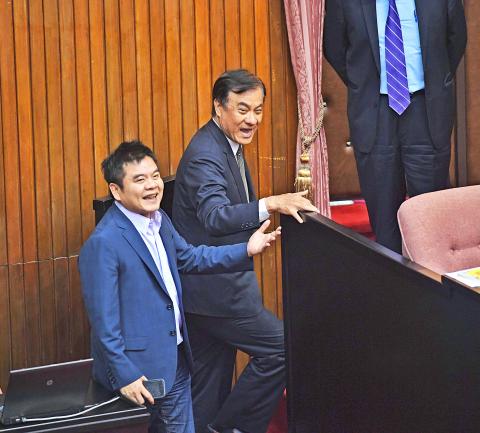
Photo: CNA
The number of legislative items the DPP caucus originally intended to handle in the extraordinary session was also cut from seven to three, which include the general budget, as well as amendments to the Electricity Act (電業法) and the Long-term Care Services Act (長期照顧服務法).
The nomination of former minister of the interior Lee Yi-yang (李逸洋) as Examination Yuan vice president, a draft governing preschool educators, a draft for encouraging the rebuilding of old and condemned buildings, and draft amendments to the Securities Transaction Tax Act (證券交易稅條例) were all removed from the agenda.
The Executive Yuan had hoped to see draft amendments to the Securities Transaction Tax Act — which seeks to cut the transaction tax on day trading from 0.003 percent to 0.0015 percent to stimulate the stock market — clear the legislative floor during the extraordinary session.
After cross-party negotiations, Legislative Speaker Su Jia-chyuan (蘇嘉全) said a consensus had been made that the next legislative session is to begin on Feb. 17, when Premier Lin Chuan (林全) and other Cabinet members would be invited to deliver their policy report.
Lee’s nomination will also be dealt with shortly after the next session starts, Su said.
The agenda changes were made after strong opposition from the KMT caucus, which insisted that only the general budget and urgent legislative items be addressed at the special session.
It has threatened to filibuster the session by submitting 4,000 motions to slash or freeze the general budget for next year.
DPP caucus whip Ker Chien-ming (柯建銘) said he had worried that the special session would last until Jan. 26 and that the KMT caucus’ tactics could delay review of the general budget.
“The outcome [yesterday] is extremely successful. From conflict to compromise to improvement, this is the new legislature and it is how I hope the future legislature would function,” Ker said.
KMT caucus convener Sufin Siluko (廖國棟) said the reason they were able to reach a consensus was because all parties respected and took into account each other’s opinions and stances.
“Due to the limited time, the DPP agreed to the KMT’s request that a review of the general budget should start tomorrow [today]... Maybe the KMT’s proposed motions would be reduced quickly so that all items listed on the agenda could be dealt with during the special session,” Sufin said.
The compromise means the Executive Yuan’s securities transaction tax and urban renewal measures — two priority bills considered essential to revive the economy — will not be reviewed until the next legislative session.
Lin said that he respected the Legislative Yuan’s decision to postpone the review despite a prior agreement between the Cabinet and legislators on the agenda of the extraordinary session.
“The Executive Yuan has submitted bills believed to be agreed on. We submitted the tax cut proposal only after an understanding was reached among legislators across party lines,” Lin said.
However, the Cabinet respects the final decision of the legislature, which has to make its judgement according to the political climate, he added.
Additional Reporting by Chen Wei-han


China has reserved offshore airspace in the Yellow Sea and East China Sea from March 27 to May 6, issuing alerts usually used to warn of military exercises, although no such exercises have been announced, the Wall Street Journal (WSJ) reported yesterday. Reserving such a large area for 40 days without explanation is an “unusual step,” as military exercises normally only last a few days, the paper said. These alerts, known as Notice to Air Missions (Notams), “are intended to inform pilots and aviation authorities of temporary airspace hazards or restrictions,” the article said. The airspace reserved in the alert is
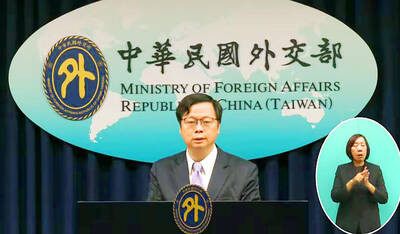
NAMING SPAT: The foreign ministry called on Denmark to propose an acceptable solution to the erroneous nationality used for Taiwanese on residence permits Taiwan has revoked some privileges for Danish diplomatic staff over a Danish permit that lists “Taiwan” as “China,” Eric Huang (黃鈞耀), head of the Ministry of Foreign Affairs’ Department of European Affairs, told a news conference in Taipei yesterday. Reporters asked Huang whether the Danish government had responded to the ministry’s request that it correct the nationality on Danish residence permits of Taiwanese, which has been listed as “China” since 2024. Taiwan’s representative office in Denmark continues to communicate with the Danish government, and the ministry has revoked some privileges previously granted to Danish representatives in Taiwan and would continue to review

More than 6,000 Taiwanese students have participated in exchange programs in China over the past two years, despite the Mainland Affairs Council’s (MAC) “orange light” travel advisory, government records showed. The MAC’s publicly available registry showed that Taiwanese college and university students who went on exchange programs across the Strait numbered 3,592 and 2,966 people respectively. The National Immigration Agency data revealed that 2,296 and 2,551 Chinese students visited Taiwan for study in the same two years. A review of the Web sites of publicly-run universities and colleges showed that Taiwanese higher education institutions continued to recruit students for Chinese educational programs without

A bipartisan group of US senators has introduced a bill to enhance cooperation with Taiwan on drone development and to reduce reliance on supply chains linked to China. The proposed Blue Skies for Taiwan Act of 2026 was introduced by Republican US senators Ted Cruz and John Curtis, and Democratic US senators Jeff Merkley and Andy Kim. The legislation seeks to ease constraints on Taiwan-US cooperation in uncrewed aerial systems (UAS), including dependence on China-sourced components, limited access to capital and regulatory barriers under US export controls, a news release issued by Cruz on Wednesday said. The bill would establish a "Blue UAS


 RSS
RSS