


Democratic Progressive Party (DPP) lawmakers yesterday said that China was the reason Sao Tome and Principe broke diplomatic ties with Taiwan, while the Chinese Nationalist Party (KMT) caucus said foreign relations are tied to cross-strait issues and asked the government to pragmatically adjust its diplomatic strategy regarding Beijing.
DPP caucus secretary-general Liu Shih-fang (劉世芳) said that China was apparently behind more efforts to isolate the nation, citing the Chinese Ministry of Foreign Affairs’ announcement on its Web site of the African nation’s decision immediately after the move was declared.
Beijing continues to suppress Taiwan’s international presence, despite the olive branch President Tsai Ing-wen (蔡英文) has offered in a bid to maintain close links and the cross-strait “status quo,” Liu said.
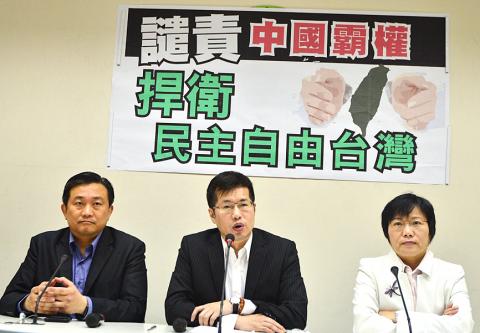
Photo: Wang Yi-sung, Taipei Times
The DPP caucus expressed regret over Sao Tome and Principe’s decision to end its decades-long friendship with Taipei on financial grounds, despite the island nation having received Taiwanese support for years, DPP Legislator Lo Chih-cheng (羅致政) said.
“We also express discontent over China’s instant acknowledgment of the decision. Apparently the two countries are singing the same tune,” Lo said, adding that Beijing’s actions would only push Taiwan away and provoke unnecessary conflict.
Despite the China factor, the severing of ties was mainly due to the African state’s demands for massive financial aid, he said.
Sao Tome and Principe reportedly sought US$210 million in financial support, although the government has not confirmed such a request and other figures have been cited.
“China is welcome to play pocketbook diplomacy if it is willing to spend that much money to establish ties with Sao Tome and Principe,” Lo said. “Taiwan does not want to play that game.”
Taiwan’s diplomatic situation has not changed because of local politics, as the Gambia ended diplomatic ties with Taiwan in 2013 when former president Ma Ying-jeou (馬英九) was in office, DPP Legislator Wang Ding-yu (王定宇) said.
“China’s suppression of Taiwan’s international space does not abate with a change of government in Taiwan,” Wang said. “We call for solidarity across political and ethnic lines against foreign interference.”
Wang said nations that value freedom and democracy should recognize the diplomatic difficulties Taiwan faces and condemn China’s actions, adding that Beijing’s attempts to lure Taiwan’s diplomatic allies is a bid to interfere with the nation’s democracy and autonomy.
The KMT caucus said that to avoid a possible “domino effect,” Tsai’s administration should adjust its foreign-relations strategy, which KMT caucus secretary-general Johnny Chiang (江啟臣) said “can not be separated from cross-strait relations.”
“After Tsai took office on May 20, there have been too many diplomatic incidents that [we are] sorry to have seen happen,” Chiang said, citing Minister of Health and Welfare Lin Tzou-yien’s (林奏延) failure to mention “Taiwan” in a speech at the World Health Assembly, the Permanent Court of Arbitration’s ruling on territorial claims in the South China Sea, and the lack of invitations from the International Civil Aviation Organization and Interpol to their annual assemblies.
“The Ministry of Foreign Affairs said it was ‘discreetly optimistic’ before each of those episodes, but could only tell the public that they were ‘sorry’ afterward,” Chiang said, calling on the government to make strategic modifications to avoid “the next Sao Tome and Principe.”
US president-elect Donald Trump’s attitude toward the “one China” policy has made international headlines and foreign relations and national security officials should brace for a new Taiwan-China-US relationship, he said.
KMT caucus deputy secretary-general Alicia Wang (王育敏) said Minister of Foreign Affairs David Lee (李大維) should step down, as he was not aware that diplomatic ties had deteriorated.
KMT Legislator Lee Yan-hsiu (李彥秀) said the ministry has to be held accountable for not keeping abreast of diplomatic developments, mistakenly claiming many times that the diplomatic ties were stable.
Separately, Legislative Speaker Su Jia-chyuan (蘇嘉全) said Taiwan “cherishes each of its diplomatic friends and hopes it is likewise treated with sincerity, because we believe that a friend in need is a friend indeed.”
He called on all parties to stand firm and in solidarity for Taiwan in the face of difficult diplomatic situations, “especially when Beijing continues to suppress our international standing with its ‘one China’ principle.”

Considering that most countries issue more than five denominations of banknotes, the central bank has decided to redesign all five denominations, the bank said as it prepares for the first major overhaul of the banknotes in more than 24 years. Central bank Governor Yang Chin-lung (楊金龍) is expected to report to the Legislative Yuan today on the bank’s operations and the redesign’s progress. The bank in a report sent to the legislature ahead of today’s meeting said it had commissioned a survey on the public’s preferences. Survey results showed that NT$100 and NT$1,000 banknotes are the most commonly used, while NT$200 and NT$2,000

The Centers for Disease Control (CDC) yesterday reported the first case of a new COVID-19 subvariant — BA.3.2 — in a 10-year-old Singaporean girl who had a fever upon arrival in Taiwan and tested positive for the disease. The girl left Taiwan on March 20 and the case did not have a direct impact on the local community, it said. The WHO added the BA.3.2 strain to its list of Variants Under Monitoring in December last year, but this was the first imported case of the COVID-19 variant in Taiwan, CDC Deputy Director-General Lin Ming-cheng (林明誠) said. The girl arrived in Taiwan on

ANNUAL EVENT: Two massive Pokemon balloons are to be set up in Daan Park, with an event zone operating from 10am to 6pm This year’s Taipei Floral Picnic is to be held at Daan Park today and tomorrow, featuring an exclusive Pokemon Go event, a themed food market, a coffee rave picnic area and stage performances, the Taipei Department of Information and Tourism said yesterday. Two massive Pokemon balloons are to be set up in the park as attractions, with an exclusive event zone operating from 10am to 6pm, it said. Participants who complete designated tasks on-site would have a chance to receive limited-edition souvenirs, it added. People could also try the newly launched game Pokemon Pokopia in the trial area, the department said. Three PokeStops are

South Korea is planning to revise its controversial electronic arrival card, a step Taiwanese officials said prompted them to hold off on planned retaliatory measures, a South Korean media report said yesterday. A Yonhap News Agency report said that the South Korean Ministry of Foreign Affairs is planning to remove the “previous departure place” and “next destination” fields from its e-arrival card system. The plan, reached after interagency consultations, is under review and aims to simplify entry procedures and align the electronic form with the paper version, a South Korean ministry official said. The fields — which appeared only on the electronic form


 RSS
RSS