


US President Barack Obama’s comments on Friday regarding the relationship between Taipei, Washington and Beijing provoked mixed reactions in Taiwan.
Obama said during his year-end news conference that there has been a long-standing agreement between China, the US and, to some degree, Taiwanese, that there should be no change to the “status quo.”
“The Taiwanese have agreed that as long as they’re able to continue to function with some degree of autonomy, that they won’t charge forward and declare independence,” he said.
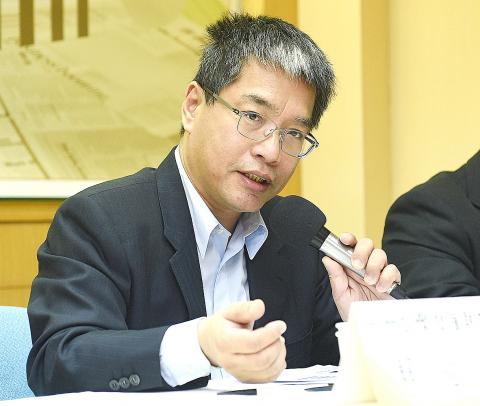
Photo: Chen Chih-chu, Taipei Times
Taiwan Thinktank member Lai I-chung (賴怡忠) said he thought it was inappropriate for Obama to make remarks on behalf of Taiwanese.
Any thoughts Taiwanese have should be spoken by themselves, and no foreign government can claim to speak on Taiwan’s behalf when even the Taiwanese government cannot claim to represent the Taiwanese people, Lai said.
Former representative to Japan Koh Se-kai (許世楷) said he thinks the “status quo” is problematic.
“If the international environment is constantly changing, then we must change with the environment,” Koh said.
Obama’s comments are a description of the present situation, but he “has not considered possible changes in Taiwan in the future,” Koh said, adding that while President Tsai Ing-wen’s (蔡英文) administration is focusing on maintaining the “status quo,” Taiwanese must realize that the “status” is constantly in flux.
Only by changing with the times can Taiwan survive in a fluctuating environment, he added.
New Power Party Legislator Huang Kuo-chang (黃國昌) said that Obama is entitled to his own observations as the outgoing US president, but he said he hopes the US respects Taiwanese democracy and its freedom of choice, just as Taiwanese respected the US’ vote for president-elect Donald Trump.
“Taiwan is an independent, sovereign state, and its policies and government are decided by the public,” Huang said.
Democratic Progressive Party Legislator Tsai Shih-ying (蔡適應) said that Obama might have been trying to steer Trump away from a radical approach on China to avoid irritating Beijing.
Chinese Nationalist Party (KMT) Legislator Ma Wen-chun (馬文君) agreed that Obama’s remarks showed his concern over regional stability and were an attempt to reduce the possibility of unnecessary conflict.
Taiwanese academics viewed Obama’s remarks as a reminder to Trump that maintaining the “status quo” would help solidify diplomatic relations for all sides.
National Chengchi University Institute of International Relations professor Yen Chen-shen (嚴震生) said if any party deviates from the “status quo,” it could place Taiwan in danger, force China’s hand into resolving a problem it does not want to address and drag the US into a war in which it might not want to intervene.
Meanwhile, the Mainland Affairs Council said that the Republic of China is a sovereign nation committed to promoting peaceful and stable relations with China, and reiterated that the government remains committed to preserving peaceful development across the Taiwan Strait and in the region.
Additional reporting by Ho Yu-hua
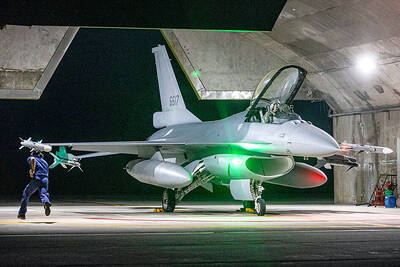
Taiwan has received more than US$70 million in royalties as of the end of last year from developing the F-16V jet as countries worldwide purchase or upgrade to this popular model, government and military officials said on Saturday. Taiwan funded the development of the F-16V jet and ended up the sole investor as other countries withdrew from the program. Now the F-16V is increasingly popular and countries must pay Taiwan a percentage in royalties when they purchase new F-16V aircraft or upgrade older F-16 models. The next five years are expected to be the peak for these royalties, with Taiwan potentially earning
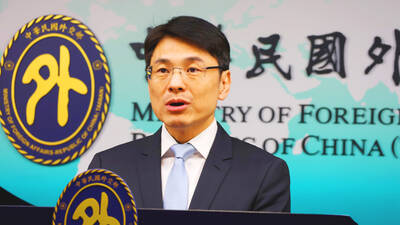
STAY IN YOUR LANE: As the US and Israel attack Iran, the ministry has warned China not to overstep by including Taiwanese citizens in its evacuation orders The Ministry of Foreign Affairs (MOFA) yesterday rebuked a statement by China’s embassy in Israel that it would evacuate Taiwanese holders of Chinese travel documents from Israel amid the latter’s escalating conflict with Iran. Tensions have risen across the Middle East in the wake of US and Israeli airstrikes on Iran beginning Saturday. China subsequently issued an evacuation notice for its citizens. In a news release, the Chinese embassy in Israel said holders of “Taiwan compatriot permits (台胞證)” issued to Taiwanese nationals by Chinese authorities for travel to China — could register for evacuation to Egypt. In Taipei, the ministry yesterday said Taiwan
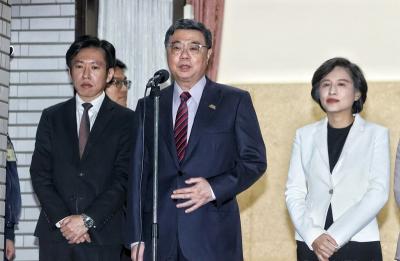
Taiwan is awaiting official notification from the US regarding the status of the Agreement on Reciprocal Trade (ART) after the US Supreme Court ruled US President Donald Trump's global tariffs unconstitutional. Speaking to reporters before a legislative hearing today, Premier Cho Jung-tai (卓榮泰) said that Taiwan's negotiation team remains focused on ensuring that the bilateral trade deal remains intact despite the legal challenge to Trump's tariff policy. "The US has pledged to notify its trade partners once the subsequent administrative and legal processes are finalized, and that certainly includes Taiwan," Cho said when asked about opposition parties’ doubts that the ART was
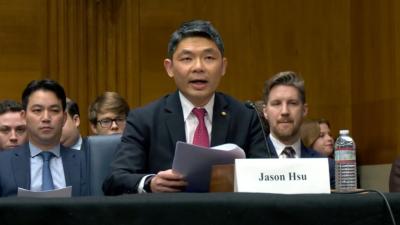
If China chose to invade Taiwan tomorrow, it would only have to sever three undersea fiber-optic cable clusters to cause a data blackout, Jason Hsu (許毓仁), a senior fellow at the Hudson Institute and former Chinese Nationalist Party (KMT) legislator, told a US security panel yesterday. In a Taiwan contingency, cable disruption would be one of the earliest preinvasion actions and the signal that escalation had begun, he said, adding that Taiwan’s current cable repair capabilities are insufficient. The US-China Economic and Security Review Commission (USCC) yesterday held a hearing on US-China Competition Under the Sea, with Hsu speaking on


 RSS
RSS