


The Council of Agriculture (COA) yesterday said it would promote agricultural cooperation with four countries under the government’s “new southbound policy.”
The four countries have yet to be finalized, but will probably be Vietnam, Thailand, Myanmar and Indonesia, council officials said, although they did not rule out other countries being included.
In a report on “new southbound agriculture” at a Cabinet meeting, the council said that the nation relies too heavily on the Chinese market for exports of its agricultural products and that it is urgent and necessary to diversify its markets.
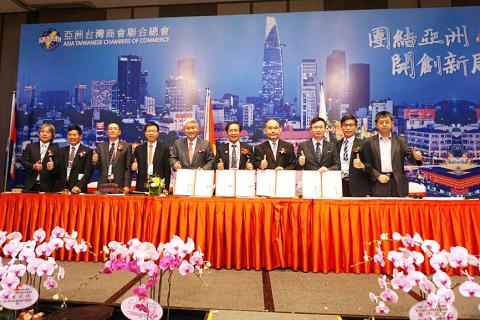
Photo: CNA
The strategy will include maintaining existing export markets and actively tapping into emerging markets, such as ASEAN, South Asia, New Zealand and Australia, the council said.
Under the “new southbound agriculture,” the council will seek to increase business opportunities and contributions by investing in select countries’ agricultural industries and exporting agricultural machinery.
The goals will be to develop full cooperation in agriculture with the four countries and help agriculture enterprises set up at least 10 model farms in those countries, the council said.
In related news, the Agricultural Technology Research Institute (ATRI) on Saturday signed additional accords in agriculture cooperation with ASEAN members.
The government-sponsored ATRI inked memoranda of understanding on agricultural cooperation with the Asia Taiwanese Chambers of Commerce (ATCC) and Taiwanese investor associations from Cambodia, Laos and Brunei, in Ho Chi Minh City, Vietnam.
Since September, the ARTI, which has set its sights on closer ties with ASEAN, has signed similar cooperation agreements with Taiwanese investor associations in eight ASEAN countries designed to accelerate the pace of agricultural development.
In addition to Cambodia, Laos and Brunei, the institute has signed accords with Taiwanese investor associations based in Thailand, Vietnam, Malaysia, Singapore and the Philippines, the institute said.
New Southbound Policy Office Director James Huang (黃志芳), who witnessed the signing ceremony, on Tuesday said that agricultural cooperation and promotion is one of his office’s key policy areas.
ATCC head Lee Tien-chi (李天柒) said that he was glad to see the ATRI achieve so much in just a few of months in terms of promoting agricultural cooperation with ASEAN, adding that such efforts have strengthened exchanges between Taiwan and the region.
The agricultural sector is one of Taiwan’s economic strengths and the nation should take advantage of its expertise to forge closer relationships with ASEAN members, many of which are focused on agricultural development, Lee said.
Chung Chia-pin (鍾佳濱), a Democratic Progressive Party legislator from Pingtung County who also attended the signing ceremony, said that he hoped the government would introduce Pingtung’s agricultural development to ASEAN as a model for development, as the county is one of Taiwan’s most important agricultural areas.

Taiwanese can file complaints with the Tourism Administration to report travel agencies if their activities caused termination of a person’s citizenship, Mainland Affairs Council Minister Chiu Chui-cheng (邱垂正) said yesterday, after a podcaster highlighted a case in which a person’s citizenship was canceled for receiving a single-use Chinese passport to enter Russia. The council is aware of incidents in which people who signed up through Chinese travel agencies for tours of Russia were told they could obtain Russian visas and fast-track border clearance, Chiu told reporters on the sidelines of an event in Taipei. However, the travel agencies actually applied
Japanese footwear brand Onitsuka Tiger today issued a public apology and said it has suspended an employee amid allegations that the staff member discriminated against a Vietnamese customer at its Taipei 101 store. Posting on the social media platform Threads yesterday, a user said that an employee at the store said that “those shoes are very expensive” when her friend, who is a migrant worker from Vietnam, asked for assistance. The employee then ignored her until she asked again, to which she replied: "We don't have a size 37." The post had amassed nearly 26,000 likes and 916 comments as of this

New measures aimed at making Taiwan more attractive to foreign professionals came into effect this month, the National Development Council said yesterday. Among the changes, international students at Taiwanese universities would be able to work in Taiwan without a work permit in the two years after they graduate, explainer materials provided by the council said. In addition, foreign nationals who graduated from one of the world’s top 200 universities within the past five years can also apply for a two-year open work permit. Previously, those graduates would have needed to apply for a work permit using point-based criteria or have a Taiwanese company

The Shilin District Prosecutors’ Office yesterday indicted two Taiwanese and issued a wanted notice for Pete Liu (劉作虎), founder of Shenzhen-based smartphone manufacturer OnePlus Technology Co (萬普拉斯科技), for allegedly contravening the Act Governing Relations Between the People of the Taiwan Area and the Mainland Area (臺灣地區與大陸地區人民關係條例) by poaching 70 engineers in Taiwan. Liu allegedly traveled to Taiwan at the end of 2014 and met with a Taiwanese man surnamed Lin (林) to discuss establishing a mobile software research and development (R&D) team in Taiwan, prosecutors said. Without approval from the government, Lin, following Liu’s instructions, recruited more than 70 software


 RSS
RSS