


Dozens of members of nine human rights groups yesterday observed International Day of Persons with Disabilities with a protest in front of the Ministry of Health and Welfare in Taipei, saying that the ministry’s policy on people with disabilities fails to address obstacles they meet every day.
The protesters — about half of whom sat in wheelchairs, some of which had signs affixed to them — chanted slogans such as “I want accessible clinics,” “remove road barriers, give back the space I need to move in” and “an incomplete system leads to no autonomy” outside of the ministry’s complex in the morning.
While the legislature in 2014 passed the Act to Implement the Convention on the Rights of Persons with Disabilities (身心障礙者權利公約施行法), which requires the government to protect the rights of people with disabilities as outlined in the UN’s Convention on the Rights of Persons with Disabilities, the ministry seems to use the international observance to promote its benevolence, rather than substantially improve the lives of such people, Taiwan Gender Queer Rights Advocacy Alliance secretary-general Nelson Hu (胡勝翔) said.
The ministry used the slogan “respect differences and participate together” for the day, but people with disabilities still face a number of obstacles in different aspects of their daily lives, he said.
“We do not need people describing us as ‘angels,’ or telling us: ‘You are great and full of courage.’ We do not need fake friendliness,” Access for All Association secretary-general Hsu Chao-fu (許朝富) said. “We are not asking for ‘extra’ rights, we are only asking for protection of our human rights.”
Many people with disabilities wanted to join the protest, but could not even leave their homes or take public transportation on their own, as most accessible transportation is only available in big cities, Hsu said.
Independent Living Association Taipei secretary-general Lin Chun-chieh (林君潔), who uses a wheelchair, said road obstacles make it difficult for her to even move from one place to another in front of the ministry’s complex, adding that people with disabilities cannot have real autonomy without the enforcement of policies and a system to protect their rights.
Lin asked the protesters to throw disposable adult diapers over the complex’s gate to demonstrate their anger.
The demonstrators demanded that the ministry enforce the convention, establish a national agency to protect their rights and allow people with disabilities to participate in the making of policies related to them.
The groups said they would protest again if the ministry does not give them an acceptable reply within one month.
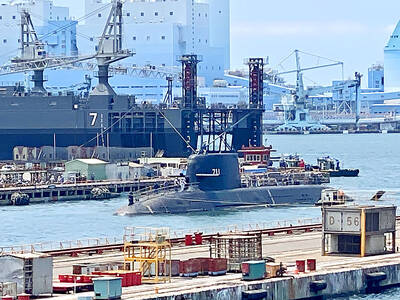
AGING: While Japan has 22 submarines, Taiwan only operates four, two of which were commissioned by the US in 1945 and 1946, and transferred to Taiwan in 1973 Taiwan would need at least 12 submarines to reach modern fleet capabilities, CSBC Corp, Taiwan chairman Chen Cheng-hung (陳政宏) said in an interview broadcast on Friday, citing a US assessment. CSBC is testing the nation’s first indigenous defense submarine, the Hai Kun (海鯤, Narwhal), which is scheduled to be delivered to the navy next month or in July. The Hai Kun has completed torpedo-firing tests and is scheduled to undergo overnight sea trials, Chen said on an SET TV military affairs program. Taiwan would require at least 12 submarines to establish a modern submarine force after assessing the nation’s operational environment and defense

A white king snake that frightened passengers and caused a stir on a Taipei MRT train on Friday evening has been claimed by its owner, who would be fined, Taipei Rapid Transit Corp (TRTC) said yesterday. A person on Threads posted that he thought he was lucky to find an empty row of seats on Friday after boarding a train on the Bannan (Blue) Line, only to spot a white snake with black stripes after sitting down. Startled, he jumped up, he wrote, describing the encounter as “terrifying.” “Taipei’s rat control plan: Release snakes on the metro,” one person wrote in reply, referring
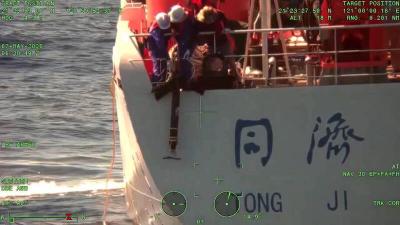
The coast guard today said that it had disrupted "illegal" operations by a Chinese research ship in waters close to the nation and driven it away, part of what Taipei sees a provocative pattern of China's stepped up maritime activities. The coast guard said that it on Thursday last week detected the Chinese ship Tongji (同濟號), which was commissioned only last year, 29 nautical miles (54km) southeast of the southern tip of Taiwan, although just outside restricted waters. The ship was observed lowering ropes into the water, suspected to be the deployment of scientific instruments for "illegal" survey operations, and the coast
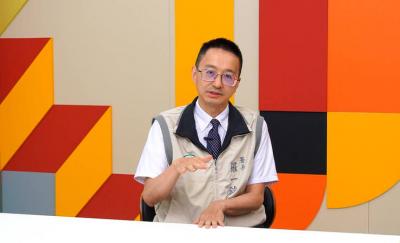
Taiwan’s two cases of hantavirus so far this year are on par with previous years’ case numbers, and the government is coordinating rat extermination work, so there should not be any outbreaks, Centers for Disease Control (CDC) Director-General Philip Lo (羅一鈞) said today in an interview with the Liberty Times (the Taipei Times’ sister newspaper). An increase in rat sightings in Taipei and New Taipei City has raised concerns about the spread of hantavirus, as rats can carry the disease. In January, a man in his 70s who lived in Taipei’s Daan District (大安) tested positive posthumously for hantavirus, Taiwan’s


 RSS
RSS