


Legislators across party lines yesterday called on China to release human rights lawyer Jiang Tianyong (江天勇), who has been missing since Monday last week after he visited a relative of an imprisoned human rights advocate in China’s Hunan Province.
Jiang went to Changsha to visit the wife of jailed lawyer Xie Yang (謝陽) on Nov. 21, but Jiang went missing after making a call to his wife informing her of his planned return to Beijing, reports said.
Jiang’s wife and parents have attempted to file police reports with Chinese authorities in Beijing, Changsha and Zhengzhou, but they were deliberately thwarted, the reports said.

Photo: CNA
Jiang was an attorney in human rights cases, including one involving Chinese human rights advocate Chen Guangcheng (陳光誠), an expropriate dispute between the local government and private petroleum companies in Shaanxi Province, and a case involving the rights of people with HIV/AIDS.
Jiang’s actions have provoked the ire of Chinese authorities, which removed his license to practice law in 2009, reports said.
He has continued to work on human rights issues, but has been detained, abducted and tortured by the police, causing him rib fractures which had not healed when he disappeared, according to reports.
Taiwanese lawmakers urged China to release Jiang, who is believed to be detained incommunicado.
Democratic Progressive Party Legislator Lin Ching-yi (林靜儀) said Taiwan has been through the 228 Massacre and the ensuing White Terror era, making the nation keenly aware of the importance of human rights.
“‘Forced disappearance,’ a joking term now used by young people here, is actually a dark reality for people living in countries where human rights are violated,” Lin said, calling on China to release Jiang ahead of Human Rights Day on Saturday next week to show respect for human rights and freedom of expression.
Lawyers representing people who experienced political persecution during the Martial Law era were obstructed and harassed by the government and the law enforcement agencies, but they might be “forced to disappear” and deprived of their rights if they were in China, New Power Party Legislator Freddy Lim (林昶佐) said.
As Taiwan and China have engaged in closer interactions, making China a country that abides by the rule of law is advantageous to Taiwan, Lim said.
Chinese Nationalist Party (KMT) Legislator Apollo Chen (陳學聖) said there are also people in the pan-blue camp who are concerned about human rights issues in China.
Taiwan as a democracy should not remain silent about human rights violation over fears of offending the Chinese government, Chen said, calling on Beijing not to fear dissidents as if they were monsters.

SECURITY: Starlink owner Elon Musk has taken pro-Beijing positions, and allowing pro-China companies to control Taiwan’s critical infrastructure is risky, a legislator said Starlink was reluctant to offer services in Taiwan because of the nation’s extremely high penetration rates in 4G and 5G services, the Ministry of Digital Affairs said yesterday. The ministry made the comments at a meeting of the legislature’s Transportation Committee, which reviewed amendments to Article 36 of the Telecommunications Management Act (電信管理法). Article 36 bans foreigners from holding more than 49 percent of shares in public telecommunications networks, while shares foreigners directly and indirectly hold are also capped at 60 percent of the total, unless specified otherwise by law. The amendments, sponsored by Chinese Nationalist Party (KMT) Legislator Ko

The eastern extension of the Taipei MRT Red Line could begin operations as early as late June, the Taipei Department of Rapid Transit Systems said yesterday. Taipei Rapid Transit Corp said it is considering offering one month of free rides on the new section to mark its opening. Construction progress on the 1.4km extension, which is to run from the current terminal Xiangshan Station to a new eastern terminal, Guangci/Fengtian Temple Station, was 90.6 percent complete by the end of last month, the department said in a report to the Taipei City Council's Transportation Committee. While construction began in October 2016 with an
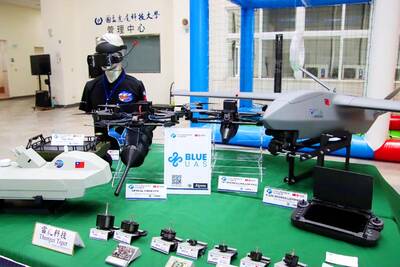
NON-RED SUPPLY: Boosting the nation’s drone industry is becoming increasingly urgent as China’s UAV dominance could become an issue in a crisis, an analyst said Taiwan’s drone exports to Europe grew 41.7-fold from 2024 to last year, with demand from Ukraine’s fight against Russian aggression the most likely driver of growth, a study showed. The Institute for Democracy, Society and Emerging Technology (DSET) in a statement on Wednesday said it found that many of Taiwan’s uncrewed aerial vehicle (UAV) sales were from Poland and the Czech Republic. These countries likely transferred the drones to Ukraine to aid it in its fight against the Russian invasion that started in 2022, it said. Despite the gains, Taiwan is not the dominant drone exporter to these markets, ranking second and fourth
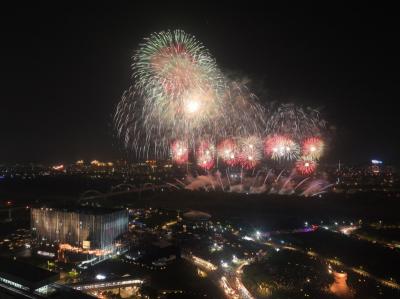
The New Taipei City Art Museum this weekend plans to celebrate its first anniversary with a two-day extravaganza featuring live concerts and a large-scale synchronized fireworks and drone display, the New Taipei City Cultural Affairs Department said. The two-day celebrations are to take place in the museum’s outdoor park, with markets and live performances by singers including Ann Bai (白安), Bii (畢書盡) and the Cosmos People (宇宙人), the department said. The highlight on both evenings would be the "Echoes of Light" show, an aerial spectacle combining fireworks and drone performances designed around the concept of "dual stages in the sky," it


 RSS
RSS