


The government plans to roll out floor space incentives and property tax breaks to encourage urban renewal, Minister of the Interior Yeh Jiunn-rong (葉俊榮) said yesterday, following reports that the Executive Yuan was mulling granting life-long tax benefits to property owners who participate in urban renewal projects.
To encourage wider participation in urban renewal, the ministry plans to raise floor area ratios, the ratio of a building’s total floor area to the size of the plot of land on which it is built, Yeh said at a meeting of the Legislative Yuan’s Internal Administration Committee.
Depending on the size of the land to be developed, homeowners participating in urban renewal projects could be entitled to preferential floor area ratios, he said.
A site smaller than 500m2 could be redeveloped at its original floor area ratio, while a site between 500m2 and 1,000m2 could be redeveloped at 115 percent of its original ratio and a site larger than 1,000m2 could be redeveloped to 130 percent of its original ratio, Yeh said.
In addition to the floor space incentives, the Ministry of the Interior on Tuesday proposed preferential housing and land taxes for homeowners participating in urban renewal projects.
Participants in urban renewal projects who do not sell their new properties are entitled to a 50 percent reduction in housing and land taxes for two years after the completion of the project.
The ministry proposed extending the preferential tax rates indefinitely, allowing participants to enjoy the tax breaks until they sell the properties.
Under the proposal, buyers of the new properties would not be eligible for the tax breaks.
The incentives are aimed at encouraging homeowners to rebuild aging structures, especially those that are more than 30 years old, into safer ones with better earthquake resistance and public facilities, Yeh said.
“[The incentives] would mean homeowners could afford to live in a new home,” he added.
There are about 140,000 buildings nationwide that are 30 years old or older, housing more than 1 million households, with about 50,000 in dire need of repairs and reinforcement, as they might not be able to withstand a strong earthquake, the ministry said, adding that about 10,000 are in Taipei and New Taipei City.
The preferential tax rates and floor space incentives have yet to be finalized, Executive Yuan spokesman Hsu Kuo-yung (徐國勇) said.

LOUD AND PROUD Taiwan might have taken a drubbing against Australia and Japan, but you might not know it from the enthusiasm and numbers of the fans Taiwan might not be expected to win the World Baseball Classic (WBC) but their fans are making their presence felt in Tokyo, with tens of thousands decked out in the team’s blue, blowing horns and singing songs. Taiwanese fans have packed out the Tokyo Dome for all three of their games so far and even threatened to drown out home team supporters when their team played Japan on Friday. They blew trumpets, chanted for their favorite players and had their own cheerleading squad who dance on a stage during the game. The team struggled to match that exuberance on the field, with
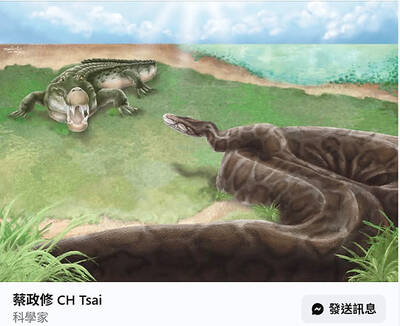
Taiwanese paleontologists have discovered fossil evidence that pythons up to 4m long inhabited Taiwan during the Pleistocene epoch, reporting their findings in the international scientific journal Historical Biology. National Taiwan University (NTU) Institute of Ecology and Evolutionary Biology associate professor Tsai Cheng-hsiu (蔡政修) led the team that discovered the largest snake fossil ever found in Taiwan. The single trunk vertebra was discovered in Tainan at the Chiting Formation, dated to between 400,000 and 800,000 years ago in the Middle Pleistocene, the paper said. The area also produced Taiwan’s first avian fossil, as well as crocodile, mammoth, saber-toothed cat and rhinoceros fossils, it said. Discoveries

Taiwanese paleontologists have discovered fossil evidence that pythons up to 4m long inhabited Taiwan during the Pleistocene epoch, reporting their findings in the international scientific journal Historical Biology. National Taiwan University (NTU) Institute of Ecology and Evolutionary Biology associate professor Tsai Cheng-hsiu (蔡政修) led the team that discovered the largest snake fossil ever found in Taiwan. A single trunk vertebra was discovered in Tainan at the Chiting Formation, dated to between 800,000 to 400,000 years ago in the Middle Pleistocene, the paper said. The area also produced Taiwan’s first avian fossil, as well as crocodile, mammoth, sabre-toothed cat and rhinoceros fossils, it said. Discoveries
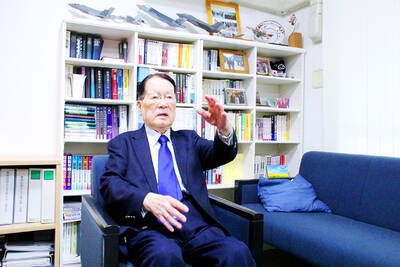
Whether Japan would help defend Taiwan in case of a cross-strait conflict would depend on the US and the extent to which Japan would be allowed to act under the US-Japan Security Treaty, former Japanese minister of defense Satoshi Morimoto said. As China has not given up on the idea of invading Taiwan by force, to what extent Japan could support US military action would hinge on Washington’s intention and its negotiation with Tokyo, Morimoto said in an interview with the Liberty Times (sister paper of the Taipei Times) yesterday. There has to be sufficient mutual recognition of how Japan could provide


 RSS
RSS