


Gay rights advocates yesterday accused churches of illegally using donations to support a massive demonstration against same-sex marriage last week, calling for an investigation and new sunshine regulations on religious groups’ use of donated funds.
“Even though it is impossible for us to see direct evidence of funding, we did see some church pastors and elders openly calling for participation or stating that they would mobilize their entire church or have church staff take the day off to take part [in the rally],” Taiwan International Association for Gay Rights president Chen Chih-ming (陳志明) said, citing the Taipei Truth Lutheran Church and the Bread of Life Church in Taipei as examples.
He said that in some cases, protesters had convened outside churches to ride chartered buses to the protest site.
While the thousands of demonstrators who rallied against same-sex marriage legislation last week were ostensibly organized by the Alliance for the Happiness of Future Generations, the group is widely viewed as a front for religious groups and leaders, with organizers last week stating that the rally was intended to support a group of petitioning Taiwan Presbyterian Church pastors.
“Just making public statements is not illegal, but using church money is,” Chen said, contending that under the Charity Donations Destined for Social Welfare Funds Implementation Regulations (公益勸募條例) church spending is only exempt from reporting and approval requirements when it is used explicitly for “religious activities.”
“Churches have used the banner of religious activities to raise funds, and there is always a chance someone inside the church might be opposed to having their donation used for political activities,” he said, calling for a government investigation and new sunshine regulations requiring religious groups to make their finances public.
“At present, the only way to address this is if individual members report their groups,” he said, while adding that it was unlikely.
Alliance spokesman Tseng Hsien-ying (曾獻瑩) slammed the criticism, calling it “groundless accusations.”
“They should put forth specific evidence,” Tseng said.
Last week’s protest was funded by individuals who took direct responsibility for their own expenses, he said.
“Think of all the money we could have raised if each person who attended had given just NT$100,” he said, while stressing that the alliance, which is not an officially registered organization, did not solicit donations.

Taiwan has received more than US$70 million in royalties as of the end of last year from developing the F-16V jet as countries worldwide purchase or upgrade to this popular model, government and military officials said on Saturday. Taiwan funded the development of the F-16V jet and ended up the sole investor as other countries withdrew from the program. Now the F-16V is increasingly popular and countries must pay Taiwan a percentage in royalties when they purchase new F-16V aircraft or upgrade older F-16 models. The next five years are expected to be the peak for these royalties, with Taiwan potentially earning
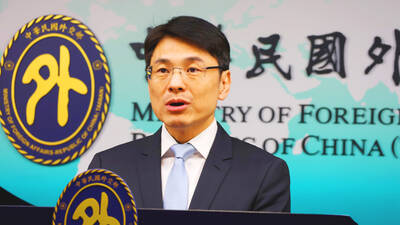
STAY IN YOUR LANE: As the US and Israel attack Iran, the ministry has warned China not to overstep by including Taiwanese citizens in its evacuation orders The Ministry of Foreign Affairs (MOFA) yesterday rebuked a statement by China’s embassy in Israel that it would evacuate Taiwanese holders of Chinese travel documents from Israel amid the latter’s escalating conflict with Iran. Tensions have risen across the Middle East in the wake of US and Israeli airstrikes on Iran beginning Saturday. China subsequently issued an evacuation notice for its citizens. In a news release, the Chinese embassy in Israel said holders of “Taiwan compatriot permits (台胞證)” issued to Taiwanese nationals by Chinese authorities for travel to China — could register for evacuation to Egypt. In Taipei, the ministry yesterday said Taiwan
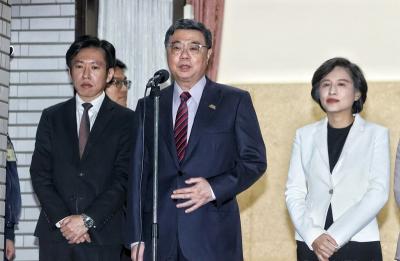
Taiwan is awaiting official notification from the US regarding the status of the Agreement on Reciprocal Trade (ART) after the US Supreme Court ruled US President Donald Trump's global tariffs unconstitutional. Speaking to reporters before a legislative hearing today, Premier Cho Jung-tai (卓榮泰) said that Taiwan's negotiation team remains focused on ensuring that the bilateral trade deal remains intact despite the legal challenge to Trump's tariff policy. "The US has pledged to notify its trade partners once the subsequent administrative and legal processes are finalized, and that certainly includes Taiwan," Cho said when asked about opposition parties’ doubts that the ART was
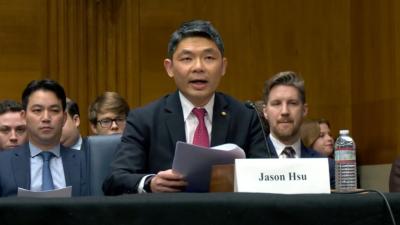
If China chose to invade Taiwan tomorrow, it would only have to sever three undersea fiber-optic cable clusters to cause a data blackout, Jason Hsu (許毓仁), a senior fellow at the Hudson Institute and former Chinese Nationalist Party (KMT) legislator, told a US security panel yesterday. In a Taiwan contingency, cable disruption would be one of the earliest preinvasion actions and the signal that escalation had begun, he said, adding that Taiwan’s current cable repair capabilities are insufficient. The US-China Economic and Security Review Commission (USCC) yesterday held a hearing on US-China Competition Under the Sea, with Hsu speaking on


 RSS
RSS