


Labor regulations should be reformed to allow workers to take up to six months of paid leave to arrange for long-term care of family members, the Taiwan Association of Family Caregivers said yesterday.
Arranging for long-term care can be an extremely chaotic process, as families face choices such as doing the caretaking on their own or hiring a foreign caregiver, association president Chen Chen-fen (陳正芬) said.
“Families need time to hold discussions before making a decision,” she said, adding that an average of 180,000 people leave the workforce annually to provide care for family members.
“We hope that the government can provide a kind of work insurance, allowing workers to continue drawing salaries while making arrangements [for long-term care] to help us hold on to much of this lost labor,” she said.
Workers are currently only allowed seven days off to make arrangements for long-term care for a family member.
“If these people can be kept in the workforce without sacrificing care for their family members, their income can be stabilized, which can help keep them out of poverty,” she said.
Funding could come from the Ministry of Labor’s Employment Security Fund, she said, but added that the association was not sure how much funding would be needed.
She said the fund could also be used to provide one day a week “breathing space” home nursing service to families that employ foreign workers.
The fund is based on levies imposed on families employing foreign workers, who are currently ineligible for the government-provided “breathing space” service.
Chen said the group supports calls for the government to begin providing subsidies for institutional care of the severely disabled, a key demand of a Sunday rally of more than 1,000 people on Ketagalan Boulevard, as the government considers reforms to address the nation’s rapidly aging population.

Taiwan has received more than US$70 million in royalties as of the end of last year from developing the F-16V jet as countries worldwide purchase or upgrade to this popular model, government and military officials said on Saturday. Taiwan funded the development of the F-16V jet and ended up the sole investor as other countries withdrew from the program. Now the F-16V is increasingly popular and countries must pay Taiwan a percentage in royalties when they purchase new F-16V aircraft or upgrade older F-16 models. The next five years are expected to be the peak for these royalties, with Taiwan potentially earning
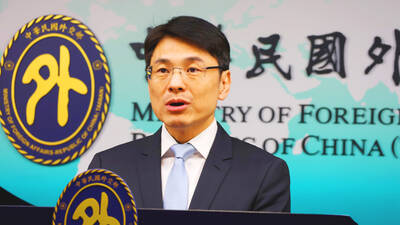
STAY IN YOUR LANE: As the US and Israel attack Iran, the ministry has warned China not to overstep by including Taiwanese citizens in its evacuation orders The Ministry of Foreign Affairs (MOFA) yesterday rebuked a statement by China’s embassy in Israel that it would evacuate Taiwanese holders of Chinese travel documents from Israel amid the latter’s escalating conflict with Iran. Tensions have risen across the Middle East in the wake of US and Israeli airstrikes on Iran beginning Saturday. China subsequently issued an evacuation notice for its citizens. In a news release, the Chinese embassy in Israel said holders of “Taiwan compatriot permits (台胞證)” issued to Taiwanese nationals by Chinese authorities for travel to China — could register for evacuation to Egypt. In Taipei, the ministry yesterday said Taiwan
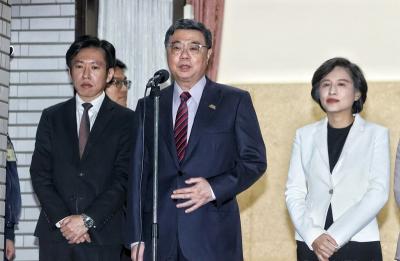
Taiwan is awaiting official notification from the US regarding the status of the Agreement on Reciprocal Trade (ART) after the US Supreme Court ruled US President Donald Trump's global tariffs unconstitutional. Speaking to reporters before a legislative hearing today, Premier Cho Jung-tai (卓榮泰) said that Taiwan's negotiation team remains focused on ensuring that the bilateral trade deal remains intact despite the legal challenge to Trump's tariff policy. "The US has pledged to notify its trade partners once the subsequent administrative and legal processes are finalized, and that certainly includes Taiwan," Cho said when asked about opposition parties’ doubts that the ART was
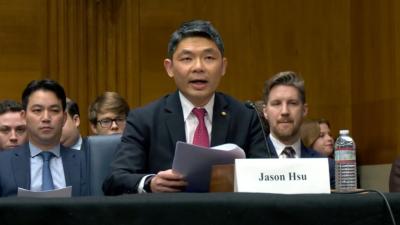
If China chose to invade Taiwan tomorrow, it would only have to sever three undersea fiber-optic cable clusters to cause a data blackout, Jason Hsu (許毓仁), a senior fellow at the Hudson Institute and former Chinese Nationalist Party (KMT) legislator, told a US security panel yesterday. In a Taiwan contingency, cable disruption would be one of the earliest preinvasion actions and the signal that escalation had begun, he said, adding that Taiwan’s current cable repair capabilities are insufficient. The US-China Economic and Security Review Commission (USCC) yesterday held a hearing on US-China Competition Under the Sea, with Hsu speaking on


 RSS
RSS